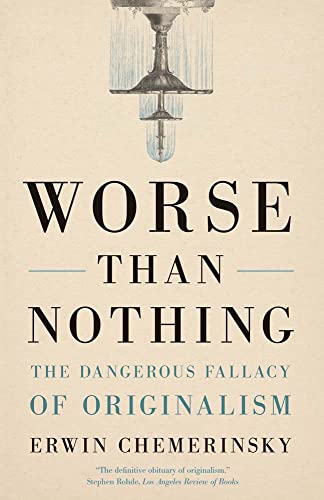

Worse than nothing : the dangerous fallacy of originalism / Erwin Chemerisnsky.
Detalles de publicación: New Haven : Yale University Press, 2022.Descripción: xiii, 248 pages ; 22 cmTipo de contenido:- text
- unmediated
- volume
- 9780300273984
- KF 4546 .C517w 2022
| Imagen de cubierta | Tipo de ítem | Biblioteca actual | Biblioteca de origen | Colección | Ubicación en estantería | Signatura topográfica | Materiales especificados | Info Vol | URL | Copia número | Estado | Notas | Fecha de vencimiento | Código de barras | Reserva de ítems | Prioridad de la cola de reserva de ejemplar | Reservas para cursos | |
|---|---|---|---|---|---|---|---|---|---|---|---|---|---|---|---|---|---|---|
| Libro | Biblioteca de Derecho Mons. Fremiot Torres Oliver Colección General biblioteca derecho | KF 4546 .C517w 2022 (Navegar estantería(Abre debajo)) | c. 1 | Disponible | 70000000906290 |
Descripciones mejoradas de Syndetics:
Why originalism is a flawed, incoherent, and dangerously ideological method of constitutional interpretation
"Chemerinsky . . . offers a concise, point-by-point refutation of the theory [of originalism]. He argues that it cannot deliver what it promises--and if it could, no one would want what it is selling."--David Cole, New York Review of Books
Originalism, the view that the meaning of a constitutional provision is fixed when it is adopted, was once the fringe theory of a few extremely conservative legal scholars but is now a well-accepted mode of constitutional interpretation. Three of the Supreme Court's nine justices explicitly embrace the originalist approach, as do increasing numbers of judges in the lower courts.
Noted legal scholar Erwin Chemerinsky gives a comprehensive analysis of the problems that make originalism unworkable as a method of constitutional interpretation. He argues that the framers themselves never intended constitutional interpretation to be inflexible and shows how it is often impossible to know what the "original intent" of any particular provision was. Perhaps worst of all, though its supporters tout it as a politically neutral and objective method, originalist interpretation tends to disappear when its results fail to conform to modern conservative ideology.
Includes bibliographical references and index.
Preface -- Chapter 1: The Rise of Originalism -- Chapter 2: The Allure of Originalism -- Chapter 3: The Epistemological Problem -- Chapter 4: The Incoherence Problem -- Chapter 5: The Abhorrence Problem -- Chapter 6: The Modernity Problem -- Chapter 7: The Hypocrisy Problem -- Chapter 8: In Defense of Non-Originalism -- Chapter 9: We Should Be Afraid -- Notes -- Acknowledgements -- Index
Originalism, once a fringe theory, has become an accepted mode of constitutional interpretation in the U.S. court system. Erwin Chemerinsky reveals how it is inherently flawed, incoherent, and—though touted as politically neutral and objective—dangerously ideological. --Back cover
Tabla de contenidos provista por Syndetics
- Preface(ix)
- Chapter 1 The Rise of Originalism(1)
- Chapter 2 The Allure of Originalism(25)
- Chapter 3 The Epistemological Problem(44)
- Chapter 4 The Incoherence Problem(75)
- Chapter 5 The Abhorrence Problem(92)
- Chapter 6 The Modernity Problem(115)
- Chapter 7 The Hypocrisy Problem(139)
- Chapter 8 In Defense of Non-Originalism(166)
- Chapter 9 We Should Be Afraid(186)
- Notes(209)
- Acknowledgments(239)
- Index(241)