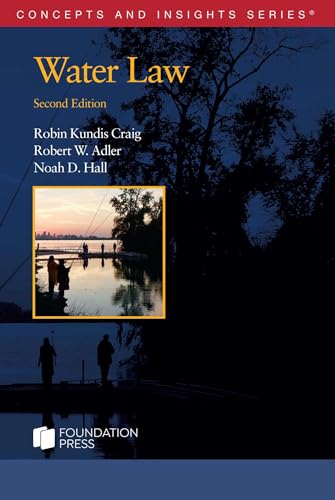

Water law / Robin Kundis Craig, Robert W. Adler, Noah D. Hall.
Series Concepts and insights seriesEditor: Eagan, MN : Foundation Press, 2024Edición: Second editionDescripción: xv, 340 pages : illustrations, maps ; 24 cmTipo de contenido:- text
- unmediated
- volume
- 9781685611149
- KF 5569 .C73 2024
| Imagen de cubierta | Tipo de ítem | Biblioteca actual | Biblioteca de origen | Colección | Ubicación en estantería | Signatura topográfica | Materiales especificados | Info Vol | URL | Copia número | Estado | Notas | Fecha de vencimiento | Código de barras | Reserva de ítems | Prioridad de la cola de reserva de ejemplar | Reservas para cursos | |
|---|---|---|---|---|---|---|---|---|---|---|---|---|---|---|---|---|---|---|
| Libro | Biblioteca de Derecho Mons. Fremiot Torres Oliver sala Estados Unidos | KF 5569 .C73 2024 (Navegar estantería(Abre debajo)) | Disponible | 70000000906735 |
Descripciones mejoradas de Syndetics:
Intended for a general audience, Water Law: Concepts & Insights provides both a general overview of basic water law doctrines and an exploration of how water law--the law and policies governing allocation of water--fit into broader ecological and environmental law issues. The book provides an overview of important hydrological principles before discussing the major state-law systems governing use of water in the United States--riparian law, prior appropriation, and specific groundwater doctrines. It then explores the federal government's interests in the fresh waters of the United States, ranging from protection of navigability to water infrastructure projects to reserved federal water rights. Putting the law governing water use into a broader context, Water Law: Concepts & Insights then explores the intersections of state water law with energy policy and production, water quality protections, endangered species protections, and broader watershed management. It ends by returning to the concept of water rights as protected private property rights and the complexities of constitutional "takings" litigation when environmental protections interfere with those rights.
Includes bibliographical references and index.
Introduction to water law -- Riparian law -- Dealing with western water realities : the creation and adoption of prior appropriation -- Allocating groundwater : the five groundwater doctrines used in the United States -- Moving from the common law to permits -- Navigable waters -- State public trust doctrines -- Federal water interests -- Interstate water pollution, apportionment and management -- The water-energy nexus -- The intersection of water law and water pollution control law -- Human use of water and endangered species -- Comprehensive water resources management and watershed planning -- Public interests, private rights in water, and constitutional taking claims.
"Water Law: Concepts & Insights provides both a general overview of basic water law doctrines and an exploration of how water law--the law and policies governing allocation of water--fit into broader ecological and environmental law issues. The book provides an overview of important hydrological principles before discussing the major state-law systems governing use of water in the United States--riparian law, prior appropriation, and specific groundwater doctrines. It then explores the federal government's interests in the fresh waters of the United States, ranging from protection of navigability to water infrastructure projects to reserved federal water rights. Putting the law governing water use into a broader context, Water Law: Concepts & Insights then explores the intersections of state water law with energy policy and production, water quality protections, endangered species protections, and broader watershed management. It ends by returning to the concept of water rights as protected private property rights and the complexities of constitutional 'takings' litigation when environmental protections interfere with those rights"--