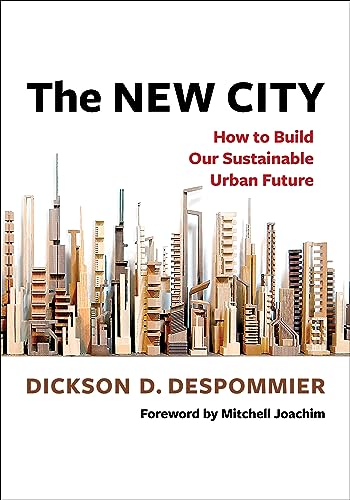

The new city : how to build our sustainable urban future. / Dickson D. Despommier ; foreword by Mitchell Joachim. txt
Editor: New York : Columbia University Press, 2023Descripción: xxiii, 187 p. : ill. ; maps ; graph. ; col. ; 26 cmTipo de contenido:- text
- unmediated
- volume
- 9780231219099
- 23/eng/20230317 307.1/216
- HT166 D5463 2023
| Imagen de cubierta | Tipo de ítem | Biblioteca actual | Biblioteca de origen | Colección | Ubicación en estantería | Signatura topográfica | Materiales especificados | Info Vol | URL | Copia número | Estado | Notas | Fecha de vencimiento | Código de barras | Reserva de ítems | Prioridad de la cola de reserva de ejemplar | Reservas para cursos | |
|---|---|---|---|---|---|---|---|---|---|---|---|---|---|---|---|---|---|---|
| Libro Col. General CARIBET | CARIBET Biblioteca Arquitectura Colección General CARIBET | General HT166 D5463 2023 (Navegar estantería(Abre debajo)) | 1 | Disponible | 91000000753111 |
Descripciones mejoradas de Syndetics:
Cities are at once among humanity's crowning achievements and core drivers of the climate crisis. Their dependence on the outside world for vital resources is causing global temperatures to rise and wildlife habitats to shrink. But we have the opportunity to make cities more sustainable by transforming the built environment.
Dickson D. Despommier proposes a visionary yet achievable plan for creating a new, self-sustaining urban landscape. He argues that we can find solutions through the concept of biomimicry: emulating successful strategies found in nature. A better city is possible if we heed the lessons that forests and trees teach about how to store carbon, grow food, collect rainwater, and convert sunlight into energy. Touring established and leading-edge technologies, The New City provides a blueprint for tomorrow's urban environment. Cities built from wood will be more resilient and less destructive than concrete and steel construction; they will also encourage reforestation, boosting carbon sequestration. Vertical farms inside city limits will supply residents with a reliable, healthy food supply. Buildings will harvest moisture from the rain and air to secure a clean water supply. Renewable energy, including not only wind, solar, and geothermal but also clear photovoltaic window glass and nonpolluting hydrogen fuel cells, will power a cleaner city.
The New City delivers both a passionate call to action for halting climate change and a bold vision of the sustainable future within our grasp.
Includes bibliographical references and index.
LIST OF FIGURES AND TABLES IX --
FOREWORD, BY MITCHELL JOACHIM XV --
PREFACE XVII --
ACKNOWLEDGMENTS XXI --
Introduction 1 --
History and Evolution of Cities 1 --
Rapid Climate Change 8 --
Urban Design 19 --
Inspiration From Intact Biodiverse Temperate- Zone Forests 20 --
A Flawed Example: Aggressively Competitive Tropical Forests 28 --
1 Pillar One: CARBON STORAGE 33 --
Carbon Farming 35 --
Building Cities Out of Wood 35 --
Engineered Wood Products 43 --
2 Pillar Two: URBAN AGRICULTURE 61 --
A Brief History of Farming 61 --
Traditional Farming Today 65 --
Food Awareness and Urban Agriculture 67 --
Vertical Farming 69 --
3 Pillar Three: HARVESTING WATER FROM THE AIR 77 --
History of Water Use and the Rise of Public Health 77 --
Has Sanitation Become a Luxury? 89 --
The Changing Reality of Water Resources 95 --
Creating a Circular Water Economy 98 --
Getting Off the Water Grid 102 --
Desalination 113 --
4 Pillar Four: RENEWABLE ENERGY 117 --
The Value of Renewable Energy 117 --
Renewable Energy Generation 120 --
Energy Storage Systems 135 --
5 The New City Imagined 139 --
APPENDIX 157 --
NOTES 161 --
INDEX 175 --
Figures and Tables:
0.1. Tokyo as seen at night from the International Space Station 4 --
0.2. Paris as seen at night from the International Space Station 4 --
0.3. São Paulo as seen at night from the International Space Station 5 --
0.4. Carbon footprint of selected cities throughout the world 8 --
0.5. Rise in average annual temperature of the Earth 9 --
0.6. Average annual ocean temperature in the Gulf of Mexico has been rising each year since measurements were first recorded 10 --
0.7. Schematic diagram of Gulf Stream currents 10 --
0.8. Schematic diagram of the global ocean conveyor belt 11 --
0.9. Annual loss of ice pack in the Arctic Ocean 13 --
0.10. Healthy coral reef; bleached coral reef caused by a warning ocean 15 --
0.11 Schematic diagram of the negative effects of ocean acidification on shellfish 16 --
0.12. Extended range of the mountain pine beetle due to rapid climate change 17 --
0.13. Global distribution of availability of fresh water 21 --
0.14 A portion of clear cut forest 24 --
0.15. An entire clear- cut watershed 24 --
0.16. Cross- section of soil and seedling showing connections between soil and tree roots 25 --
0.17. Strangler fig tree slowly killing its host tree 29 --
1.1. Buddhist temple Hōryūji. The wood used to build it is 1,300 years old 36 --
1.2. A devastated portion of Santa Rosa, California, after a major fire in 2017 37 --
1.3. Aftermath of a forest fire. Note that the tree trunks are charred but still remain intact 38 --
1.4. Cross- laminated mass plywood panels 40 --
1.5. A variety of traditional wood braces 41 --
1.6. Cross- laminated timber panels 44 --
1.7. Interior of the Ascent building. Kevin Marshall, photographer 47 --
1.8. Interior of a home made from cross- laminated timber 48 --
1.9. Nail- laminated timber panel 49 --
1.10. T3 building, Minneapolis, Minnesota. Michael Green, architect 51 --
1.11. Model- C building, Roxbury, Massachusetts. John Klein, architect 52 --
1.12. Forte building, Melbourne, Australia. Lendlease Architects 53 --
1.13. Michigan State University S.T.E.M. building, East Lansing, Michigan, Integrated Design Solutions and Ellenzweig Architects 54 --
1.14. Ascent building, Milwaukee, Wisconsin, Korb + Associates Architects. Chris Lark, photographer 55 --
1.15. Daltston Works apartment compex constructed out of cross- laminated timber. Courtesy Andrew Waugh, architect 56 --
2.1. Global distribution of agricultural land 62 --
2.2. Carbon dioxide levels in the atmosphere 66 --
2.3. Global distribution of vertical farms in 2022 68 --
2.4A. Pasona O2 building, Tokyo, Japan 70 --
2.4B. Indoor rice field in lobby of Pasona O2 building 71 --
2.5. Schematic diagram of a hydroponics system 73 --
2.6. Schematic diagram of an aeroponics system 73 --
3.1. Roman aqueduct circa 117 AD 78 --
3.2. Trevi Fountain, Rome, Italy 79 --
3.3 Roman baths (restored), Bath, England 80 --
3.4. Gametocytes of Plasmodium falciparum 82 --
3.5. Vibrio cholerae. The green color is computer generated 84 --
3.6. Head of Necator americanus (hookworm) 87 --
3.7. Oocysts (red- stained spheres) of Cryptosporidium parvum 88 --
3.8. Map of New York City’s reservoir system 92 --
3.9. Global distribution of dams 96 --
3.10. Water purification system for Orange Country, California 99 --
3.11. The Salesforce building, San Francisco 101 --
3.12. The Salesforce building in San Francisco recycles all its water into drinking water quality. 102 --
3.13. Grooved roof of a typical home in Bermuda. Rainwater is channeled to an underground cistern where it is filtered and stored 107 --
3.14. Fog harvesting device designed for a small town 109 --
3.15. Global locations ideal for harvesting water from fog 110 --
3.16. The Darkling beetle harvesting water form the morning fog on the coastal side of a Namibian sand dune 111 --
3.17. Global distribution of desalination plants. Green dots show where salt deposits contaminate the groundwater supply 114 --
4.1. Thermal vents with associated ocean life 118 --
4.2. Annual growth of the solar power industry 118 --
4.3. Solar panels on the roof of a house 121 --
4.4. Solar panel on a telephone pole 122 --
4.5. Solar panels on farmland 122 --
4.6. Car park roof with solar panels 123 --
4.7. Babcock Ranch, Florida. All 19,500 homes are powered by solar panels 124 --
4.8. A special coating on a plain glass window allows visible light to pass through while capturing radiant energy in the ultraviolet and infrared spectra that is then converted into electricity 126 --
4.9. Global map of wind speed 128 --
4.10. Horizontal urban wind turbines on the roof of an office building 130 --
4.11. Global map of geothermal energy sources 131 --
4.12. Schematic for continuous generation of electricity from geothermal sources 132 --
5.1. Chicago as seen at night from the International Space Station 144 --
5.2. Greater metropolitan area of New York City, including Manhattan, as seen at night from the International Space Station 145 --
5.3. Italy as seen at night form the International Space Station 146 --
5.4. Houston as seen at night from the International Space Station 147 --
5.5. Istanbul as seen at night from the International Space Station 147 --
5.6. Beijing as seen at night from the International Space Station 148 --
5.7. Berlin as seen at night from the International Space Station 148 --
5.8. Rio de Janeiro as seen at night from the International Space Station 149 --
5.9. Shanghai as seen at night from the International Space Station 149 --
5.10. Montreal as seen at night from the International Space Station 150 --
5.11. London as seen at night from the International Space Station 150 --
5.12. Cattle in the street 152 --
5.13. City goat 152 --
5.14. Uncollected garbage 153 --
5.15. Feral dog 153 --
5.16. Hungry cat 154 --
5.17. The IAC building, New York. Frank Gehry, architect 154 --
TABLES:
TABLE 3.1 Infant mortality rates for top 20 less developed countries (per 1,000 live births) 90 --
TABLE 3.2 Potential Water Harvesting for the 21 Most Populated Cities 100 --
TABLE 4.1 Wind power in use by top 10 countries 129 --
"Dickson Despommier, Emeritus Professor at Columbia, pioneered the concept of vertical farming--i.e. growing crops inside tall buildings--which could become a solution to food scarcity and food insecurity. When his previous book THE VERTICAL FARM was first published by Thomas Dunne/St. Martin's Press in 2010, no such farms existed; now hundreds of them, comprising a multi-billion-dollar industry, can be found all over the world. Now, with his new book, THE NEW CITY, Despommier presents us with a bold new vision of our urban future, if only we are willing to listen to what nature can teach us about the best way to grow food, store carbon, harvest rainwater, and renew energy for the cities of the future. Drawing on a unique concept called "biomimicry," Despommier's book will be both a synthesis of how following principles of nature can help us create a new built environment for cities in which we can thrive, as well as a courageous call to action on how we can achieve it"--
Tabla de contenidos provista por Syndetics
- List of Figures and Tables(ix)
- Foreword(xv)
- Preface(xvii)
- Acknowledgments(xxi)
- Introduction(1)
- History and Evolution of Cities(1)
- Rapid Climate Change(8)
- Urban Design(19)
- Inspiration From Intact Biodiverse Temperate-Zone Forests(20)
- A Flawed Example: Aggressively Competitive Tropical Forests(28)
- 1 Pillar One Carbon Storage(33)
- Carbon Farming(35)
- Building Cities Out of Wood(35)
- Engineered Wood Products(43)
- 2 Pillar Two Urban Agriculture(61)
- A Brief History of Farming(61)
- Traditional Farming Today(65)
- Food Awareness and Urban Agriculture(67)
- Vertical Farming(69)
- 3 Pillar Three Harvesting Water from the Air(77)
- History of Water Use and the Rise of Public Health(77)
- Has Sanitation Become a Luxury?(89)
- The Changing Reality of Water Resources(95)
- Creating a Circular Water Economy(98)
- Getting Off the Water Grid(102)
- Desalination(113)
- 4 Pillar Four Renewable Energy(117)
- The Value of Renewable Energy(117)
- Renewable Energy Generation(120)
- Energy Storage Systems(135)
- 5 The New City Imagined(139)
- Appendix(157)
- Notes(161)
- Index(175)