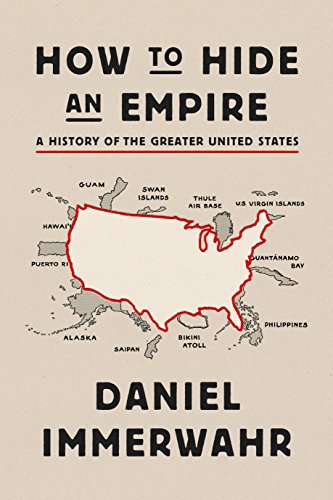
Imagen de portada de Amazon
Imagen de Amazon.com
Imagen de cubierta Syndetics
Portada de Syndetics
Imagen de OpenLibrary

How to hide an empire : a history of the greater United States / Daniel Immerwahr.

Por: Editor: New York : Farrar, Straus and Giroux, 2019Fecha de copyright: ♭2019Edición: First editionDescripción: viii, 516 pages : illustrations, maps ; 24 cmTipo de contenido:
  • text
Tipo de medio:
  • unmediated
Tipo de soporte:
  • volume
ISBN:
  • 9780374172145
Otro título:
  • History of the greater United States
Tema(s): Clasificación CDD:
  • 973 23
Clasificación LoC:
  • F965 .I46 2019
Contenidos:
The fall and rise of Daniel Boone -- Indian Country -- Everything you always wanted to know about Guano but were afraid to ask -- Teddy Roosevelt's very good day -- Empire state of mind -- Shouting the battle cry of freedom -- Outside the charmed circle -- White city -- Doctors without borders -- Fortress America -- Warfare state -- There are times when men have to die -- Kilroy was here -- Decolonizing the United States -- Nobody knows in America, Puerto Rico's in America -- Synthetica -- This is what God hath wrought -- The empire of the red octagon -- Language is a virus -- Power is sovereignty, Mister Bond -- Baselandia -- The war of points.
Resumen: "A history of the United States' overseas possessions, from Puerto Rico to the Philippines and beyond, and what they reveal about the true meaning of American empire."--Provided by publisher.
Valoración
    Valoración media: 0.0 (0 votos)
Existencias
Imagen de cubierta Tipo de ítem Biblioteca actual Biblioteca de origen Colección Ubicación en estantería Signatura topográfica Materiales especificados Info Vol URL Copia número Estado Notas Fecha de vencimiento Código de barras Reserva de ítems Prioridad de la cola de reserva de ejemplar Reservas para cursos
Libro mb Biblioteca de Mayagüez Colección General mb F965 .I46 2019 (Navegar estantería(Abre debajo)) c. 1 Disponible 52000003299337
Total de reservas: 0

Descripciones mejoradas de Syndetics:

Named one of the ten best books of the year by the Chicago Tribune
A Publishers Weekly best book of 2019 | A 2019 NPR Staff Pick

A pathbreaking history of the United States' overseas possessions and the true meaning of its empire

We are familiar with maps that outline all fifty states. And we are also familiar with the idea that the United States is an "empire," exercising power around the world. But what about the actual territories--the islands, atolls, and archipelagos--this country has governed and inhabited?

In How to Hide an Empire , Daniel Immerwahr tells the fascinating story of the United States outside the United States. In crackling, fast-paced prose, he reveals forgotten episodes that cast American history in a new light. We travel to the Guano Islands, where prospectors collected one of the nineteenth century's most valuable commodities, and the Philippines, site of the most destructive event on U.S. soil. In Puerto Rico, Immerwahr shows how U.S. doctors conducted grisly experiments they would never have conducted on the mainland and charts the emergence of independence fighters who would shoot up the U.S. Congress.

In the years after World War II, Immerwahr notes, the United States moved away from colonialism. Instead, it put innovations in electronics, transportation, and culture to use, devising a new sort of influence that did not require the control of colonies. Rich with absorbing vignettes, full of surprises, and driven by an original conception of what empire and globalization mean today, How to Hide an Empire is a major and compulsively readable work of history.

Includes bibliographical references and index.

The fall and rise of Daniel Boone -- Indian Country -- Everything you always wanted to know about Guano but were afraid to ask -- Teddy Roosevelt's very good day -- Empire state of mind -- Shouting the battle cry of freedom -- Outside the charmed circle -- White city -- Doctors without borders -- Fortress America -- Warfare state -- There are times when men have to die -- Kilroy was here -- Decolonizing the United States -- Nobody knows in America, Puerto Rico's in America -- Synthetica -- This is what God hath wrought -- The empire of the red octagon -- Language is a virus -- Power is sovereignty, Mister Bond -- Baselandia -- The war of points.

"A history of the United States' overseas possessions, from Puerto Rico to the Philippines and beyond, and what they reveal about the true meaning of American empire."--Provided by publisher.

Tabla de contenidos provista por Syndetics

  • Introduction: Looking Beyond the Logo Map(p. 3)
  • A Note on Language(p. 21)
  • Part I The Colonial Empire
  • 1 The Fall and Rise of Daniel Boone(p. 25)
  • 2 Indian Country(p. 36)
  • 3 Everything You Always Wanted to Know About Guano but Were Afraid to Ask(p. 46)
  • 4 Teddy Roosevelt's Very Good Day(p. 59)
  • 5 Empire State of Mind(p. 73)
  • 6 Shouting the Battle Cry of Freedom(p. 88)
  • 7 Outside the Charmed Circle(p. 108)
  • 8 White City(p. 122)
  • 9 Doctors Without Borders(p. 137)
  • 10 Fortress America(p. 154)
  • 11 Warfare State(p. 171)
  • 12 There Are Times When Men Have to Die(p. 187)
  • Part II The Pointillist Empire
  • 13 Kilroy Was Here(p. 215)
  • 14 Decolonizing the United States(p. 227)
  • 15 Nobody Knows in America, Puerto Rico's in America(p. 242)
  • 16 Synthetics(p. 262)
  • 17 This Is What God Hath Wrought(p. 278)
  • 18 The Empire of the Red Octagon(p. 298)
  • 19 Language Is a Virus(p. 317)
  • 20 Power Is Sovereignty, Mister Bond(p. 336)
  • 21 Baselandia(p. 355)
  • 22 The War of Points(p. 372)
  • Conclusion: Enduring Empire(p. 391)
  • Notes(p. 403)
  • Acknowledgments(p. 485)
  • Index(p. 489)

Reseñas proporcionadas por Syndetics

Library Journal Review

What does bird guano and screw threads have to do with empire? Actually, quite a bit. Immerwahr (history, Northwestern Univ.; Thinking Small) explores U.S. history by placing America's overseas colonies and their inhabitants front and center. He shows how westward expansion served as a starting point for America's imperial dreams. In the 1850s, the United States sought out and laid claim to hundreds of islands covered in bird guano, as the excrement reinvigorated soil that was depleted of nutrients. These same islands later served as fueling stations and airfields for America's military. After World War II, with American troops occupying bases around the world, the United States gave up its empire, granting independence to many of its former colonies, such as the Philippines. Immerwahr notes that the resistance of the colonized as well as U.S. technological advantages made an empire no longer necessary. Such advantage allowed America to force other countries to adapt its standards, such as the angle threads wrapped around screws. VERDICT Through archival and secondary source research, Immerwahr recasts American history in a new light in this thought-provoking and insightful work.-Chad E. Statler, Westlake Porter P.L., Westlake, OH © Copyright 2019. Library Journals LLC, a wholly owned subsidiary of Media Source, Inc. No redistribution permitted.

Publishers Weekly Review

Historian Immerwahr argues in this substantial work that the U.S. is more than the 50 states its name references, and that, despite its identification with antiimperialism, for more than two centuries the U.S. has been "a partitioned country, divided into two sections, with different laws applying in each"-in short, a kind of empire. The second section is made up of territories, many of which were once called colonies, and which are now barely acknowledged in popular conceptions of the country: first, native lands near the "frontier" of the nascent country; then for a time Hawaii, Alaska, and the Philippines; and to this day places including Puerto Rico, Guam, and the Virgin Islands. (And, Immerwahr goes on, the U.S. engages in other kinds of empirebuilding, through, for example, its massive network of overseas military bases and economic globalization.) Presentday residents of territories "have no representation in Congress... cannot vote for president... [their] rights and citizenship remain a gift from Washington," and their status as U.S. citizens is unknown by almost half of the states' population. This insightful, excellent book, with its new perspective on an element of American history that is almost totally excluded from mainstream education and knowledge, should be required reading for those on the mainland. (Feb.) © Copyright PWxyz, LLC. All rights reserved.

Booklist Review

Contemplating the Louisiana Purchase, which doubled the size of the nation, President Jefferson imagined an ""Empire of Liberty"" stretching to the Pacific. As a staunch republican, Jefferson would be appalled if his remark were associated with the trappings of kingship and imperial pomp. But if empire is defined in the broadest possible sense, Jefferson's words were prophetic. Immerwahr illustrates how American territorial expansion included control over and governance of millions of Spanish speakers and various Indian tribes who had to be forcefully subdued. The purchase of Alaska and the takeover of the Philippines and numerous islands, atolls, and archipelagos in the Pacific and Caribbean dramatically increased both the territory and population under U.S. rule. While most Americans saw their administration as a form of benign stewardship, Immerwahr stresses that the native inhabitants were often disrespected, mistreated, and marginalized. Perhaps that is an unbalanced view, but this is still a useful and informative work, since many of these overseas territories remain under our governance.--Jay Freeman Copyright 2019 Booklist

Notas de autor provistas por Syndetics

Daniel Immerwahr is an associate professor of history at Northwestern University and the author of Thinking Small: The United States and the Lure of Community Development , which won the Organization of American Historians' Merle Curti Award. He has written for Slate , n+1 , Dissent , and other publications.
Compartir
logopucpr-y-vive

Contáctanos

¡Queremos saber de ti!

Tel. 787.841.2000 Ext. 1801

bibliotecavaldes@pucpr.edu

⁣Búscanos en las redes

© 2026 Desarrollado por Ignite Online • All Rights Reserved • Powered by Koha.