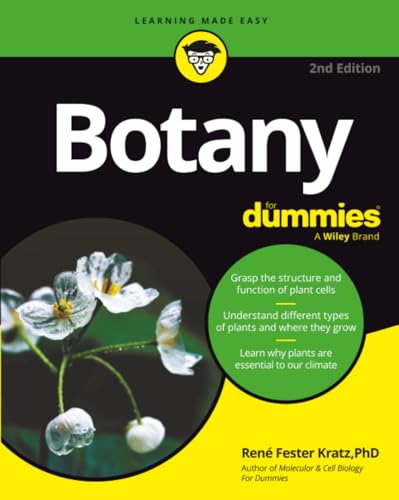

Botany for dummies / René Fester Kratz.
Editor: Indianapolis : John Wiley and Sons, 2025Edición: Second editionDescripción: 1 online resource (339 pages) : illustrationsTipo de contenido:- text
- computer
- online resource
- 9781394273898
- QK47 .F478 2025
| Imagen de cubierta | Tipo de ítem | Biblioteca actual | Biblioteca de origen | Colección | Ubicación en estantería | Signatura topográfica | Materiales especificados | Info Vol | URL | Copia número | Estado | Notas | Fecha de vencimiento | Código de barras | Reserva de ítems | Prioridad de la cola de reserva de ejemplar | Reservas para cursos | |
|---|---|---|---|---|---|---|---|---|---|---|---|---|---|---|---|---|---|---|
| Libro electrónico | Biblioteca de Mayagüez Acceso en línea | QK47 .F478 2025 (Navegar estantería(Abre debajo)) | Ebook | Disponible | 52000003299375 |
Descripciones mejoradas de Syndetics:
Harvest basic botany knowledge from this abundant book
Botany For Dummies gives you a thorough overview of the fundamentals of botany, but in simple terms that anyone can understand. Great for supplementing your botany coursework or brushing up before an exam, this book covers plant evolution, the structure and function of plant cells, and plant identification. Plus, you'll learn about how plants of different types are changing and adapting in response to changing climates. This new edition goes into more detail on fungi--not technically plants, but no one is holding that against them. Regardless of what brought you to the wonderful world of botany, this book will show you around.
Get an easy-to-understand introduction to the key concepts in botany Read about recent discoveries and theories in the world of plant science Understand different families of plants and where they grow Improve your grade and pass your exam in your introductory botany courseGet a copy of Botany For Dummies and watch your botany knowledge bloom.
Includes bibliographical references and index.
Introduction -- Part 1: Getting Started with Botany Basics -- 1: Exploring Botany -- 2: Peering at Plant Cells and Tissues -- 3: Vegetative Structures: Stems, Roots, and Leaves -- 4: Reproductive Structures: Spores, Seeds, Cones, Flowers, and Fruits -- Part 2: Discovering Plant Physiology -- 5: Photosynthesis: Making Sugar from Scratch -- 6: Cellular Respiration: Making Your Cake and Eating It, Too -- 7: Moving Materials through Plants -- 8: Regulating Plant Growth and Development -- Part 3: Making More Plants: Plant Reproduction and Genetics -- 9: Greening the Earth: Plant Reproduction -- 10: Passing Plant Characteristics to the Next Generation -- 11: Changing with the Times: Evolution and Adaptation -- Part 4: The Wide, Wonderful World of Plants -- 12: The Tree of Life: Showing the Relationships between Living Things -- 13: Precursors to Plants: Bacteria, Protists, and Algae -- 14: Examining the Forest Floor: Bryophytes and Seedless Vascular Plants -- 15: Their Seeds Are Naked: Gymnosperms -- 16: Say It with Flowers: Angiosperms -- 17: I’m Not a Plant, But I’m a … Fungi -- Part 5: Embracing the Synergy of Plants and People -- 18: Exploring the Relationship Between People and Plants -- 19: Foraging, Farming, and Engineering Plants -- 20: Making Connections with Plant Ecology -- Part 6: The Part of Tens -- 21: Ten Weirdest Plants --22: Ten Tips for Improving Your Grade in Botany -- Index.
Harvest basic botany knowledge from this abundant book Botany For Dummies gives you a thorough overview of the fundamentals of botany, but in simple terms that anyone can understand. Great for supplementing your botany coursework or brushing up before an exam, this book covers plant evolution, the structure and function of plant cells, and plant identification. Plus, you'll learn about how plants of different types are changing and adapting in response to changing climates. This new edition goes into more detail on fungi--not technically plants, but no one is holding that against them. Regardless of what brought you to the wonderful world of botany, this book will show you around. Get an easy-to-understand introduction to the key concepts in botany Read about recent discoveries and theories in the world of plant science Understand different families of plants and where they grow Improve your grade and pass your exam in your introductory botany course Get a copy of Botany For Dummies and watch your botany knowledge bloom.
Tabla de contenidos provista por Syndetics
- Introduction(1)
- About this Book(1)
- Foolish Assumptions(1)
- Icons Used in This Book(2)
- Beyond the Book(2)
- Where to Go from Here(3)
- Part 1 Getting Started with Botany Basics(5)
- Chapter 1 Exploring Botany(7)
- Taking a Close Look at Plant Structure(7)
- Figuring Out Plant Functions(8)
- Making and using food(9)
- Transporting materials(9)
- Responding to hormones(10)
- Considering Plant Reproduction and Genetics(10)
- Exploring the Wide World of Plants(11)
- Making Connections Between Plants and People(11)
- Chapter 2 Peering at Plant Cells and Tissues(13)
- Building Cells from Four Types of Molecules(13)
- Carbohydrates(14)
- Proteins(16)
- Nucleic acids(17)
- Lipids(20)
- Entering the World of Cells(22)
- Customs; Plasma membrane(23)
- The library: Storing information in DNA(25)
- Factories: Ribosomes(25)
- Exploring Plant Cells(26)
- Post office: The endomembrane system(27)
- Scaffolding and railroad tracks: The cytoskeleton(29)
- Solar-powered batteries: Chloroplasts(30)
- Powerplants: Mitochondria(32)
- Rebar and concrete: Cell walls and extracellular matrices(33)
- Combining Cells to Form Tissues(34)
- Growing with meristems(35)
- Building plant bodies with ground tissue(38)
- Protecting plants with dermal tissue(42)
- Transporting materials with vascular tissue(44)
- Chapter 3 Vegetative Structures: Stems, Roots, and leaves(47)
- Getting Organized into Plant Organs(47)
- Getting Taller with Stems(48)
- Primary growth(49)
- Secondary growth(52)
- Specialized stems(55)
- Digging Deep with Roots(58)
- Regions within roots(58)
- Specialized roots(62)
- Forming partnerships with soil fungi(62)
- Reaching Out with Leaves(63)
- Leaf structure(64)
- Leaf types(65)
- Leaf arrangements(67)
- Specialized leaves(69)
- Chapter 4 Reproductive Structures: Spores, Seeds, Cones, Flowers, and Fruits(71)
- Reproducing with Spores(71)
- Protecting the Offspring with Seeds(72)
- Seed structure(73)
- Organizing Reproduction in Cones(77)
- Finding a Mate with Flowers(77)
- Flower structure(77)
- Moving pollen(80)
- Flower arrangement(81)
- Packaging the Seeds in Fruits(83)
- Fruit types(84)
- Dispersing Fruits and Seeds(87)
- Part 2 Discovering Plant Physiology(91)
- Chapter 5 Photosynthesis: Making Sugar from Scratch(93)
- Rethinking the Role of Soil(93)
- van Helmont's experiment(94)
- The real role of soil(95)
- Discovering Photosynthesis Fundamentals(96)
- Going solar(98)
- Catching some rays with pigments(98)
- Connections between the light and light-independent reactions(100)
- Harnessing the Sun: The Light Reactions(103)
- Transferring light energy to chemical energy with electron transport chains(103)
- Noncyclic and cyclic photophosphorylation(107)
- Storing Matter and Energy in Sugar: The Light-Independent Reactions(110)
- The steps of the light-independent reactions(111)
- Getting carbon dioxide to rubisco(112)
- Chapter 6 Cellular Respiration: Making Your Cake and Eating it, Too(115)
- Digging into Cellular Respiration Fundamentals(116)
- Breaking Down Glucose in Glycolysis(119)
- Glycolysis is universal(119)
- Making ATP by substrate-level phosphorylation(120)
- More is better(120)
- Going Further with the Krebs Cycle(122)
- Making Useful Energy: Chemiosmosis and Oxidative Phosphorylation(124)
- Transferring electrons(125)
- Transferring energy(125)
- Chapter 7 Moving Materials through Plants(127)
- Shipping and Receiving Materials throughout the Plant(127)
- Moving across Membranes(128)
- Diffusion(129)
- Active transport(130)
- Osmosis(131)
- Under pressure(132)
- Losing it(133)
- Going with the Flow; Water Transport(134)
- Clinging for support: The cohesion of water(134)
- The pull from above: Transpiration(136)
- Fixing a break in the tines: Cavitation(138)
- Reaching out with roots(139)
- Sticky Business: Sugar Transport(140)
- Sources and sinks(140)
- The pressure-flow hypothesis(141)
- Chapter 8 Regulating Plant Growth and Development(143)
- Exploring the Cyclical Nature of Plant Life(143)
- The Cellular Basis of Plant Growth and Development(144)
- Receiving signals(145)
- Responding to signals(145)
- Sending Signals with Plant Hormones(146)
- Auxins(146)
- Cytokinins(149)
- Gibbereilins(150)
- Abscisic acid(150)
- Ethylene(151)
- Which Way Do I Go?: Plant Movements(151)
- Growth movements (tropisms)(151)
- Turgor movements(152)
- What Time is it?: Sensing the Seasons(153)
- Flowering(154)
- Orcadian rhythm(155)
- Seed germination(156)
- Part 3 Making More Plants: Plant Reproduction and Genetics(159)
- Chapter 9 Greening the Earth: Plant Reproduction(161)
- Reproducing: More Than One Way to Do it(161)
- Asexual reproduction(162)
- Sexual reproduction(164)
- Comparing reproductive styles(165)
- Copying Cells by Mitosis(165)
- Interphase(166)
- Overview of mitosis(167)
- Cytokinesis(169)
- Reproducing Sexually with Meiosis(170)
- Counting chromosomes(170)
- Following the plan(171)
- Doubling your stuff and then reducing it twice(171)
- The events of meiosis I(172)
- The events of meiosis II(173)
- Considering Alternation of Generations(174)
- Chapter 10 Passing Plant Characteristics to the Next Generation(179)
- Tracking the Inheritance of a Single Gene(179)
- Investigating plants with Gregor Mendel(180)
- Figuring out the rules of inheritance(183)
- Speaking like a geneticist(184)
- Making predictions(185)
- Tracking the inheritance of Two Independent Genes(187)
- Adding plant height to the mix(188)
- Solving the Punnett square for a dihybrid cross(190)
- Remembering meiosis(192)
- Mixing it Up with Incomplete Dominance(193)
- Inheriting Traits through Epigentics(195)
- Chapter 11 Changing with the Times: Evolution and Adaptation(197)
- Figuring Out the Fundamentals of Evolution(197)
- Mutation(198)
- Natural selection(198)
- Moving onto the Land(202)
- Identifying important Factors in Plant Evolution(203)
- Hybridization(203)
- Polyploidy(204)
- Reproductive isolation(205)
- Admiring Plant Adaptations(206)
- Desert plants(206)
- Tropical rainforest plants(208)
- Carnivorous plants(210)
- Aquatic plants(211)
- Part 4 The Wide, Wonderful World of Plants(213)
- Chapter 12 The Tree of Life: Showing the Relationships between Living Things(215)
- Examining the Branches of the Tree of Life(215)
- Digging into the three domains(216)
- Exploring the past through phylogenetic trees(218)
- Organizing Life(219)
- Developing a system(220)
- Defining plants(222)
- Naming the Rose (and Other Living Things)(224)
- Chapter 13 Precursors to Plants: Bacteria, Protists, and Algae(227)
- Bacteria Can Be Green, Too(227)
- Inventing photosynthesis(228)
- Becoming chloroplasts(230)
- The Wild World of Protists(232)
- Seaweed: The Plants of the Ocean(233)
- Red algae(234)
- Brown algae(234)
- Green algae(236)
- Chapter 14 Examining the Forest Floor: Bryophytes and Seedless Vascular Plants(237)
- Moving onto the Land(238)
- Bryophytes: Nonvascular Plants(240)
- Liverworts: Phylum Hepatophyta(240)
- Hornworts: Phylum Anthocerophyta(243)
- Mosses: Phylum Bryophyta(244)
- Tracheophytes: Vascular Plants(247)
- Seedless Vascular Plants(248)
- Club mosses: Phylum Lycophyta(249)
- Ferns and (some of) their allies: Phylum Pterophyta(254)
- Chapter 15 Their Seeds Are Naked: Gymnosperms(261)
- Protecting the Embryo with Seeds(261)
- Cycads: Cycadophyta(265)
- Ginkgos: Ginkgophyta(265)
- Conifers: Coniferophyta (Pinophyta)(266)
- Pines(267)
- Gnetophytes: Gnetophyta(271)
- Chapter 16 Say it with Flowers: Anglosperms(273)
- Delving into Flowering Plants: Anthophyta(273)
- Searching for the origin of the angiosperms(274)
- Discovering the unique characteristics of angiosperms(276)
- Looking at the life cycle of angiosperms(278)
- Exploring Angiosperm Diversity(280)
- Basal angiosperms(280)
- Magnoliids(280)
- True dicots(280)
- Monocots(283)
- Thinking about Pollination Ecology(285)
- Chapter 17 I'm Not a Plant, But I'm a…Fungi(287)
- Meet the Neighbors(287)
- What is a fungus, anyway?(288)
- There's a fungus among us(289)
- Fungal feasts: fabulous or foul?(291)
- You've Seen Us in Your Kitchen(292)
- Morels, Yeast, and Zombie Fungi(294)
- Puffballs, Stinkhorns, and Mushrooms(296)
- Part 5 Embracing the Synergy of Plants and people(299)
- Chapter 18 Exploring the Relationship Between People and Plants(301)
- Finding Our Favorites(301)
- Coffee(302)
- Tea(304)
- Chocolate(305)
- Making Use of Plant Materials(308)
- Building homes(308)
- Everyday Items(309)
- Making paper(311)
- Discovering the Power of Plant Chemicals(313)
- Finding a cure: Medicinal plants(314)
- Dangerous weapons: Poisonous plants(315)
- Having visions: Hallucinogenic plants(318)
- Chapter 19 Foraging, Farming, and Engineering Plants(321)
- From Foraging to Farming(321)
- Exploring the origins of agriculture(322)
- Using artificial selection to shape plant foods(323)
- Keeping up with human population growth(324)
- Speeding Things Up By Engineering Plants(326)
- Culturing plant tissues(328)
- Transforming plants with Agrobacterium(328)
- Editing Plant Genomes(331)
- Trying to Build a Better World(334)
- Saving lives with golden rice(334)
- Stopping crop pests with it(335)
- Resisting Weed killers(336)
- Making drugs and commercial enzymes with biopharming(336)
- Let's Talk, Talk, Talk about it: Pros and Cons of Genetic Engineering(337)
- Chapter 20 Making Connections with Plant Ecology(339)
- Exploring Ecosystems(339)
- Figuring out your job description(341)
- Going with the flow of energy(342)
- Going round and round with matter cycles(346)
- Interacting with Other Organisms(351)
- Working it out(351)
- Part 6 The Par of Tens(355)
- Chapter 21 Ten Weirdest Plants(357)
- Plants that Eat Insects: Cobra Lily(357)
- Plants that Stink: The Corpse Flower(358)
- Plants that Move: Galloping Moss(358)
- Plants that Mimic Rocks: Stone Plants(359)
- Plants that Come Back From the Dead: Resurrection Plant(359)
- Plants that just Look Strange: Welwitschia(360)
- Plants that Aren't Green: Ghost Pipe(360)
- Plants that Have Sex with Insects: Australian Tongue Orchid(361)
- Plants that Really Know How to Grow: Queen Victoria Water Lily(361)
- Plants that Climb: Banyan Tree(362)
- Chapter 22 Ten Tips for Improving Your Grade in Botany(363)
- Engage Actively During Class(363)
- Use Your Lab Time Effectively(364)
- Plan Your Study Time(365)
- Be Active, Not Passive(366)
- Make Up Tricks to Jog Your Memory(366)
- Prepare for Different Kinds of Questions(367)
- Remember the Supporting Material(367)
- Test Yourself Often(368)
- Use Your First Test as a Diagnostic Tool(368)
- Get Help Sooner Rather Than Later(368)
- Index(369)