Portada local
Portada local
Imagen de portada de Amazon
Imagen de Amazon.com
Imagen de cubierta Syndetics
Portada de Syndetics
Imagen de OpenLibrary

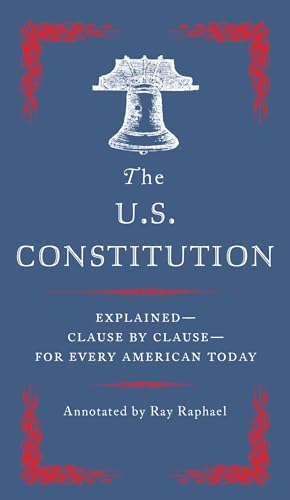
The U.S. Constitution : explained — clause by clause — for every American today / Annotated by Ray Raphael.

Por: Editor: New York : Vintage Books, ©2017Edición: First Vintage Books EditionDescripción: 179 pages ; 19 cmTipo de contenido:
  • text
Tipo de medio:
  • unmediated
Tipo de soporte:
  • volume
ISBN:
  • 9780525562542
Otro título:
  • United States Constitution
  • US Constitution
Tema(s): Clasificación LoC:
  • KF 4550 .R37 2017
Contenidos:
The Original Constitution -- Bill of Rights -- Later Amendments.
Resumen: "Politicians come and go, but the Constitution stands as the supreme law of the land. Setting forth the workings of our democracy, it is the bedrock document from which we derive our policies on topics as diverse and galvanizing as immigration, gun ownership, voting rights, taxation, policing, civil liberties, and war. In this indispensable edition, acclaimed historian and Constitutional expert Ray Raphael guides us through the origins, impact, and current relevance of the original text and all twenty-seven amendments. Here is the key historical context for issues in the news today--from the Electoral College to Washington gridlock, from peaceful protests to executive power. Thoughtful and nuanced, lively and highly readable, this annotated Constitution is for all of us to read and refer to--the ultimate political fact-checking source for every American"--
Valoración
    Valoración media: 0.0 (0 votos)
Existencias
Imagen de cubierta Tipo de ítem Biblioteca actual Biblioteca de origen Colección Ubicación en estantería Signatura topográfica Materiales especificados Info Vol URL Copia número Estado Notas Fecha de vencimiento Código de barras Reserva de ítems Prioridad de la cola de reserva de ejemplar Reservas para cursos
Libro Biblioteca de Derecho Mons. Fremiot Torres Oliver Colección General biblioteca derecho KF 4550 .R37 2017 (Navegar estantería(Abre debajo)) c. 1 Disponible 70000000906553
1 ítem está pedido.
Total de reservas: 0

Descripciones mejoradas de Syndetics:

For every citizen who wants to understand the foundation of American democracy, this clear guide by acclaimed historian Ray Raphael explains the U.S. Constitution clause by clause, revealing how its words shape our rights, our government, and the issues that define civic life today.

This edition offers: A modern clause-by-clause reading of the Constitution that explains its origins, impact, and relevance to current events Guidance for understanding today's most debated civic issues, from voting rights to gun ownership and beyond Insight from an acclaimed historian and constitutional expert A clean, user-friendly format that is easy to take to class, meetings, protests, and more
"Raphael's annotations are written with such clarity. Indeed, the kind of clarity we need at this critical moment in our nation's history."-Carol Anderson, Winner of the National Book Critics Circle Award

Presidents come and go, but the Constitution remains the supreme law of the land. It is the bedrock document from which we derive our policies on immigration, protests, gun ownership, voting rights, taxation, policing, and war. It dictates the structure of our government and sets forth our rights as citizens.

Yet even well-informed readers can stumble over the Constitution's archaic language and historical context. In this indispensable edition, Raphael offers a thoughtful, lively, and highly readable interpretation illuminating the intentions of the framers, the document's evolution over centuries, and what it means for Americans today.

Here is where concerned citizens can find answers and a reliable political fact-checking resource for navigating the issues in the news.

The Original Constitution -- Bill of Rights -- Later Amendments.

"Politicians come and go, but the Constitution stands as the supreme law of the land. Setting forth the workings of our democracy, it is the bedrock document from which we derive our policies on topics as diverse and galvanizing as immigration, gun ownership, voting rights, taxation, policing, civil liberties, and war. In this indispensable edition, acclaimed historian and Constitutional expert Ray Raphael guides us through the origins, impact, and current relevance of the original text and all twenty-seven amendments. Here is the key historical context for issues in the news today--from the Electoral College to Washington gridlock, from peaceful protests to executive power. Thoughtful and nuanced, lively and highly readable, this annotated Constitution is for all of us to read and refer to--the ultimate political fact-checking source for every American"--

Extracto provisto por Syndetics

from the Introduction In the United States, the Constitution--not the president, nor any elected leader--reigns supreme. Article VI declares succinctly: "This Constitution, and the Laws of the United States which shall be made in Pursuance thereof,...shall be the supreme Law of the Land." Americans for more than two centuries have treated the primacy of the Constitution as gospel, and that is no small part of our endurance as a nation. "Regime change" in the United States proceeds peacefully. One president passes the torch to the next, even if the two belong to opposing political parties. Representatives and senators come and go, but the Constitution provides the framework under which they all must govern. Yet the passage of time does present interpretive problems. We have agreed to abide by rules developed in a very different age. If we are to understand the historical Constitution and allow it to guide us today, we need to take account of the differences between then and now. The framers' concerns were not identical to ours. The Constitution stipulates that Congress has the authority to "grant Letters of Marque and Reprisal" and "punish Piracies and Felonies committed on the high seas," but we worry more about terrorists on airplanes than pirates on the high seas. How can we balance airport security with privacy concerns? It would be odd to treat the framers as experts in such matters. We might look to basic principles that they espoused, but the devil is in the details and details are markedly absent. Textual interpretation of the Constitution must account for the evolution of language. Article VI guarantees that the federal government will protect against "domestic Violence." Today the term refers to spousal abuse, but back then it meant civil unrest. Constitutionese is not our native tongue. To grasp the context in which our Constitution was drafted, imagine that it is the spring of 1787. Under the Articles of Confederation, Congress depends on the states for funds, but from October 1786 through March 1787, the states have paid a grand total of $663 into the federal treasury. To use a modern idiom, the federal government has shrunk to the size where it can drown in a bathtub. Penniless and powerless, Congress cannot even muster a quorum. The state of Massachusetts has asked Congress to suppress a rebellion ("domestic Violence") of indebted farmers who are closing the courts, but there is no federal army to speak of, only a few hundred soldiers stationed in western forts. Debtors are closing courts in South Carolina, Virginia, Maryland, and New Jersey as well. In Pennsylvania, farmers are preventing tax collectors from seizing their cattle. The Rhode Island legislature, under the sway of debtors, has just issued paper money. New York, North Carolina, and Georgia are now debating whether to follow Rhode Island's lead. All of this is destroying public credit. With the value of money plummeting, neither Congress nor the states can find willing lenders. What is to be done? Obviously, the Articles of Confederation--the nation's existing constitution--need to be fixed. Twelve states (but not Rhode Island) send delegates to a convention in Philadelphia "for the sole and express purpose of revising the Articles of Confederation" to "render the federal constitution adequate to the exigencies of Government & the preservation of the Union." But will "revising" the Articles suffice? That document requires unanimous approval for any amendments, a hurdle that has proved impossible to clear. Two amendments granting Congress the power to lay imposts have already failed. On the first day of deliberations, Virginia's Edmund Randolph and Pennsylvania's Gouverneur Morris move that instead of merely "correcting and enlarging" the Articles of Confederation, "a national government ought to be established consisting of a supreme legislative, executive & judiciary." (James Madison's meticulous notes on the convention emphasized the words "national" and "supreme.") Would delegates vote for it despite their instructions only to revise the Articles of Confederation? They did, and that was a defining moment. The framers wanted to create from scratch an "energetic" government with sufficient "vigor" (among their favorite words) to prevent the United States from collapsing as a nation. A writer in The Pennsylvania Gazette put it this way: "The Year 1776 is celebrated for a revolution in favor of Liberty . The year 1787, it is expected, will be celebrated with equal joy, for a revolution in favor of Government ." What would that government look like? The framers wanted it to be robust yet not tyrannical. To balance strength and restraint, they created three distinct branches that could constrain one another. "Separation of powers" and "checks and balances" are often said to limit federal power, but in fact, they serve the opposite purpose. By distributing authority to different components within the federal government, the framers gave that government greater powers than it dared grant to a single body. As protections grew, they could add more powers--that was the framers' basic strategy and crowning achievement. Excerpted from The U. S. Constitution: The Essential Edition for Every American by Ray Raphael All rights reserved by the original copyright owners. Excerpts are provided for display purposes only and may not be reproduced, reprinted or distributed without the written permission of the publisher.

Notas de autor provistas por Syndetics

Ray Raphael's ten books on the Founding Era include A People's History of the American Revolution (2001), Founding Myths: Stories That Hide Our Patriotic Past (2004), Mr. President: How and Why the Founders Created a Chief Executive (2012), and Constitutional Myths (2013). Having taught at Humboldt State University and College of the Redwoods, he is currently developing teaching tools for the Constitutional Sources Project (ConSource) and serving as an associate editor for the Journal of the American Revolution . He lives in Northern California.

Haga clic en una imagen para verla en el visor de imágenes

Portada local
Compartir
logopucpr-y-vive

Contáctanos

¡Queremos saber de ti!

Tel. 787.841.2000 Ext. 1801

bibliotecavaldes@pucpr.edu

⁣Búscanos en las redes

© 2026 Desarrollado por Ignite Online • All Rights Reserved • Powered by Koha.