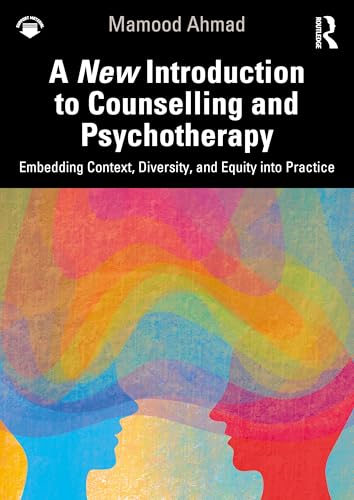

A new introduction to counselling and psychotherapy : Embedding context, diversity, and equity into practice / Mamood Ahmad.
Editor: New York : Routledge, 2026Descripción: xliii, 429 pages ; 25 cmTipo de contenido:- text
- unmediated
- volume
- 9781032805931 (pbk)
- 978103280595 (hbk)
- 9781003497592 (ebk)
- RC480 .A363 2026
| Imagen de cubierta | Tipo de ítem | Biblioteca actual | Biblioteca de origen | Colección | Ubicación en estantería | Signatura topográfica | Materiales especificados | Info Vol | URL | Copia número | Estado | Notas | Fecha de vencimiento | Código de barras | Reserva de ítems | Prioridad de la cola de reserva de ejemplar | Reservas para cursos | |
|---|---|---|---|---|---|---|---|---|---|---|---|---|---|---|---|---|---|---|
| Libro mb | Biblioteca de Mayagüez Colección General mb | RC480 .A363 2026 (Navegar estantería(Abre debajo)) | c. 1 | Disponible | 52000003299364 |
Descripciones mejoradas de Syndetics:
This groundbreaking, comprehensive, and practical textbook offers a mainstream introduction to self-development, theory, skills, and practice in counselling and psychotherapy.
Mamood Ahmad systematically embeds the implications of the "client in context" through an evolving framework called whole-person practice , woven into every aspect of mainstream knowledge and practice to address gaps. This includes essential, yet often overlooked, dimensions such as social context, culture, identity, diversity, neurodiversity, embodiment, knowledge, worldviews, power dynamics, intersectionality, and trauma- and harm-informed approaches. As a result, the book strengthens the very foundations of therapy for all and ensures that equity, diversity, and inclusion (EDI/DEI) are embedded by design from the outset rather than treated as add-ons. Each chapter is structured as a practical learning resource and lesson plan, modelling an embedded course curriculum and featuring case studies, discussion prompts, and reflection exercises to enhance critical thinking and real-world application to practise. Learning is further enriched by contributions from therapists with lived experience and specialised knowledge, as well as access to online resources and additional training opportunities.
Unlocking the future of a stronger, sustainable, and more equitable therapeutic profession, this book will be an essential part of psychotherapy and counselling curricula for students, course tutors, therapists, supervisors, and other helping professionals.
Includes bibliographical references and index.
Part 1: Personal and Professional Development -- 1. Mental Health, Root Causes and Therapy -- 2. Building Blocks of Self-development -- 3. Whole Person Self-development -- 4. Social Identities I: Race, Culture, Ethnicity, Nationality, Gender, Class, and Neurodiversity -- 5. Social Identities II: Disability, Age, Body Image, Sexuality, and Religion, Spirituality and Belief -- Part 2: Theory -- 6. Theories of Stress, Trauma and Harm -- 7. Primary Therapeutic Approaches -- 8. The Therapeutic Relationship I: Working Alliance, and Communication and Meaning -- 9. The Therapeutic Relationship II: Transference, Reparative, Personal, and Transpersonal -- Part 3: Skills -- 10. Relational Skills -- 11. Contextual and Professional Skills -- 12. Therapy in Action -- Part 4: Practice, Equity and Change -- 13. Practice, Organisation and Equity Improvement -- 14. Advocacy, Community and Social Change -- 15. Changing the Curriculum, Standards and Organisation.
This groundbreaking, comprehensive, and practical textbook offers a mainstream introduction to self-development, theory, skills, and practice in counselling and psychotherapy. Mamood Ahmad systematically embeds the implications of the "client in context" through an evolving framework called whole-person practice, woven into every aspect of mainstream knowledge and practice to address gaps. This includes essential, yet often overlooked, dimensions such as social context, culture, identity, diversity, neurodiversity, embodiment, knowledge, worldviews, power dynamics, intersectionality, and trauma- and harm-informed approaches. As a result, the book strengthens the very foundations of therapy for all and ensures that equity, diversity, and inclusion (EDI/DEI) are embedded by design from the outset rather than treated as add-ons. Each chapter is structured as a practical learning resource and lesson plan, modelling an embedded course curriculum and featuring case studies, discussion prompts, and reflection exercises to enhance critical thinking and real-world application to practise. Learning is further enriched by contributions from therapists with lived experience and specialised knowledge, as well as access to online resources and additional training opportunities. Unlocking the future of a stronger, sustainable, and more equitable therapeutic profession, this book will be an essential part of psychotherapy and counselling curricula for students, course tutors, therapists, supervisors, and other helping professionals.
Notas de autor provistas por Syndetics
Mamood Ahmad a psychotherapist, lecturer, speaker, and Whole Person DEI consultant, as well as the founder of The Anti-Discrimination Focus community. Established in 2020, this community aims to promote equity by design within the educational foundations of therapeutic practice. As a UKCP Psychotherapist with over a decade of experience in private practice, with specialisms in trauma, multicultural competence and social change, his primary focus now is professional standards change, which is the central rationale for this book.