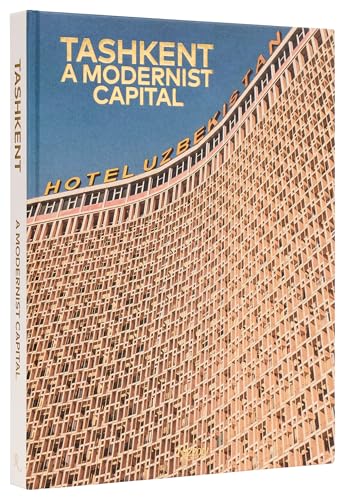

Tashkent : a modernist capital. / photography by Karel Balas ; text by Béatrice Grenier ; foreword, Saida Mirziyoyeva ; preface, Chris Dercon. txt
Editor: New York : Rizzoli, 2024Descripción: 239 p. : ill. ; col. ; 36 cmTipo de contenido:- text
- still image
- unmediated
- volume
- 9780847899982
- 0847899985
- NA1492.382.T37 T37 2024
| Imagen de cubierta | Tipo de ítem | Biblioteca actual | Biblioteca de origen | Colección | Ubicación en estantería | Signatura topográfica | Materiales especificados | Info Vol | URL | Copia número | Estado | Notas | Fecha de vencimiento | Código de barras | Reserva de ítems | Prioridad de la cola de reserva de ejemplar | Reservas para cursos | |
|---|---|---|---|---|---|---|---|---|---|---|---|---|---|---|---|---|---|---|
| Libro Col. General CARIBET | CARIBET Biblioteca Arquitectura Colección Oversize CARIBET | Oversize NA1492.382.T37 T37 2024 (Navegar estantería(Abre debajo)) | 1 | Disponible | 91000000752766 |
Descripciones mejoradas de Syndetics:
A shrine to Soviet modernist architecture, Tashkent is a rare jewel of modernism rediscovered in this book.
Established sometime around the 1st or 2nd century BCE, Tashkent is the capital city of Uzbekistan and the largest metropolis in Central Asia benefiting from its historical role as geographic crossroads, its developed resources, and its thriving multiculturalism. Previous Soviet rule was established in 1917--which over six decades heralded transformations in Tashkent's culture, identity, and, of course, its landscape and architecture.
In this extraordinary volume, realized in collaboration with the Uzbekistan Art and Culture Development Foundation, photographer Karel Balas reveals the modernist architecture of Tashkent through a collection of never-before-seen photographs. Constructed between the 1960s and early '90s, these buildings stand as powerful metaphors vis-à-vis Tashkent's past and present, painting a picture of its rich cultural heritage. Part of the overlooked Soviet modernism movement, the expression of this new architectural style represents a vision and social function for the city as a whole--all the while connoting the specific character and modernization of Central Asia. Whether a 1964 cinema, the State Museum of the Arts, the 1970 Lenin Museum, or the striking Hotel Uzbekistan dated 1976, each structure tells a captivating story about one of the most enthralling cities on the Asian continent.
"Project initiated and commissioned by Art and Culture Development Foundation under the Cabinet of Ministers of the Republic of Uzbekistan."
Includes bibliographical references.
INTRODUCTION BY GAYANE UMEROVA 8 --
IMAGES FOR A NEW MODERNIST CAPITAL BY BÉATRICE GRENIER 10 --
PALACE OF PEOPLE’S FRIENDSHIP 16 --
BIG SOLAR FURNACE 36 --
REPUBLICAN ART COLLEGE 52 --
BLUE DOMES CAFÉ 62 --
CHORSU MARKET 70 --
STATE MUSEUM OF HISTORY 82 --
REPUBLICAN SPECIALIZED SURGERY CENTER 92 --
ALISHER NAVOI METRO STATION 104 --
PAKHTAKOR METRO STATION 110 --
PEOPLE’S FRIENDSHIP METRO STATION 118 --
KOSMONAVTLAR METRO STATION 126 --
STATE MUSEUM OF ARTS 136 --
PALACE OF CULTURE OF AVIATORS 146 --
ALISHER NAVOI CINEMA PALACE 156 --
FRENCH CULTURAL CENTER AND RESTORATION CENTER 166 --
STATE CIRCUS 174 --
NATIONAL TELEVISION AND RADIO COMPANY 188 --
ZHEMCHUG RESIDENTIAL BUILDING 198 --
TV TOWER 210 --
CENTRAL EXHIBITION HALL OF THE ACADEMY OF ARTS 218 --
HOTEL UZBEKISTAN 228 --
"In this extraordinary volume, realized in collaboration with the Uzbekistan Art and Culture Development Foundation, photographer Karel Balas reveals the modernist architecture of Tashkent through a collection of never-before-seen photographs. Constructed between the 1960s and early '90s, these buildings stand as powerful metaphors vis-à-vis Tashkent's past and present, painting a picture of its rich cultural heritage. Part of the overlooked Soviet modernism movement, the expression of this new architectural style represents a vision and social function for the city as a whole--all the while connoting the specific character and modernization of Central Asia. Whether a 1964 cinema, the State Museum of the Arts, the 1970 Lenin Museum, or the striking Hotel Uzbekistan dated 1976, each structure tells a captivating story about one of the most enthralling cities on the Asian continent"--Publisher's website