Imagen de portada de Amazon
Imagen de Amazon.com
Imagen de cubierta Syndetics
Portada de Syndetics
Imagen de OpenLibrary

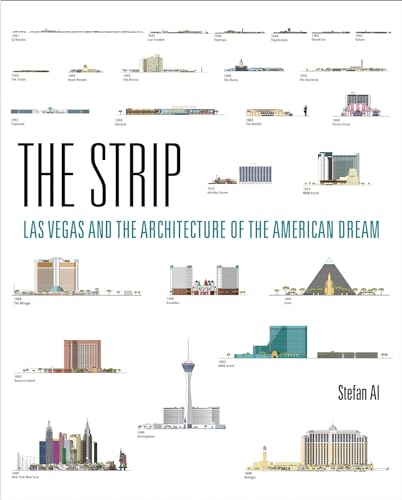
The Strip : Las Vegas and the architecture of the American dream. / Stefan Al. txt

Por: Editor: Cambridge, Massachusetts : The MIT Press, 2017Descripción: xi, 254 p. ; 27 cmTipo de contenido:
  • text
Tipo de medio:
  • unmediated
Tipo de soporte:
  • volume
ISBN:
  • 9780262035743
  • 9780262338219
  • 0262338203
  • 026233822X
  • 0262338211
  • 9780262338202
  • 9780262338226
Tema(s): Clasificación CDD:
  • 23 725/.7609793135
Clasificación LoC:
  • NA735.L3 A4 2017
Contenidos:
Acknowledgments ix -- Figure Credits xi -- Introduction: Las Vegas as America 1 -- 1 Wild West (1941 - 1946) 5 -- 2 Sunblent Modern (1946 - 1958) 29 -- 3 Pop City (1958 - 1969) 59 -- Corporate Modern (1969 - 1985) 109 -- 5 Disneyland (1985 - 1995) 133 -- 6 Sim City (1995 - 2001) 169 -- 7 Starchitecture (2001 - Present) 197 -- Conclusion: America as Las Vegas 219 -- Notes 223 -- Index 243 --
ILLUSTRATIONS: 1 WILD WEST (1941 to 1946) 5 -- 1.1 In 1939, with planes flying into Las Vegas, the Chamber of Commerce marketed the city as “Still a Frontier Town,” dedicating this map to the prospector, “who has built the West… in his quest of hidden treasures.” 11 -- 1.2 Built in 1941 just outside the city, in the vast Mojave Desert, the El Rancho was Vegas’s first self contained casino complex with a swimming pool, entertainment, and lush landscaping 14 -- 1.3 A then skimpily dressed cowgirls holds a whip in front of the El Rancho, “A truly Modern Hotel” rife with “Old West’ hospitality.” 16 -- 1.4 A postcard of sunbathing swimmers around the Last Frontier pool, sandwiched between horse drawn carriages and the highway 19 -- 1.5 A 1954 renovation of the Last Frontier forced the Little Church of the West, a miniature replica of a pioneer church in California, to relocate 21 -- 1.6 A postcard of the “1856” Texaco gas station at the Last Frontier, c. 1942 23 -- 1.7 A Last Frontier Village brochure depicts a child aiming a gun for a photo, while in the background, from a rooming- house window, a papier mache madam flaunts her leg 24 -- 1.8 A Greyhound bus stands next to a horse drawn coach at the Last Frontier Village; behind, a drive in movie screen 26 -- 2 SUNBELT MODERN (1946 to 1958) 29 -- 2.1 A postcard of the “Fabulous Flamingo Hotel” depicts its sharp roof, glass, façade, and colorful neon pylon in sharp contrast to the Western, sepia toned casinos 31 -- 2.2 Compared to the sole Flamingo down the street, the Thunderbird featured a duo of neon birds, one with its claws sunk in an observation tower 34 -- 2.3 The El Rancho windmill, and an arrow pointing to it, complete with the Thunderbird duo and the Mobil Pegasus 35 -- 2.4 A woman holding a camera sits on a high diving board at the Desert Inn’s keyhole shaped pool, overlooked by a glass skybox and a neon saguaro cactus 37 -- 2.5 A postcard features two plaster camels and a nomad standing in front of the Sahara roadside sign and the then largest pylon on the Strip 39 -- 2.6 A postcard depicts a woman in a beige Cadillac arriving at the Sand’s angular entrance pylons. The neon Sands letters float on a see through grille in the background 41 -- 2.7 Croupiers, gamblers, and female bystanders, all in swimwear, stand around the Sands’s floating craps table, in front of three poolside slot machines, 1954 43 -- 2.8 A 1955 Fabulous Las Vegas Magazine cover depicts the conversion of Western “Last Frontier” to Space Age “New Frontier,” with the then longest trylon and canopy 45 -- 2.9 In 1953, the Flamingo added a canopy with metal cylinders, and a neon ringed “champagne tower.” 46 -- 2.10 A postcard shows greeters dressed as Indian chiefs posing at a Cadillac, backed by the Royal Nevada’s Arthurian crown and neon fountain 47 -- 2.11 A tall slab extends from the sunscreen decorated Fremont Hotel, while a bright mushroom cloud climbs upward, 1957 49 -- 2.12 A man in a spotted shirt photographs the fiberglass Sultan Standing atop the Dunes entrance canopy 51 -- 2.13 In front of the Hacienda’s curving façade and tall pylon, guests aim for a “$5,000 Hole in One jackpot.” 53 -- 2.14 The Tropicana’s circular drive leads to a razor sharp, upsweeping canopy stretching out 130 feet with down lighting, followed by a mosaic-tiled entrance 55 -- 3 POP CITY (1958 to 1969) 59 -- 3.1 Amid a sea of tail fin cars, the Stardust’s circular sign fronts a starburst plastered casino façade of plastic planets, neon rays, and a globe circling Sputnik, 1958 62 -- 3.2 The Mint’s curvilinear sign swept from a tall vertical “blade” into an “eyebrow” porte cochere, 1957 66 -- 3.3 A Las Vegas Club photo montage by Hermon Boernge features a woman holding a hamburger and a Coke, sitting on the casino’s new 120 foot tall sign. The smaller Pioneer Club sign is depicted on the right 67 -- 3.4 A postcard delineates the remodeled Horseshoe, now the “world’s largest electric sign,” blending Western style letters and horseshoes with futuristic ribbed grilles and a concave bullnose 68 -- 3.5 A postcard shows the Golden Nugget’s “bullnose,” Lucky Casino’s “nose,” and Vegas Vic, from underneath a neon swirled canopy 69 -- 3.6 A Dome of the Sea postcard calls for the “seafaring traveler” to “submit” to the “seasescape” of deep sea projections, an iridescent inner shell like vaulted ceiling, and harpist “Mermaid” whirling figure eights in a pool 75 -- 3.7 A postcard features the flaming silhouette and brilliant diamond of the Dunes sign, eclipsing the hotel tower 76 -- 3.8 The Aladdin sign, with its coil of golden beer cans and car-sized oil lamp, stands as a beacon of a generic casino building 79 -- 3.9 Aladdin’s canopy, a neon version of an Islamic dentate cornice, paints the parking lot red 80 -- 3.10 In contrast to the smaller 1950s desert Inn’s sign stand the revolving 1960s silver slipper and cantilevering Frontier, 1968 81 -- 3.11 An Ad Art blueprint for the 188 foot long Stardust sign describes an eight phase “Flashing Action: sequence that began with switching on all the lights, from bottom to top in 12 steps, in only one second 83 -- 3.12 At 130 feet, undulating neon tubes give a feathered look to the flamingo’s plume of salmon, blush, and pink, 1968 84 -- 3.13 The new Stardust sign and animated electronic façade had recycled the globe and Electra jag letters of the original 1958 sign-front, 1968 86 -- 3.14 The Thunderbird’s new 560 foot sign skin fronts the existing casino and even the hotel rooms, which now faced the sign’s back, 1968 87 -- 3.15 A guest poses with a fiberglass centurion at the base of Caesars’s Roman style roadside sign, 1970. The even larger Romans on the columns were later additions to the original 1966 sign 91 -- 3.16 A replica of the Winged Goddess of Victory fronts Caesars Place’s driveway entrance, amid fountains and cypresses 93 -- 3.17 A brochure depicts Caesars Palace as a conveyor belt of unique experiences, from cocktails inside a moving Cleopatra’s barge to dinner among Iconic column plastered walls and “goddesses” carrying wine casks 95 -- 3.18 Trapeze artist perform right above gamblers at Circus Circus, 1968 98 -- 3.19 A rendering of the Viva Hotel shows an outward tapering form decked with staircase spires, and a conical rooftop nightclub. Bruce Alonzo Goff, “Viva Casino and Hotel: Perspective Rendering,” 1961, graphite on tracing paper, 77.6 x 78cm. (31 x 13in.), Gift of Shin’enKan, Inc., 1990.807.1, The Art Institute of Chicago 104 -- 3.20 An Ad Art rendering of the Sands reveals how the hotel tower, the entrance, and the sign share a sculptural language of arcs 105 -- 3.21 The Landmark’s casino “saucer” on a hotel “pole,” a large sign equivalent of a building, was imploded in 1995. The next year, it was shot down by Martians in the movie Mars Attacks 106 – 4 CORPORATE MODERN (1969 to 1985) 109 -- 4.1 a Martin Stern rendering of the 1969 international reveals a Y shaped building modeled on the UNESCO headquarters. Stern pioneered integrating all of the casino resort functions into a single megastructure 113 -- 4.2 An electric architectural drawing depicts the holiday Casino, a replica of a nineteenth century Mississippi gambling steamboat, in contrast to the minimalist Holiday Inn, 1971 116 -- 4.3 A postcard depicts the 1979 Imperial Palace, a box-shaped building decorated with Japanese blue tiled roofs, “wooden” details, and a pagoda canopy 117-- 4.4 An artist’s impression of the 1973 MGM Grand focuses attention on the porte cochere, the resorts new “sign” 119 -- 4.5 Neptune, sirens, and mermaids shooting water from their breasts stand beneath the MGM Grand’s porte cochere, the size of a football field 121 -- 4.6 An Ad Art rendering by Jack Dubois of the Aladdin’s gold polished porte cochere, effectively a freestanding building with massive “chandelier” fixtures, 1975 124 -- 4.7 A sign canopy Hybrid with mirrored wings and outward radiating lights defines the Silverbird, formerly known as the Thunderbird, 1979 125 -- 4.8 In 1978, the desert Inn, Howard Hughes’s former headquarters, discarded its neon cactus for a new 14 story addition to the existing buildings (left), both clad in one way mirrored glass ribbons 127-- 4.9 An artist’s Impression of the Donald Trump proposed Xanadu, 1975, inspired by the pyramid sloped Acapulco Princess, final residence of Howard Hughes 128 -- 5 DISNEYLAND (1985 to 1995) 133 -- 5.1 Strip passerby halt for the Mirage’s fire spewing, roaring volcano reeking of piña colada, 1989 138 -- 5.2 A drawbridge crosses a moat and a driveway into the Excalibur’s central “castle within a castle,” with deliberately overscaled turrets to make the castle more recognizable from a distance 141 -- 5.3 below a changing sky, Neptune holds his spear on a shop lined “piazza” at the Forum Shops, 2008. Photograph courtesy of Vladislav Bezrukov, Flickr 145 -- 5.4 A driveway cuts through the Sphinx, sandwiched between a misted obelisk and a glass pyramid with the world’s brightest beam, 1993 147 -- 5.5 A cutaway model shows a “city” within the Luxor pyramid, including a Manhattan skyline, a ziggurat style temple, and a black monolith featuring a vertical movie screen, 1993 149 -- 5.6 Room corridors overlook the attractions level of the Luxor, Las Vegas’s first atrium hotel, 2015. The former Manhattan skyline (left) was remodeled in 1997 to look Egyptian 151 -- 5.7 A pirate leaps from his ship into the whitecaps of Buccaneer Bay, Treasure Island, 1993 154 -- 5.8 Guests cross a long wooden bridge into “a living fantasy the pirate capital of the world,” 1993. To humanize the treasure Island’s gigantic hotel tower with the smaller village, four rooms were clustered into only one window opening, each with fake shutters and a balcony 156 -- 5.9 Dorothy, the Scarecrow, the Tin Man, and the Cowardly Lion walk the yellow brick road from the green-glass Emerald City, below twinkling stars, 1993 158 -- 5.10 A 10 story cubist Looey the Lion is the entrance to the emerald green MGM Grand Casino and Theme Park, 1994. 160 -- 5.11 An LCD canopy projects video over five entire city blocks in Fremont Street, among casino’s flashing neon and flickering light bulbs, 1998. 163 -- 5.12 The Las Vegas skyline is a battle between the Strip’s clashing and competing “Disneylands”. 166 -- 6 SIM CITY (1995 to 2001) 169 -- 6.1 The Stratosphere, America’s tallest observation tower, features a “Big shot” thrill ride that catapults guests up the tower’s mast, 2011. 172 -- 6.2 A rendering of the Monte Carlo shows a copy of Pari’s Fontaines de la Concorde and other Belle Époque inspired monuments below the generic hotel building. 175 -- 6.3 A New York New York brochure spells out the architectural references of the resort’s “skyline,” which is in fact one single hotel tower. 177 -- 6.4 Fountains burst 460 feet upward from an artificial lake at the Bellagio, an amalgamation of Tuscan style villas, domed Galleria arcades, and a stretched out Italian Renaissance palace, 1997. 180 -- 6.5 Mandalay Ba’s fake beach attracts to the Mojave Desert pool revelers who might have gone to real beaches otherwise, 1999. 183 -- 6.6 “The Rialto Bridge and the Campanile Di San Marco together in one picture, complete with a portico!” the photographer of this Venetian photo wrote. “The Rialto Bridge had escalators, I bet the steps of the real bridge will be a disappointment to many tourists!” 185 -- 6.7 The Venetian’s Rialto Bridge spans not the Grand Canal but a vehicular access road, 2015. 187 -- 6.8 Gondoliers steer guest along the Venetian’s Grand canal, dyed monthly to keep its azure color, past St. Mark’s Square, one floor above the casino. 188 -- 6.9 At Paris Las Vegas, the half size replica od the Eiffel Tower stands partly outside the Strip, partly inside the casino, against the backdrop of the stretched out Parisian city hall. 189 -- 6.10 The Aladdin’s video screen honors troops aid onion shaped domes, minarets, and faux sandstone cliffs, 2003. 192 -- 7 STARCHITECTURE (2001 to Present) 197 -- 7.1 A man made mountain of 1,500 trees and eight waterfalls shields the Wynn casino from public realm of the Las Vegas Strip, 2014. 201 -- 7.2 Crocodile embossed leather VIP booths surround a pool surrounding a larger pool at XS, a pool nightclub hybrid. 205 -- 7.3 Big Edge, Nancy Rubin’s bouquet of canoes, fronts the energy saving façade of the César Pelli designed Aria Hotel. 207 -- 7.4 Daniel Libeskind’s titanium clad Crystals mall outshines Norman Foster’s downsized, blue silver Harmon hotel (right), backed by Helmut Jahn’s pair of leaning Veer towers. 209 -- 7.5 A guest scrutinizes Claes Oldenburg and Coosje van Bruggen’s “Typewriter eraser,” I front of one of the yellow checkboard Veer towers. 210 -- 7.6 four miles of gently pulsating LED lighting accentuates The Cosmopolitan’s undulating ground façade and two towers, 2010. 212 -- 7.7 where Paris Las Vegas once took pride in being a replica, The Cosmopolitan (right) is an “original,” 2014. 213 -- 7.8 Singapore’s Marina Bay Sands casino features a 1,115 foot long sky park at an altitude of 653 feet, and a lotus shaped museum, 2014. 215 --
Resumen: "The Las Vegas Strip has impersonated the Wild West, with saloon doors and wagon wheels; it has decked itself out in midcentury modern sleekness. It has illuminated itself with twenty-story-high neon signs, then junked them. After that came Disney-like theme parks featuring castles and pirates, followed by replicas of Venetian canals, New York skyscrapers, and the Eiffel Tower. (It might be noted that forty-two million people visited Las Vegas in 2015 -- ten million more than visited the real Paris.) More recently, the Strip decided to get classy, with casinos designed by famous architects and zillion-dollar collections of art. Las Vegas became the'implosion capital of the world'as developers, driven by competition, got rid of the old to make way for the new -- offering a non-metaphorical definition of'creative destruction.'In The Strip, Stefan Al examines the many transformations of the Las Vegas Strip, arguing that they mirror transformations in America itself. The Strip is not, as popularly supposed, a display of architectural freaks but representative of architectural trends and a record of social, cultural, and economic change. Al tells two parallel stories. He describes the feverish competition of Las Vegas developers to build the snazziest, most tourist-grabbing casinos and resorts -- with a cast of characters including the mobster Bugsy Siegel, the eccentric billionaire Howard Hughes, and the would-be political kingmaker Sheldon Adelson. And he views the Strip in a larger social context, showing that it has not only reflected trends but also magnified them and sometimes even initiated them. Generously illustrated with stunning color images throughout, The Strip traces the many metamorphoses of a city that offers a vivid projection of the American dream."--Publisher description
Valoración
    Valoración media: 0.0 (0 votos)
Existencias
Imagen de cubierta Tipo de ítem Biblioteca actual Biblioteca de origen Colección Ubicación en estantería Signatura topográfica Materiales especificados Info Vol URL Copia número Estado Notas Fecha de vencimiento Código de barras Reserva de ítems Prioridad de la cola de reserva de ejemplar Reservas para cursos
Libro Col. General CARIBET CARIBET Biblioteca Arquitectura Colección General CARIBET General NA735.L3 A4 2017 (Navegar estantería(Abre debajo)) 1 Disponible 91000000752683
Total de reservas: 0

Descripciones mejoradas de Syndetics:

The transformations of the Strip--from the fake Wild West to neon signs twenty stories high to "starchitecture"--and how they mirror America itself.

The Las Vegas Strip has impersonated the Wild West, with saloon doors and wagon wheels; it has decked itself out in midcentury modern sleekness. It has illuminated itself with twenty-story-high neon signs, then junked them. After that came Disney-like theme parks featuring castles and pirates, followed by replicas of Venetian canals, New York skyscrapers, and the Eiffel Tower. (It might be noted that forty-two million people visited Las Vegas in 2015--ten million more than visited the real Paris.) More recently, the Strip decided to get classy, with casinos designed by famous architects and zillion-dollar collections of art. Las Vegas became the "implosion capital of the world" as developers, driven by competition, got rid of the old to make way for the new--offering a non-metaphorical definition of "creative destruction." In The Strip , Stefan Al examines the many transformations of the Las Vegas Strip, arguing that they mirror transformations in America itself. The Strip is not, as popularly supposed, a display of architectural freaks but representative of architectural trends and a record of social, cultural, and economic change.

Al tells two parallel stories. He describes the feverish competition of Las Vegas developers to build the snazziest, most tourist-grabbing casinos and resorts--with a cast of characters including the mobster Bugsy Siegel, the eccentric billionaire Howard Hughes, and the would-be political kingmaker Sheldon Adelson. And he views the Strip in a larger social context, showing that it has not only reflected trends but also magnified them and sometimes even initiated them. Generously illustrated with stunning color images throughout, The Strip traces the many metamorphoses of a city that offers a vivid projection of the American dream.

Includes index.

Maps showing the Las Vegas Strip over time on front and back endpapers.

Acknowledgments ix --
Figure Credits xi --
Introduction: Las Vegas as America 1 --
1 Wild West (1941 - 1946) 5 --
2 Sunblent Modern (1946 - 1958) 29 --
3 Pop City (1958 - 1969) 59 --
Corporate Modern (1969 - 1985) 109 --
5 Disneyland (1985 - 1995) 133 --
6 Sim City (1995 - 2001) 169 --
7 Starchitecture (2001 - Present) 197 --
Conclusion: America as Las Vegas 219 --
Notes 223 --
Index 243 --

ILLUSTRATIONS:
1 WILD WEST (1941 to 1946) 5 --
1.1 In 1939, with planes flying into Las Vegas, the Chamber of Commerce marketed the city as “Still a Frontier Town,” dedicating this map to the prospector, “who has built the West… in his quest of hidden treasures.” 11 --
1.2 Built in 1941 just outside the city, in the vast Mojave Desert, the El Rancho was Vegas’s first self contained casino complex with a swimming pool, entertainment, and lush landscaping 14 --
1.3 A then skimpily dressed cowgirls holds a whip in front of the El Rancho, “A truly Modern Hotel” rife with “Old West’ hospitality.” 16 --
1.4 A postcard of sunbathing swimmers around the Last Frontier pool, sandwiched between horse drawn carriages and the highway 19 --
1.5 A 1954 renovation of the Last Frontier forced the Little Church of the West, a miniature replica of a pioneer church in California, to relocate 21 --
1.6 A postcard of the “1856” Texaco gas station at the Last Frontier, c. 1942 23 --
1.7 A Last Frontier Village brochure depicts a child aiming a gun for a photo, while in the background, from a rooming- house window, a papier mache madam flaunts her leg 24 --
1.8 A Greyhound bus stands next to a horse drawn coach at the Last Frontier Village; behind, a drive in movie screen 26 --
2 SUNBELT MODERN (1946 to 1958) 29 --
2.1 A postcard of the “Fabulous Flamingo Hotel” depicts its sharp roof, glass, façade, and colorful neon pylon in sharp contrast to the Western, sepia toned casinos 31 --
2.2 Compared to the sole Flamingo down the street, the Thunderbird featured a duo of neon birds, one with its claws sunk in an observation tower 34 --
2.3 The El Rancho windmill, and an arrow pointing to it, complete with the Thunderbird duo and the Mobil Pegasus 35 --
2.4 A woman holding a camera sits on a high diving board at the Desert Inn’s keyhole shaped pool, overlooked by a glass skybox and a neon saguaro cactus 37 --
2.5 A postcard features two plaster camels and a nomad standing in front of the Sahara roadside sign and the then largest pylon on the Strip 39 --
2.6 A postcard depicts a woman in a beige Cadillac arriving at the Sand’s angular entrance pylons. The neon Sands letters float on a see through grille in the background 41 --
2.7 Croupiers, gamblers, and female bystanders, all in swimwear, stand around the Sands’s floating craps table, in front of three poolside slot machines, 1954 43 --
2.8 A 1955 Fabulous Las Vegas Magazine cover depicts the conversion of Western “Last Frontier” to Space Age “New Frontier,” with the then longest trylon and canopy 45 --
2.9 In 1953, the Flamingo added a canopy with metal cylinders, and a neon ringed “champagne tower.” 46 --
2.10 A postcard shows greeters dressed as Indian chiefs posing at a Cadillac, backed by the Royal Nevada’s Arthurian crown and neon fountain 47 --
2.11 A tall slab extends from the sunscreen decorated Fremont Hotel, while a bright mushroom cloud climbs upward, 1957 49 --
2.12 A man in a spotted shirt photographs the fiberglass Sultan Standing atop the Dunes entrance canopy 51 --
2.13 In front of the Hacienda’s curving façade and tall pylon, guests aim for a “$5,000 Hole in One jackpot.” 53 --
2.14 The Tropicana’s circular drive leads to a razor sharp, upsweeping canopy stretching out 130 feet with down lighting, followed by a mosaic-tiled entrance 55 --
3 POP CITY (1958 to 1969) 59 --
3.1 Amid a sea of tail fin cars, the Stardust’s circular sign fronts a starburst plastered casino façade of plastic planets, neon rays, and a globe circling Sputnik, 1958 62 --
3.2 The Mint’s curvilinear sign swept from a tall vertical “blade” into an “eyebrow” porte cochere, 1957 66 --
3.3 A Las Vegas Club photo montage by Hermon Boernge features a woman holding a hamburger and a Coke, sitting on the casino’s new 120 foot tall sign. The smaller Pioneer Club sign is depicted on the right 67 --
3.4 A postcard delineates the remodeled Horseshoe, now the “world’s largest electric sign,” blending Western style letters and horseshoes with futuristic ribbed grilles and a concave bullnose 68 --
3.5 A postcard shows the Golden Nugget’s “bullnose,” Lucky Casino’s “nose,” and Vegas Vic, from underneath a neon swirled canopy 69 --
3.6 A Dome of the Sea postcard calls for the “seafaring traveler” to “submit” to the “seasescape” of deep sea projections, an iridescent inner shell like vaulted ceiling, and harpist “Mermaid” whirling figure eights in a pool 75 --
3.7 A postcard features the flaming silhouette and brilliant diamond of the Dunes sign, eclipsing the hotel tower 76 --
3.8 The Aladdin sign, with its coil of golden beer cans and car-sized oil lamp, stands as a beacon of a generic casino building 79 --
3.9 Aladdin’s canopy, a neon version of an Islamic dentate cornice, paints the parking lot red 80 --
3.10 In contrast to the smaller 1950s desert Inn’s sign stand the revolving 1960s silver slipper and cantilevering Frontier, 1968 81 --
3.11 An Ad Art blueprint for the 188 foot long Stardust sign describes an eight phase “Flashing Action: sequence that began with switching on all the lights, from bottom to top in 12 steps, in only one second 83 --
3.12 At 130 feet, undulating neon tubes give a feathered look to the flamingo’s plume of salmon, blush, and pink, 1968 84 --
3.13 The new Stardust sign and animated electronic façade had recycled the globe and Electra jag letters of the original 1958 sign-front, 1968 86 --
3.14 The Thunderbird’s new 560 foot sign skin fronts the existing casino and even the hotel rooms, which now faced the sign’s back, 1968 87 --
3.15 A guest poses with a fiberglass centurion at the base of Caesars’s Roman style roadside sign, 1970. The even larger Romans on the columns were later additions to the original 1966 sign 91 --
3.16 A replica of the Winged Goddess of Victory fronts Caesars Place’s driveway entrance, amid fountains and cypresses 93 --
3.17 A brochure depicts Caesars Palace as a conveyor belt of unique experiences, from cocktails inside a moving Cleopatra’s barge to dinner among Iconic column plastered walls and “goddesses” carrying wine casks 95 --
3.18 Trapeze artist perform right above gamblers at Circus Circus, 1968 98 --
3.19 A rendering of the Viva Hotel shows an outward tapering form decked with staircase spires, and a conical rooftop nightclub. Bruce Alonzo Goff, “Viva Casino and Hotel: Perspective Rendering,” 1961, graphite on tracing paper, 77.6 x 78cm. (31 x 13in.), Gift of Shin’enKan, Inc., 1990.807.1, The Art Institute of Chicago 104 --
3.20 An Ad Art rendering of the Sands reveals how the hotel tower, the entrance, and the sign share a sculptural language of arcs 105 --
3.21 The Landmark’s casino “saucer” on a hotel “pole,” a large sign equivalent of a building, was imploded in 1995. The next year, it was shot down by Martians in the movie Mars Attacks 106 –
4 CORPORATE MODERN (1969 to 1985) 109 --
4.1 a Martin Stern rendering of the 1969 international reveals a Y shaped building modeled on the UNESCO headquarters. Stern pioneered integrating all of the casino resort functions into a single megastructure 113 --
4.2 An electric architectural drawing depicts the holiday Casino, a replica of a nineteenth century Mississippi gambling steamboat, in contrast to the minimalist Holiday Inn, 1971 116 --
4.3 A postcard depicts the 1979 Imperial Palace, a box-shaped building decorated with Japanese blue tiled roofs, “wooden” details, and a pagoda canopy 117--
4.4 An artist’s impression of the 1973 MGM Grand focuses attention on the porte cochere, the resorts new “sign” 119 --
4.5 Neptune, sirens, and mermaids shooting water from their breasts stand beneath the MGM Grand’s porte cochere, the size of a football field 121 --
4.6 An Ad Art rendering by Jack Dubois of the Aladdin’s gold polished porte cochere, effectively a freestanding building with massive “chandelier” fixtures, 1975 124 --
4.7 A sign canopy Hybrid with mirrored wings and outward radiating lights defines the Silverbird, formerly known as the Thunderbird, 1979 125 --
4.8 In 1978, the desert Inn, Howard Hughes’s former headquarters, discarded its neon cactus for a new 14 story addition to the existing buildings (left), both clad in one way mirrored glass ribbons 127--
4.9 An artist’s Impression of the Donald Trump proposed Xanadu, 1975, inspired by the pyramid sloped Acapulco Princess, final residence of Howard Hughes 128 --
5 DISNEYLAND (1985 to 1995) 133 --
5.1 Strip passerby halt for the Mirage’s fire spewing, roaring volcano reeking of piña colada, 1989 138 --
5.2 A drawbridge crosses a moat and a driveway into the Excalibur’s central “castle within a castle,” with deliberately overscaled turrets to make the castle more recognizable from a distance 141 --
5.3 below a changing sky, Neptune holds his spear on a shop lined “piazza” at the Forum Shops, 2008. Photograph courtesy of Vladislav Bezrukov, Flickr 145 --
5.4 A driveway cuts through the Sphinx, sandwiched between a misted obelisk and a glass pyramid with the world’s brightest beam, 1993 147 --
5.5 A cutaway model shows a “city” within the Luxor pyramid, including a Manhattan skyline, a ziggurat style temple, and a black monolith featuring a vertical movie screen, 1993 149 --
5.6 Room corridors overlook the attractions level of the Luxor, Las Vegas’s first atrium hotel, 2015. The former Manhattan skyline (left) was remodeled in 1997 to look Egyptian 151 --
5.7 A pirate leaps from his ship into the whitecaps of Buccaneer Bay, Treasure Island, 1993 154 --
5.8 Guests cross a long wooden bridge into “a living fantasy the pirate capital of the world,” 1993. To humanize the treasure Island’s gigantic hotel tower with the smaller village, four rooms were clustered into only one window opening, each with fake shutters and a balcony 156 --
5.9 Dorothy, the Scarecrow, the Tin Man, and the Cowardly Lion walk the yellow brick road from the green-glass Emerald City, below twinkling stars, 1993 158 --
5.10 A 10 story cubist Looey the Lion is the entrance to the emerald green MGM Grand Casino and Theme Park, 1994. 160 --
5.11 An LCD canopy projects video over five entire city blocks in Fremont Street, among casino’s flashing neon and flickering light bulbs, 1998. 163 --
5.12 The Las Vegas skyline is a battle between the Strip’s clashing and competing “Disneylands”. 166 --
6 SIM CITY (1995 to 2001) 169 --
6.1 The Stratosphere, America’s tallest observation tower, features a “Big shot” thrill ride that catapults guests up the tower’s mast, 2011. 172 --
6.2 A rendering of the Monte Carlo shows a copy of Pari’s Fontaines de la Concorde and other Belle Époque inspired monuments below the generic hotel building. 175 --
6.3 A New York New York brochure spells out the architectural references of the resort’s “skyline,” which is in fact one single hotel tower. 177 --
6.4 Fountains burst 460 feet upward from an artificial lake at the Bellagio, an amalgamation of Tuscan style villas, domed Galleria arcades, and a stretched out Italian Renaissance palace, 1997. 180 --
6.5 Mandalay Ba’s fake beach attracts to the Mojave Desert pool revelers who might have gone to real beaches otherwise, 1999. 183 --
6.6 “The Rialto Bridge and the Campanile Di San Marco together in one picture, complete with a portico!” the photographer of this Venetian photo wrote. “The Rialto Bridge had escalators, I bet the steps of the real bridge will be a disappointment to many tourists!” 185 --
6.7 The Venetian’s Rialto Bridge spans not the Grand Canal but a vehicular access road, 2015. 187 --
6.8 Gondoliers steer guest along the Venetian’s Grand canal, dyed monthly to keep its azure color, past St. Mark’s Square, one floor above the casino. 188 --
6.9 At Paris Las Vegas, the half size replica od the Eiffel Tower stands partly outside the Strip, partly inside the casino, against the backdrop of the stretched out Parisian city hall. 189 --
6.10 The Aladdin’s video screen honors troops aid onion shaped domes, minarets, and faux sandstone cliffs, 2003. 192 --
7 STARCHITECTURE (2001 to Present) 197 --
7.1 A man made mountain of 1,500 trees and eight waterfalls shields the Wynn casino from public realm of the Las Vegas Strip, 2014. 201 --
7.2 Crocodile embossed leather VIP booths surround a pool surrounding a larger pool at XS, a pool nightclub hybrid. 205 --
7.3 Big Edge, Nancy Rubin’s bouquet of canoes, fronts the energy saving façade of the César Pelli designed Aria Hotel. 207 --
7.4 Daniel Libeskind’s titanium clad Crystals mall outshines Norman Foster’s downsized, blue silver Harmon hotel (right), backed by Helmut Jahn’s pair of leaning Veer towers. 209 --
7.5 A guest scrutinizes Claes Oldenburg and Coosje van Bruggen’s “Typewriter eraser,” I front of one of the yellow checkboard Veer towers. 210 --
7.6 four miles of gently pulsating LED lighting accentuates The Cosmopolitan’s undulating ground façade and two towers, 2010. 212 --
7.7 where Paris Las Vegas once took pride in being a replica, The Cosmopolitan (right) is an “original,” 2014. 213 --
7.8 Singapore’s Marina Bay Sands casino features a 1,115 foot long sky park at an altitude of 653 feet, and a lotus shaped museum, 2014. 215 --

"The Las Vegas Strip has impersonated the Wild West, with saloon doors and wagon wheels; it has decked itself out in midcentury modern sleekness. It has illuminated itself with twenty-story-high neon signs, then junked them. After that came Disney-like theme parks featuring castles and pirates, followed by replicas of Venetian canals, New York skyscrapers, and the Eiffel Tower. (It might be noted that forty-two million people visited Las Vegas in 2015 -- ten million more than visited the real Paris.) More recently, the Strip decided to get classy, with casinos designed by famous architects and zillion-dollar collections of art. Las Vegas became the'implosion capital of the world'as developers, driven by competition, got rid of the old to make way for the new -- offering a non-metaphorical definition of'creative destruction.'In The Strip, Stefan Al examines the many transformations of the Las Vegas Strip, arguing that they mirror transformations in America itself. The Strip is not, as popularly supposed, a display of architectural freaks but representative of architectural trends and a record of social, cultural, and economic change. Al tells two parallel stories. He describes the feverish competition of Las Vegas developers to build the snazziest, most tourist-grabbing casinos and resorts -- with a cast of characters including the mobster Bugsy Siegel, the eccentric billionaire Howard Hughes, and the would-be political kingmaker Sheldon Adelson. And he views the Strip in a larger social context, showing that it has not only reflected trends but also magnified them and sometimes even initiated them. Generously illustrated with stunning color images throughout, The Strip traces the many metamorphoses of a city that offers a vivid projection of the American dream."--Publisher description

Tabla de contenidos provista por Syndetics

  • Acknowledgments(p. ix)
  • Figure Credits(p. xi)
  • Introduction: Las Vegas as America(p. 1)
  • 1 Wild West (1941-1946)(p. 5)
  • 2 Sunbelt Modern (1946-1958)(p. 29)
  • 3 Pop City (1958-1969)(p. 59)
  • 4 Corporate Modern (1909-1985)(p. 109)
  • 5 Disneyland (1985-1995)(p. 133)
  • 6 Sim City (1995-2001)(p. 169)
  • 7 Starchitecture (2001-Present)(p. 197)
  • Conclusion: America as Las Vegas(p. 219)
  • Notes(p. 223)
  • Index(p. 243)

Reseñas proporcionadas por Syndetics

Library Journal Review

This book outlines the architectural trends on Nevada's Las Vegas Strip from 1941 to the present. Dutch architect Al (urban design, Univ. of Pennsylvania; Villages in the City; Mall City) encourages readers to take the structural design of the area seriously, because he believes it echoes American architectural movements found throughout the country. Making a chronological journey of the Strip from its beginnings as a false-front Western town in 1941 to the hot neon lights of the 1960s, the Disneyland-like entertainment of the 1980s, up to the serious architecture of today, Al reviews each era of development, naming key architects, influential artists, and notable exterior themes. The chapters include photographs (historic and contemporary, color and black and white) that document the general and specific architectural elements discussed. VERDICT Those interested in Las -Vegas history will find this an enjoyable read. It will also appeal to undergraduate students of American building trends and Las Vegas architecture.-Valerie Nye, Coll. of Santa Fe, NM © Copyright 2017. Library Journals LLC, a wholly owned subsidiary of Media Source, Inc. No redistribution permitted.

Publishers Weekly Review

Al, a Dutch architect and professor of urban design at the University of Pennsylvania, provides a tour of the Las Vegas Strip that is erudite, entertaining, and impossible to conduct in person, given the breakneck pace of demolition, refurbishment, and replacement that has been that city's only constant. These shifts, Al convincingly argues, aren't an outlier but rather a physical chronology of the American leisure imagination, from the Wild West to the atomic age to corporate glitz to Disney to the age of "starchitecture." When cultural trends percolate elsewhere, they are poured into foundations in Vegas. The argument is fascinating both in its larger sweep and in its particulars. Al is a droll observer of culture and design evolution. The city is a story of fripperies constantly being added and altered: Circus Circus, a circus-themed hotel and event venue, made a splash until its owners realized that aerialists were distracting gamblers. Casinos rapidly abandoned the '90s theme park trend when they learned that families spent far less per capita than visitors without children. Al's Las Vegas is a story of the American national identity, and once you've bought in, this compulsive read won't lose you a dime. Color photos. (Apr.) © Copyright PWxyz, LLC. All rights reserved.

CHOICE Review

"Las Vegas is a microcosm of America," writes Al (urban design, Univ. of Pennsylvania) in his introduction to this volume, which looks at the evolution of Las Vegas from a frontier town to a Disneyfied city of mega casinos flavored with replicated landmarks from around the world. In seven chronological chapters the author tells two stories: the story of how developers constantly improved the city as a "consumer mousetrap" and the story of a city "at the forefront of ... societal trends." Las Vegas is continually changing its image. The first few chapters focus on the Las Vegas of the Wild West and the Sunbelt, and the chapters that follow look at the influence of Disneyland and SimCity. The spotlight is on the architecture, but Al also delves into Las Vegas's impact on other cities and efforts to urbanize and green the Strip. Al ends with marketing, discussing the Strip's evolution from a resort town with flashy neon signs to a city offering big-name art and performances. Las Vegas has successfully changed over time to become a model for innovation and urban development. The book is peppered with well-chosen black-and-white and color illustrations. Summing Up: Highly recommended. All readers. --Lauren B. Allsopp, Arizona State University

Notas de autor provistas por Syndetics

Stefan Al, a Dutch architect and urban designer, is Associate Professor of Urban Design at the University of Pennsylvania. His books include Villages in the City and Mall City .
Compartir
logopucpr-y-vive

Contáctanos

¡Queremos saber de ti!

Tel. 787.841.2000 Ext. 1801

bibliotecavaldes@pucpr.edu

⁣Búscanos en las redes

© 2026 Desarrollado por Ignite Online • All Rights Reserved • Powered by Koha.