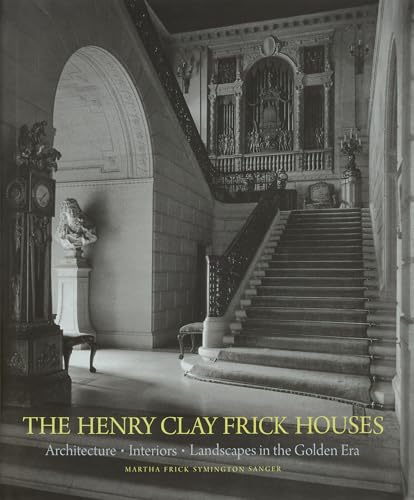

The Henry Clay Frick houses : architecture, interiors, landscapes in the golden era. / Martha Frick Symington Sanger ; foreword by Wendell Garrett. txt
New York : Monacelli Press, 2024Descripción: xiv, 295 p. : ill. ; maps ; plans ; 31 cmTipo de contenido:- text
- unmediated
- volume
- 9781580931045
- 1580931049
- 21 728.8/092
- NA7207 S26 2024
| Imagen de cubierta | Tipo de ítem | Biblioteca actual | Biblioteca de origen | Colección | Ubicación en estantería | Signatura topográfica | Materiales especificados | Info Vol | URL | Copia número | Estado | Notas | Fecha de vencimiento | Código de barras | Reserva de ítems | Prioridad de la cola de reserva de ejemplar | Reservas para cursos | |
|---|---|---|---|---|---|---|---|---|---|---|---|---|---|---|---|---|---|---|
| Libro Col. General CARIBET | CARIBET Biblioteca Arquitectura Colección General CARIBET | General NA7207 S26 2024 (Navegar estantería(Abre debajo)) | 1 | Disponible | 91000000752493 |
Descripciones mejoradas de Syndetics:
Henry Clay Frick, the world-famous art collector and steel tycoon, was a towering figure in America's "gilded age" of the nineteenth and early twentieth centuries. The houses he built for himself and his family exemplify the great residences of the era, with priceless art, cultivated gardens, and interiors by the most prestigious designers of the day.
This elegant volume, written by Frick's great-granddaughter and biographer, features the four major houses purchased, built, and renovated for the steel magnate; each is described in exacting detail, with information about the architects and interior designers, furnishings and art, and decoration. Beautiful archival photographs―interior and exterior, many previously unseen―and architectural drawings document the residences.
The late-Victorian Clayton, in Pittsburgh, was Henry Clay Frick's first home as a married man and the chairman of the Carnegie Steel Company; it now houses the Frick Art and Historical Center. Eagle Rock, the Fricks' summer retreat to the north of Boston, was a neoclassical, all-brick colossus designed by Arthur Little and Herbert W. C. Browne.
The most famous house in the book is 1 East Seventieth Street, along New York's Fifth Avenue. Long recognized as one of the city's most elegant buildings and today housing the world-renowned Frick Collection, it was designed in 1912 by Thomas Hastings of Carrère & Hastings.
The fourth house in the book is the Clayton Estate, a Georgian Revival masterpiece in Roslyn, New York, originally designed in 1901 by Odgen Codman Jr.; it is now the Nassau County Museum of Fine Arts.
Includes bibliographical references (p. 287-289) and index.
Vii Foreword WENDELL GARRETT --
X Preface --
2 INTRODUCTION Beginning: Westmoreland Count, Pennsylvania Influence on the Henry Clay Frick Houses --
14 CHAPTER I Clayton The Residence of Mrs. Henry Clay Frick Pittsburgh, Pennsylvania --
84 CHAPTER II Eagle Rock A Summer Retreat, Boston’s North Shore --
136 CHAPTER III One East Seventieth Street The New York City Residence, The Frick Collection --
218 CHAPTER IV The Clayton Estate The Home of Mr. and Mrs. Childs Frick Long Island, New York --
278 EPILOGUE Endings: Westmoreland Farm The Country Home of Helen Clay Frick --
282 Notes --
285 Glossary --
287 Bibliography --
289 Archival Resources --
290 Acknowledgments --
292 Illustration Credits --
293 Index --
Book interweaves the stories of the lives of Henry Clay Frick, his wife, Adelaide, and their children with the history of the houses in which they lived. Discusses the construction of One East Seventieth Street, the New York home which is today the Frick Collection, and the interior decoration of all the homes the family lived in from the mid-nineteenth to the twentieth century.
Reseñas proporcionadas por Syndetics
Library Journal Review
Frick Symington Sanger offers a 300-page addendum to her biography of her great-grandfather, Henry Clay Frick: An Intimate Portrait (LJ 10/1/98). Here she intersperses biographical details exhaustively explored in her earlier book with colorful and copious commentary on the family mansions and their contents. The four houses examined, the foremost being the Manhattan beaux-arts palace that now houses the Frick collection, were produced by fashionable, academically trained architects and decorators circa 1900, many of whom are the subjects of a resurgence of interest in the wake of Postmodernism. The author has a peculiar critical methodology; she maintains that a vaguely defined pre-World War I period was the "Golden Era" of the arts and that aesthetic choices are somehow determined by deep-seated psychological processes. Bypassing her pop psychology and superficial aesthetic analysis, the reader will uncover an interesting portrayal of one of America's wealthiest industrialists, his heirs, and their extravagant homes. Plentiful photos and illustrations recommend this book to comprehensive architecture and design collections. David Soltsz, Cuyahoga Cty. P.L., Parma, OH (c) Copyright 2010. Library Journals LLC, a wholly owned subsidiary of Media Source, Inc. No redistribution permitted.CHOICE Review
A sumptuous and beautiful volume, this large-format book by one of Frick's great-granddaughters examines four houses commissioned or dramatically modified by the great industrialist and collector, together with briefer discussions of his family's beginnings in Westmoreland County, PA, and his daughter Helen Clay Frick's Westmoreland Farm in Westchester County, NY. With chapters devoted to Clayton, the Frick residence in Pittsburgh; Eagle Rock, the house he built in Pride's Crossing, MA; the New York town house at Fifth Ave. and 70th St., now the Frick Collection; and the Clayton Estate at Roslyn, Long Island, of his son and daughter-in-law, Childs and Frances Frick, the book combines relatively brief histories and descriptions with a wonderful collection of period photographs of exteriors, interiors, and gardens, as well as some architectural drawings. There are source notes at the end of the book, but no footnote numbers in the text. Although there are only four houses discussed here, they are highly representative not only of Frick's taste but of major facets of the architecture and furnishing trends of the very rich in late 19th- and early 20th-century America from Late Victorian and the Colonial Revival to Beaux-Arts Academicism. General readers; lower-division undergraduates through faculty. D. Stillman emeritus, University of DelawareBooklist Review
A paean to ostentatious capitalism and the glory of the golden era of domestic architecture and design (1880 through World War I), Sanger's comprehensive history of steel tycoon and art collector Frick's opulent houses, which easily compete with those of the Vanderbilts and Carnegies, evokes a bygone era of elaborate luxury. A gorgeous coffee-table book, it offers a detailed, even chatty description of the creation of each estate, from Clayton in Pittsburgh to One East Seventieth Street in New York City, accompanied by profuse illustrations from the family's archives. As far as decorative arts go, the Frick collections are fabulous examples of early-twentieth-century styles and taste--ranging from the crowded Victorian to the Beaux Arts school and neoclassical revivals. But this is no ordinary work of scholarship and appreciation: it's written by Frick's great-granddaughter and biographer, who remembers these edifices as homes rather than museum pieces, a viewpoint that serves to bring these palatial residences to life. --Regina SchroederNotas de autor provistas por Syndetics
Martha Frick Symington Sanger is a great-granddaughter of Henry Clay Frick and the author of Henry Clay Frick: An Intimate Portrait . She has spent the last decade researching, writing about, and lecturing on Frick, his art collection, and his personal history. She has given presentations at the Frick Collection in New York and the Victoria and Albert Museum in London. She has also served as a consultant and commentator for the PBS documentary "Andrew Carnegie: The Richest Man in the World."
Wendell Garrett is senior vice president of American decorative arts at Sotheby's and editor-at-large of the magazine Antiques .