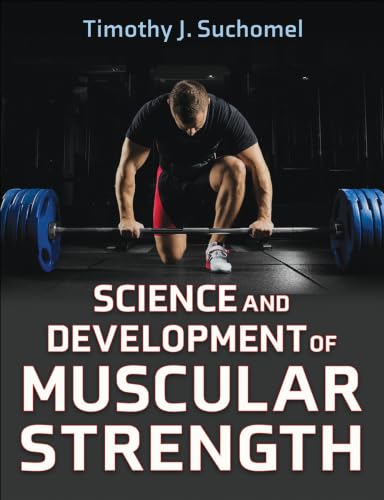

Science and development of muscular strength / Timothy J. Suchomel.
Idioma: Inglés Editor: Champaign, Illinois : Human Kinetics, 2026Descripción: vii, 309 pages : color illustrations; 29 cmTipo de contenido:- text
- unmediated
- volume
- 9781718223660
- 612.7/4 23/eng/20250224
- QP321 .S918 2025
| Imagen de cubierta | Tipo de ítem | Biblioteca actual | Biblioteca de origen | Colección | Ubicación en estantería | Signatura topográfica | Materiales especificados | Info Vol | URL | Copia número | Estado | Notas | Fecha de vencimiento | Código de barras | Reserva de ítems | Prioridad de la cola de reserva de ejemplar | Reservas para cursos | |
|---|---|---|---|---|---|---|---|---|---|---|---|---|---|---|---|---|---|---|
| Libro | Biblioteca Encarnación Valdés Colección General bev | 612.76 S9428s 2026 (Navegar estantería(Abre debajo)) | Disponible | 80000002665902 |
Descripciones mejoradas de Syndetics:
Science and Development of Muscular Strength is the ultimate guide for anyone looking to understand, build, and optimize muscular strength for peak performance.
Written by Timothy J. Suchomel, PhD, a leading authority on muscular strength, Science and Development of Muscular Strength eliminates the need to consult multiple resources to understand the evolving definitions of strength as well as its crucial role in athletic success. With over 2,500 references across 12 chapters, this text is the most comprehensive resource on muscular strength.
Designed to be applicable for all levels of knowledge, the book includes helpful features to improve the reading experience: Figures that depict the application of strength during different performance tasks Tables that identify the key factors of programs designed to maximize muscular strength Key Points within each chapter to aid comprehension Take-Home Points at the end of each chapter that highlight important content Comprehensive subject and author indexes to optimize use as a reference tool Dive into the science behind training adaptations, from neuromuscular responses to genetic factors, and discover the key mechanisms that drive strength gains. You will learn to build effective, adaptable programs; tailor conditioning methods; and leverage powerful strategies for concurrent training. With methods for assessing strength, optimizing training loads, integrating evidence-based approaches for measurable results, and more, this resource has it all.
Science and Development of Muscular Strength is your go-to resource for research-based guidelines and practical recommendations to develop strength.
Earn continuing education credits/units! A continuing education exam that uses this book is also available. It may be purchased separately or as part of a package that includes both the book and exam.
Includes bibliographical references and index.
Defining strength -- Strength-related responses and adaptations to training -- Mechanisms of strength -- Principles and organization of training -- Training methods -- Advanced training methods -- Program design -- Concurrent training -- Measuring strength -- Monitoring and adjusting training loads -- Nutritional considerations for muscular strength -- Recovery considerations for strength.
"Science and Development of Muscular Strength describes the science behind training adaptations, and readers discover the key mechanisms that drive strength gains. The audience includes strength and conditioning professionals as well as researchers and scientists studying muscular strength, including upper-level undergraduate or graduate Exercise Science students"-- Provided by publisher.
Tabla de contenidos provista por Syndetics
- Acknowledgments(vii)
- Chapter 1 Defining Strength(1)
- The History of Strength Competitions(1)
- Definitions of Strength(2)
- The Importance of Strength Within Sport(5)
- Redefining Strength(8)
- Strength Definition(9)
- Chapter 2 Strength-Related Responses and Adaptations to Training(13)
- Neuromuscular System(13)
- General Adaptation Syndrome(19)
- Fitness-Fatigue Paradigm(19)
- Timeline of Adaptation(20)
- Adaptations to Training(20)
- Influence of Training Stimuli on Strength Adaptations(24)
- Impact of the Training Year(26)
- Detraining(27)
- External Stressors(28)
- Chapter 3 Mechanisms of Strength(29)
- Genetics and Epigenetics (Nature and Nurture)(29)
- Fiber Type(30)
- Neuromuscular Factors(31)
- Neuroendocrine System(34)
- Muscle Architecture(36)
- Motor Learning and Skill Acquisition(40)
- Chapter 4 Principles and Organization of Training(45)
- Training Principles(45)
- Organization of Training(51)
- Chapter 5 Training Methods(57)
- Types of Training(57)
- Additional Training Methods(69)
- Chapter 6 Advanced Training Methods(75)
- Relative Strength Levels(75)
- Potentiation Complexes(75)
- Variable Resistance Training(80)
- Accentuated Eccentric Loading(84)
- Chapter 7 Program Design(93)
- Needs Analysis(93)
- Programming Variables(94)
- Training Age(109)
- Training Year(110)
- Overall Training Approach(111)
- Chapter 8 Concurrent Training(113)
- The Interference Effect(113)
- Conditioning Methods(116)
- Concurrent Training Programming Considerations(120)
- Practical Application(122)
- Chapter 9 Measuring Strength(125)
- Rationale for Measuring Strength(125)
- Strength Testing Considerations(126)
- Types of Strength Testing(128)
- Combined Assessment Methods(141)
- Timing of Testing(144)
- Integration of Sport Science and Evidence-Based Practice(145)
- Chapter 10 Monitoring and Adjusting Training Loads(147)
- Monitoring and Load Adjustment Methods(147)
- Motor Learning and Skill Acquisition Monitoring(158)
- Additional Considerations for Monitoring and Load Adjustment(159)
- Chapter 11 Nutritional Considerations for Muscular Strength(161)
- Energy Balance(161)
- Macronutrients(162)
- Micronutrients(167)
- Antioxidants(171)
- Hydration(171)
- Ergogenic Aids(172)
- Periodization of Nutrition(177)
- Monitoring Nutrition(178)
- Chapter 12 Recovery Considerations for Strength(181)
- Recovery Methods(182)
- Mental Fatigue and Recovery(189)
- The Placebo Effect(191)
- Periodization of Recovery(192)
- Measuring Recovery(192)
- References(195)
- Subject Index(279)
- Author Index(283)
- About the Author(309)
- Earn Continuing Education Credits/Units(310)
Notas de autor provistas por Syndetics
Timothy J. Suchomel, PhD, CSCS,*D, RSCC,*D, mISCP, is an associate professor and the director of the sports science master's program at the University of Pittsburgh. He has published over 110 peer-reviewed journal articles on topics such as strength and power development, weightlifting movements and their derivatives, eccentric training methods, postactivation potentiation, and athlete monitoring.Suchomel has served the National Strength and Conditioning Association (NSCA) as the chair of the Sport Science Special Interest Group, the Wisconsin state director, and a research committee member, and he currently serves as senior associate editor of the Journal of Strength and Conditioning Research and associate editor for Strength and Conditioning Journal . He was honored by the NSCA with the State/Provincial Director of the Year Award in 2019, the Terry J. Housh Outstanding Young Investigator Award in 2022, and the Journal of Strength and Conditioning Research Editorial Excellence Award in 2023. Suchomel is a certified strength and conditioning specialist with distinction (CSCS,*D) and a registered strength and conditioning coach with distinction (RSCC,*D) through the NSCA and has been recognized as a master international strength and conditioning practitioner (mISCP) through the International Universities Strength and Conditioning Association (IUSCA).
Suchomel completed his bachelor's degree in kinesiology at the University of Wisconsin-Oshkosh in 2010, master's degree in human performance at the University of Wisconsin-La Crosse in 2012, and doctoral degree in sport physiology and performance at East Tennessee State University in 2015.