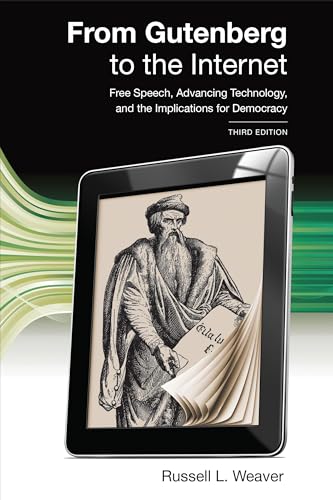

From Gutenberg to the internet : free speech, advancing technology, and the implications for democracy / Russell L. Weaver.
Editor: Durham, North Carolina : Carolina Academic Press, 2025Edición: Third editionDescripción: xi, 525 pages ; 23 cmTipo de contenido:- text
- unmediated
- volume
- 9781531032890
- JA 85 .W43 2025
| Imagen de cubierta | Tipo de ítem | Biblioteca actual | Biblioteca de origen | Colección | Ubicación en estantería | Signatura topográfica | Materiales especificados | Info Vol | URL | Copia número | Estado | Notas | Fecha de vencimiento | Código de barras | Reserva de ítems | Prioridad de la cola de reserva de ejemplar | Reservas para cursos | |
|---|---|---|---|---|---|---|---|---|---|---|---|---|---|---|---|---|---|---|
| Libro | Biblioteca de Derecho Mons. Fremiot Torres Oliver Colección General biblioteca derecho | JA 85 .W43 2025 (Navegar estantería(Abre debajo)) | c. 1 | Disponible | 70000000906236 |
Descripciones mejoradas de Syndetics:
The history of free expression is inextricably intertwined with advances in speech technology. However, until recently, most forms of communication were limited and controlled by so-called "gatekeepers" who had the power to limit or control the ability of ordinary individuals to communicate with each other. With the advent of the Internet and new forms of technology, people have much greater capacity to communicate with each other. Although both governments and private entities have attempted to control discourse over the Internet, new technologies have enabled ordinary individuals to more easily communicate with each other and to participate in the political process.
This greatly expanded new edition provides an up-to-date examination of how advancing technologies are implicating the democratic process. In addition to tracing the history and evolution of speech technologies, it examines how burgeoning social media -- including Musk's takeover of Twitter (X) -- has impacted traditional media (e.g., newspapers, radio and television), as well as its effects on political campaigns. New chapters on disinformation, robotic speech, bots and chatbots are included.
Includes bibliographical references and index.
Early communication -- The Gutenberg revolution -- The emergence of "gatekeepers" : public and private -- The development of electricity brings an explosion of new communications technologies -- Electronic (non-internet) gatekeepers -- The internet -- The implications of the internet for democracy -- The internet, governmental repression, and the emergence of new gatekeepers -- Disinformation -- The rise of bots and artificial intelligence -- The internet's impact on traditional media
"The history of free expression is inextricably intertwined with advances in speech technology. However, until recently, most forms of communication were limited and controlled by so-called "gatekeepers" who had the power to limit or control the ability of ordinary individuals to communicate with each other. With the advent of the Internet and new forms of technology (e.g., personal computers, iPhones, etc.), people have much greater capacity to communicate with each other. Although both governments and private entities have attempted to control discourse over the Internet, new technologies have enabled ordinary individuals to more easily communicate with each other and to participate in the political process. As a result, the Internet is reshaping political debate and political action all over the world"--Back cover.