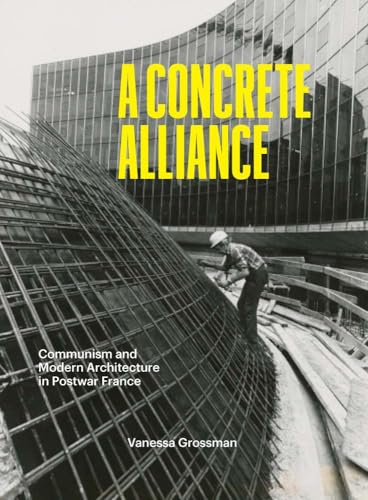

A concrete alliance : communism and modern architecture in postwar France. / Vanessa Grossman. txt
Editor: New Haven ; London : Yale University Press, 2024Descripción: xi, 276 p. : ill. ; col. ; plans ; 26 cmTipo de contenido:- text
- still image
- unmediated
- volume
- 0300259344
- 9780300259346
- NA1048.5.M63 G76 2024
| Imagen de cubierta | Tipo de ítem | Biblioteca actual | Biblioteca de origen | Colección | Ubicación en estantería | Signatura topográfica | Materiales especificados | Info Vol | URL | Copia número | Estado | Notas | Fecha de vencimiento | Código de barras | Reserva de ítems | Prioridad de la cola de reserva de ejemplar | Reservas para cursos | |
|---|---|---|---|---|---|---|---|---|---|---|---|---|---|---|---|---|---|---|
| Libro Col. General CARIBET | CARIBET Biblioteca Arquitectura Colección General CARIBET | General NA1048.5.M63 G76 2024 (Navegar estantería(Abre debajo)) | 1 | Disponible | 91000000751644 |
Descripciones mejoradas de Syndetics:
The compelling story of the significant relationship between communism and modern architecture in postwar France
The massive reshaping of French cities that took place between 1958 and 1981 is commonly regarded as a unique episode in which modernist ideals were tested on an unprecedented scale. Yet the history of postwar French modernism has never fully accounted for the influence of one of architecture's most important institutional patrons, the French Communist Party (PCF). Drawing political theory and architectural history into conversation, Vanessa Grossman probes the shifting but enduring alliance between modern architecture and the PCF in the aftermath of the political crisis of 1958, prompted by the Algerian War of Independence and Charles de Gaulle's rise to power.
Focusing on key episodes, Grossman discusses the work of Renée Gailhoustet (a rare female architect of her generation), Jean Renaudie, and members of the Atelier d'urbanisme et d'architecture (AUA), in collaboration with architectural elders such as Jean Prouvé and Oscar Niemeyer, who self-exiled to France, and in relation to contemporary Marxist thinkers such as philosophers Louis Althusser and Henri Lefebvre. Grossman exposes how communist politics and architectural modernism were mutually reinforcing ideologies that circulated in France across national and international networks of architects, urban planners, civil servants, intellectuals, activists, and politicians. Offering a new understanding of the postwar realization that architecture, particularly housing, could be employed as a political tool, this highly original book reveals the meaningful dialogue between French communism and architectural modernism.
Includes bibliographical references and index.
Acknowledgments vi –
List of Abbreviations x –
Introduction: Communism and Architectural Modernism 1 –
Chapter 1 Networks: Toward a Countersociety of Architects 25 –
Chapter 2 Programs: Theater, Public Works, Resistance, and the New Brutalism, (1958 68) 47—
Chapter 3 Monuments: Party Headquarters Architecture and Aggiornamento in Paris, (1965 71) 91 –
Chapter 4 Landscapes: Technique over Politics, or On Urbanism and Factories, (1972 74) 139 –
Chapter 5 Systems: Revisions and the Crisis of Representation in Ivry sur Seine’s City Center Urban Renewal, (1974 81) 183 –
Epilogue: From Militant to Classic 232 –
Notes 242 –
Credits 266 –
Index 268 --
"The massive reshaping of French cities that took place between 1958 and 1981 is commonly regarded as a unique episode in which modernist ideals were tested on an unprecedented scale. Yet the history of postwar French modernism has never fully accounted for the influence of one of architecture's most important institutional patrons, the French Communist Party (PCF). Drawing political theory and architectural history into conversation, Vanessa Grossman probes the shifting but enduring alliance between modern architecture and the PCF in the aftermath of the political crisis of 1958, prompted by the Algerian War of Independence and Charles de Gaulle's rise to power. Focusing on key episodes, Grossman discusses the work of Renée Gailhoustet (a rare female architect of her generation), Jean Renaudie, and members of the Atelier d'urbanisme et d'architecture (AUA), in collaboration with architectural elders such as Jean Prouvé and Oscar Niemeyer, who self-exiled to France, and in relation to contemporary Marxist thinkers such as philosophers Louis Althusser and Henri Lefebvre. Grossman exposes how communist politics and architectural modernism were mutually reinforcing ideologies that circulated in France across national and international networks of architects, urban planners, civil servants, intellectuals, activists, and politicians. Offering a new understanding of the postwar realization that architecture, particularly housing, could be employed as a political tool, this highly original book reveals the meaningful dialogue between French communism and architectural modernism"--