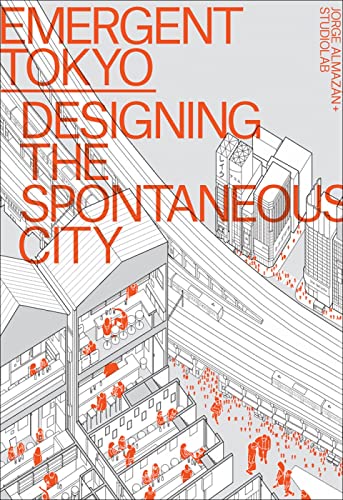

Emergent Tokyo : designing the spontaneous city. / Jorge Almazán + Studiolab. txt
Editor: Novato, California : ORO Editions, 2024Descripción: 223 p. : ill. ; col. ; maps ; 21 cmTipo de contenido:- text
- still image
- unmediated
- volume
- 9781951541323
- 1951541324
- 23 307.1/160952135
- HT169.J3 A46 2024
| Imagen de cubierta | Tipo de ítem | Biblioteca actual | Biblioteca de origen | Colección | Ubicación en estantería | Signatura topográfica | Materiales especificados | Info Vol | URL | Copia número | Estado | Notas | Fecha de vencimiento | Código de barras | Reserva de ítems | Prioridad de la cola de reserva de ejemplar | Reservas para cursos | |
|---|---|---|---|---|---|---|---|---|---|---|---|---|---|---|---|---|---|---|
| Libro Col. General CARIBET | CARIBET Biblioteca Arquitectura Colección General CARIBET | General HT169.J3 A46 2024 (Navegar estantería(Abre debajo)) | 1 | Disponible | 91000000751420 |
Descripciones mejoradas de Syndetics:
Tokyo is one of the most vibrant and livable cities on the planet, a megacity that somehow remains intimate and adaptive. Compared to Western metropolises like New York or Paris, however, few outsiders understand Tokyo's inner workings. For cities around the globe mired in crisis and seeking new models for the future, Tokyo's success at balancing between massive growth and local communal life poses a challenge: can we design other cities to emulate its best qualities?
This book demystifies Tokyo's emergent urbanism for an international audience, explaining its origins, its place in today's Tokyo, and its role in the Tokyo of tomorrow. Visitors to Japan, architects, and urban policy practitioners alike will come away with a fresh understanding of the world's premier megacity--and a practical guide for how to bring Tokyo-style intimacy, adaptability, and spontaneity to other cities around the world.
Includes bibliographical references.
Machine generated contents note: 1. Introduction: Why Tokyo? --
1.1. The city that inspires the world --
1.2. Tokyo at a dangerous crossroads --
1.3. Glimpsing Tokyo's future through its postwar past --
1.4. A field guide to several different Tokyos --
1.5. The urban fabrics that nurture emergent Tokyo --
1.6. Beyond exotic mystery and glamorous chaos --
1.7. Emergence: a new lens for understanding Tokyo --
2. Yokocho Alleyways --
2.1. An alleyway that's designed to be explored --
2.2. What defines a yokocho? --
2.3. Clandestine origins, uncertain future --
2.4. The yokocho revival --
2.5. The world's densest bar district: Golden Gai --
2.6. Shibuya's hidden Nombei Yokocho --
2.7. Yanagi Koji in Nishi-Ogikubo --
2.8. Learning from yokocho alleyways --
Case 01 Golden Gai --
Case 02 Nombei Yokocho --
Case 03 Yanagi Koji --
3. Zakkyo Buildings --
3.1. The iconic buildings that no one talks about --
3.2. What makes a building zakkyo? --
3.3. How does a building become a zakkyo building? --
3.4. The iconic zakkyo of Yasukuni Avenue --
3.5. Kagurazaka's zakkyo buildings have an Edo legacy --
3.6. The Karasumori zakkyo block in Shimbashi --
3.7. Learning from zakkyo buildings --
Case 04 Yasukuni Avenue --
Case 05 Kagurazaka Street --
Case 06 Karasumori Block --
4. Undertrack Infills --
4.1. What lies beneath --
4.2. A century of undertrack spaces --
4.3. Ameyoko: old-school shopping under the railways --
4.4. Koenji: finding the slow life in a fast city --
4.5. Ginza Corridor: courtship under the expressway --
4.6. Learning from undertrack infills --
Case 07 Ameyoko --
Case 08 Koenji --
Case 09 Ginza Corridor --
5. Ankyo Streets --
5.1. The flowing streets of Tokyo --
5.2. The campaign to make Japanese street life boring --
5.3. Ankyo river streets in history --
5.4. Mozart-Brahms Lane: Harajuku's linear oasis --
5.5. Yoyogi Lane: portrait of a communal backstreet --
5.6. The inclusive Kuhombutsu Promenade --
5.7. Learning from ankyo streets --
Case 10 Mozart-Brahms Lane --
Case 11 Yoyogi Lane --
Case 12 Kuhombutsu Promenade -
6. Dense Low-Rise Neighborhoods --
6.1. An ocean of houses --
6.2. How dense, how low? A working definition --
6.3. The joys of dense, low-rise neighborhoods --
6.4. The origins of a delicate balance --
6.5. Higashi-Nakanobu: ordinary in the best sense --
6.6. Tsukishima: spontaneity in the grid --
6.7. North Shirokane: the beauty of urban diversity --
6.8. Learning from dense low-rise neighborhoods --
Case 13 Higashi-Nakanobu --
Case 14 Tsukishima --
Case 15 North Shirokane --
7. Tokyology --
7.1. A chronology of thinking about Tokyo --
7.2. Self-orientalism: nihonjinron in Tokyology --
7.3. Charting a new critical approach to Tokyo --
8. A Tokyo Model Of Emergent Urbanism --
8.1. Tokyo's rising corporate-led urbanism --
8.2. Tokyo's corporate urban centers: what fails and why --
8.3. Safety as a pretext for homogenization --
8.4. Emergent urbanism versus corporate-led urbanism --
8.5. Designing the conditions of emergence --
This book examines the urban fabric of contemporary Tokyo as a valuable demonstration of permeable, inclusive, and adaptive urban patterns that required neither extensive master planning nor corporate urbanism to develop. These urban patterns are emergent: that is, they are the combined result of numerous modifications and appropriations of space by small agents interacting within a broader socio-economic ecosystem. Together, they create a degree of urban intensity and liveliness that is the envy of the world's cities. This book examines five of these patterns that appear conspicuously throughout Tokyo: yokocho alleyways, multi-tenant zakkyo buildings, undertrack infills, low-rise dense neighborhoods, and the river-like ankyo streets. Unlike many of the discussions on Tokyo that emphasize cultural uniqueness, this book aims at transcultural validity, with a focus on empirical analysis of the spatial and social conditions that allow these patterns to emerge. The authors of 'Emergent Tokyo' acknowledge the distinct character of Tokyo without essentializing or fetishizing it, offering visitors, architects, and urban policy practitioners an unparalleled understanding of Tokyo's urban landscape.