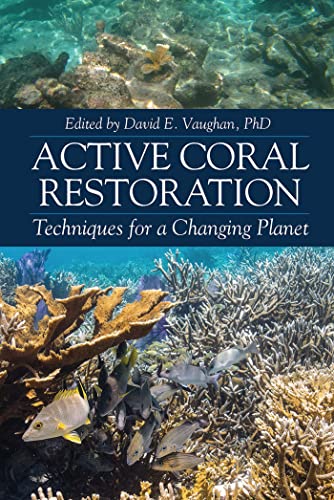

Active coral restoration : techniques for a changing planet / edited by David E. Vaughan, PhD.
Idioma: Inglés Editor: Plantation, Florida : J. Ross Publishing, 2021Descripción: xxiii, 609 pages : illustrations ; 26 cmTipo de contenido:- text
- unmediated
- volume
- 9781604271430
- 578.7789 23
- QH541.5.C7 A28 2021
| Imagen de cubierta | Tipo de ítem | Biblioteca actual | Biblioteca de origen | Colección | Ubicación en estantería | Signatura topográfica | Materiales especificados | Info Vol | URL | Copia número | Estado | Notas | Fecha de vencimiento | Código de barras | Reserva de ítems | Prioridad de la cola de reserva de ejemplar | Reservas para cursos | |
|---|---|---|---|---|---|---|---|---|---|---|---|---|---|---|---|---|---|---|
| Libro | Biblioteca Encarnación Valdés Colección General bev | 578.7789 A1885 2021 (Navegar estantería(Abre debajo)) | Disponible | 80000002660606 |
Descripciones mejoradas de Syndetics:
Restore and protect coral reefs with proven, cutting-edge techniques.
Active Coral Restoration: Techniques for a Changing Planet offers professionals, researchers, and students a comprehensive guide to the latest coral reef restoration methods. Learn how to combat climate change, pollution, and other threats with active intervention.
Discover the history and evolution of coral reef restoration. Explore biological considerations and methodologies for coral propagation. Review case studies from around the world. Examine emerging technologies for the future of coral reef restoration.Edited by David E. Vaughan, this essential resource provides the knowledge and tools needed to actively restore and ensure the resilience of coral reefs.
Includes bibliographical references and index.
"Active Coral Restoration: Techniques for a Changing Planet is a timely, comprehensive volume that provides a foundational understanding of the current and emerging practices and technologies used for active coral reef restoration projects around the world. Edited by David E. Vaughan, this work contains contributed chapters written by some of the foremost authorities on coral reef restoration. It is a must have for all practitioners of coral reef restoration, including research scientists, resource managers, aquarists, volunteers, students of marine science, and policy makers"--
Tabla de contenidos provista por Syndetics
- Foreword(p. xv)
- About the Editor(p. xvii)
- Contributing Authors(p. xix)
- Acknowledgments(p. xxiii)
- WAV™ page(p. xxv)
- Section I Overview(p. 1)
- 1 Introduction(p. 5)
- References(p. 5)
- 2 History of Reef Restoration(p. 7)
- Introduction(p. 7)
- Coral Reefs(p. 8)
- Coral Restoration(p. 8)
- Indigenous People and Reef Restoration(p. 10)
- Scientific Pioneers of Reef Restoration(p. 10)
- Management Support for Coral Reef Restoration(p. 16)
- Communication and Education on Reef Restoration(p. 17)
- The Role of Private Business in Reef Restoration(p. 19)
- Global Literature Review(p. 21)
- Discussion(p. 26)
- Conclusions(p. 27)
- Recommended Future Research and Goals(p. 28)
- Acknowledgments(p. 28)
- References(p. 28)
- 3 The Quandary of Active and Passive Reef Restoration in a Changing World(p. 31)
- What Is Ecological Restoration?(p. 31)
- Active and Passive Restoration-the Path of Silviculture(p. 33)
- The Path of Active and Passive Restoration in Coral Reefs(p. 35)
- Quandary and Solution for Active Reef Restoration(p. 37)
- Acknowledgments(p. 38)
- References(p. 38)
- 4 Live Rock Farmer to Live Coral Farmer(p. 43)
- Introduction(p. 43)
- Early History: The Passion for Coral Reefs(p. 43)
- Catastrophic Changes(p. 44)
- The Live Rock Farm(p. 45)
- The Coral Farm(p. 48)
- Coral Reef Restoration(p. 51)
- A Coral Farm Becomes a Coral Nursery(p. 52)
- Starting the Coral Restoration Foundation(p. 60)
- Developing the Coral Tree Nursery Design(p. 62)
- Taking It to the Next Level(p. 64)
- Conclusions(p. 65)
- Recommended Future Research(p. 66)
- Acknowledgments(p. 67)
- Section II Biological Considerations and Methodologies(p. 69)
- 5 Land and Field Nurseries(p. 71)
- Introduction(p. 71)
- Locations for Nurseries(p. 73)
- Area Required(p. 74)
- Equipment(p. 74)
- Supplies and Materials(p. 77)
- Designs, Plans, Drawings, and Layouts(p. 80)
- Fouling-Maintenance and Cleaning(p. 81)
- Label Everything(p. 81)
- Measuring the Growth of Corals(p. 84)
- Production Capacity(p. 85)
- Vessels and Vehicles(p. 86)
- Safety Concerns(p. 86)
- Least Ecological Impact(p. 86)
- Discussion and Future Work(p. 87)
- Acknowledgments(p. 87)
- References(p. 87)
- 6 Asexual Coral Propagation-Fragmentation and Micro-Fragmentation(p. 89)
- Introduction(p. 90)
- Micro-Fragmentation(p. 95)
- New Ways of Fragmenting(p. 99)
- Conclusions(p. 101)
- Recommended Future Research and Future Techniques(p. 101)
- Acknowledgments(p. 102)
- References(p. 102)
- 7 Coral Fusion: Harnessing Coral Clonality for Reef Restoration(p. 103)
- Introduction(p. 103)
- Coral Re-Skinning(p. 104)
- Natural or Artificial Coral Modules(p. 107)
- Tiling the Reef(p. 108)
- Coral Seedlings(p. 109)
- Fusion in Land Nurseries(p. 110)
- Fusion in Field Nurseries(p. 111)
- The Fusion Process(p. 112)
- Fusion or Confusion: To Fuse or Not to Fuse?(p. 114)
- Sexual or Asexual: To Clone or Not to Clone?(p. 115)
- Speeding up Sexual Maturity with Micro-Fragmentation(p. 116)
- Fusion for Genetic Crosses(p. 117)
- Conclusions(p. 118)
- Acknowledgments(p. 119)
- References(p. 119)
- 8 Sexual Reproduction and Rearing Corals for Restoration(p. 123)
- Introduction(p. 123)
- Sexual Reproduction of Corals(p. 128)
- Larval Culture, Settlement, and Post-Metamorphosis(p. 129)
- Larval Development(p. 130)
- Settlement and Metamorphosis(p. 132)
- Multiple Settlement and Survival(p. 135)
- Post-Settlement Care(p. 136)
- Grow Out to Juvenile Size(p. 137)
- Nursery Growth to a Juvenile and Raceway Ecology(p. 138)
- Managing Raceway Ecology(p. 140)
- Conclusions(p. 141)
- References(p. 141)
- 9 Assisted Evolution and Coral Reef Resilience(p. 145)
- Introduction(p. 146)
- Assisted Evolution Approaches: Acclimatization (Nongenetic) Processes(p. 154)
- Experimental Evolution of Algal Endosymbionts (Symbiodiniaceae)(p. 161)
- Manipulating the Host Microbiome(p. 168)
- Interspecific Hybridization(p. 177)
- Intraspecific Managed Breeding and Genetic Adaptation(p. 184)
- Conclusions(p. 200)
- Acknowledgments(p. 201)
- References(p. 201)
- 10 Genetic Considerations for Coral Reef Restoration(p. 221)
- Introduction(p. 222)
- The Need for an Evolutionary Perspective Within Coral Reef Restoration(p. 225)
- Factors That Could Drive Reductions in Fitness During Restoration Activities(p. 229)
- Recommendations(p. 237)
- The Coral Holobiont and Role of Algal Symbionts(p. 255)
- Molecular Tools(p. 257)
- Conclusions(p. 261)
- Acknowledgments(p. 263)
- References(p. 263)
- Section III Case Studies From Around the World(p. 285)
- 11 Belize: Fragments of Hope(p. 287)
- Introduction(p. 288)
- Laughing Bird Caye National Park Experience(p. 288)
- Current Techniques and Methods(p. 304)
- Community Involvement(p. 308)
- Next Steps(p. 309)
- Conclusion(p. 311)
- Acknowledgments(p. 311)
- References(p. 312)
- 12 Indian Ocean: Seychelles(p. 313)
- Introduction(p. 313)
- Large-Scale Coral Reef Restoration Project in Seychelles(p. 315)
- Small-Scale Coral Reef Restoration Projects in Seychelles(p. 324)
- Biomimicry Applications and Inventions(p. 326)
- Capacity Building: Empowering the End User(p. 333)
- Summary(p. 334)
- Recommended Future Research(p. 335)
- Acknowledgments(p. 336)
- References(p. 336)
- 13 Active Coral Reef Restoration In Eilat, Israel: Reconnoitering the Long-Term Prospectus(p. 341)
- Introduction(p. 342)
- Techniques and Methods(p. 345)
- Monitoring(p. 349)
- Community Involvement, Volunteers, and Citizen Science(p. 351)
- Major Outcomes and Discussion(p. 354)
- Conclusions(p. 360)
- Acknowledgments(p. 361)
- References(p. 361)
- 14 Active Reef Restoration in the Mexican Caribbean: 15-Year Timeline(p. 365)
- Introduction(p. 366)
- Techniques and Methods(p. 367)
- 2004-2005 Period(p. 367)
- 2005-2009 Period(p. 369)
- 2009-2011 Period(p. 370)
- 2012-2016 Period(p. 371)
- 2017-2022 Period(p. 377)
- Monitoring the Effectiveness of Restoration Actions(p. 386)
- Community Involvement, Volunteers, and Citizen Science(p. 387)
- Discussion(p. 389)
- Conclusions(p. 389)
- Acknowledgments(p. 391)
- References(p. 391)
- 15 Active Coral Reef Restoration in Australia(p. 393)
- Introduction(p. 394)
- Techniques and Methods(p. 394)
- Agincourt Reef, Cairns 2003(p. 397)
- Manta Ray Bay, Whitsunday Islands 2017(p. 397)
- Fitzroy Island, Cairns 2017-2019(p. 397)
- Blue Pearl and Manta Ray Bay, Whitsunday Islands 2018-2020(p. 400)
- Agincourt Reef #3, Cairns 2018-2020(p. 401)
- Lovers Cove, Daydream Island, Whitsundays 2019(p. 402)
- Vlasoff and Arlington Reef, Cairns 2018-2019(p. 404)
- Monitoring(p. 404)
- Community Involvement, Volunteers, and Citizen Science(p. 407)
- Governance Overview(p. 410)
- Permits and Guidelines(p. 411)
- The Reef Restoration and Adaptation Program(p. 413)
- Discussion(p. 414)
- Conclusion(p. 415)
- Acknowledgments(p. 415)
- References(p. 416)
- 16 Reef Restoration in the Eastern Tropical Pacific, a Case Study in Golfo Duke, Costa Rica(p. 417)
- Introduction(p. 417)
- Techniques and Methods(p. 420)
- Monitoring(p. 422)
- Community Involvement, Volunteers, and Citizen Science(p. 427)
- Discussion(p. 427)
- Conclusion(p. 428)
- Acknowledgments(p. 428)
- References(p. 428)
- 17 Line Islands, Kiribati(p. 431)
- Introduction(p. 431)
- Coral Nursery Establishment(p. 433)
- Larval-Based Coral Recruitment(p. 436)
- May 2017 Nursery Expansion Using Threatened Acropora Recruits(p. 438)
- The Discovery of Regenerating Coral Colonies via Surviving Tissue Fragments(p. 440)
- Tabuaeran Findings(p. 443)
- Discovery of Surviving Staghorn Corals on a Kiritimati Reef Flat(p. 446)
- Outplanting of Corals from the Nursery(p. 449)
- Discussion(p. 453)
- Proposed 500-Meter No-Go and No-Fishing Area Around Cook Islet(p. 455)
- Coral Reef Restoration Strategy for Kiribati(p. 457)
- Corals for Conservation's Coral Reef Restoration for Climate Change Adaptation Strategy(p. 459)
- Acknowledgments(p. 461)
- References(p. 462)
- 18 Indonesia: Mars Assisted Reef Restoration System(p. 463)
- Introduction(p. 464)
- The Restoration Site and the Specific Restoration Problem(p. 465)
- The MARRS Approach(p. 467)
- The Reef Stars(p. 467)
- The Restoration Build(p. 468)
- Monitoring the Performance of the MARRS Technique(p. 473)
- Brief Overview of Ecological Response to Restoration(p. 477)
- Future Restoration and Achieving Scale Through Catalyzing Action(p. 479)
- Acknowledgments(p. 481)
- References(p. 481)
- 19 Hurricane Impacts on Reef Restoration: The Good, the Bad and the Ugly(p. 483)
- Introduction(p. 484)
- Methods(p. 485)
- Results(p. 492)
- Lessons Learned: Damage Prevention Strategies(p. 505)
- Conclusions(p. 507)
- References(p. 509)
- 20 Bolstering Reef Restoration Efforts: A Multifaceted Approach from Reef Renewal Foundation Bonaire(p. 511)
- Introduction(p. 511)
- Techniques and Methods(p. 516)
- New Techniques: Boulder Corals and Larval Propagation(p. 521)
- Monitoring(p. 524)
- Community Involvement, Volunteers, and Citizen Science (If Applicable)(p. 528)
- Discussion(p. 530)
- Conclusion-Words of Wisdom from the Case Study(p. 533)
- Acknowledgments(p. 533)
- References(p. 534)
- 21 Punta Cana, Dominican Republic(p. 535)
- Introduction(p. 536)
- Coral Restoration in Punta Cana(p. 537)
- Center for Marine Innovation (CIM)(p. 543)
- Dominican Consortium of Coastal Restoration(p. 544)
- The Nature Conservancy(p. 544)
- The Marine Sanctuary Arrecifes del Sureste(p. 545)
- Discussion and Conclusions(p. 547)
- Acknowledgments(p. 547)
- References(p. 547)
- Section IV The Future of Coral Reef Restoration(p. 549)
- 22 Emerging Technologies(p. 551)
- Introduction(p. 551)
- New Ways of Fragmenting(p. 552)
- Revisting Fragment Size(p. 555)
- Revisiting Fragment Growth Rate(p. 555)
- Feeds and Supplements for Coral Growth(p. 555)
- Increasing the Survival of Sexual Reproduction(p. 556)
- Vessels and Vehicles Used in Active Coral Restoration(p. 557)
- Substrates and Adhesives for Coral Attachment(p. 557)
- Modules and Components for Transportation(p. 558)
- Innovative and Emerging Coral Nurseries(p. 558)
- Increasing Coral Production at Scale(p. 561)
- Selective Rapid Growth Cycle(p. 564)
- Conclusion(p. 566)
- Acknowledgments(p. 566)
- Reference(p. 566)
- 23 Making Restoration Meaningful: A Vision for Working at Multiple Scales to Help Secure a Future for Coral Reefs(p. 567)
- Introduction(p. 567)
- The Value of Restoration Efforts at Various Scales(p. 569)
- Conclusions(p. 576)
- Disclaimer(p. 576)
- References(p. 576)
- Epilogue(p. 581)
- Appendix: Notes for Record Keeping(p. 583)
- Why Keep Records?(p. 583)
- Daily Environmental Records(p. 583)
- Land-Based Nursery Records(p. 584)
- Outplantings and Field Nursery Records(p. 585)
- Costs of Operation(p. 586)
- Conclusions(p. 586)
- Acknowledgments(p. 586)
- References(p. 587)
- Appendix 1A Record of Daily Environmental Data(p. 588)
- Appendix 1B Record for Daily Raceway Maintenance(p. 589)
- Appendix 1C Monthly Record for Coral Growth and Health(p. 590)
- Appendix 1D Record for Mechanical Maintenance at Land Based Nursery(p. 591)
- Appendix 1E Record for Field Nursery/Outplant Site for Coral Growth and Health(p. 592)
- Glossary(p. 593)
- Index(p. 601)