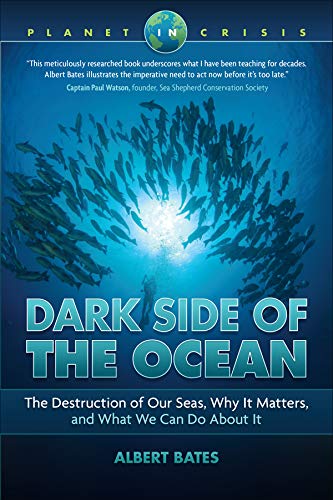

Dark side of the ocean : the destruction of our seas, why it matters, and what we can do about it / Albert Bates.
Idioma: Inglés Editor: Summertown, Tennessee : GroundSwell Books, [2020]Descripción: vii, 158 pages : illustrations, maps ; 23 cmTipo de contenido:- text
- unmediated
- volume
- 9781570673948
- 333.95/616 23
- QH91.8.B6 B38 2020
| Imagen de cubierta | Tipo de ítem | Biblioteca actual | Biblioteca de origen | Colección | Ubicación en estantería | Signatura topográfica | Materiales especificados | Info Vol | URL | Copia número | Estado | Notas | Fecha de vencimiento | Código de barras | Reserva de ítems | Prioridad de la cola de reserva de ejemplar | Reservas para cursos | |
|---|---|---|---|---|---|---|---|---|---|---|---|---|---|---|---|---|---|---|
| Libro | Biblioteca Encarnación Valdés Colección General bev | 333.95616 B3291d 2020 (Navegar estantería(Abre debajo)) | Disponible | 80000002660747 |
Descripciones mejoradas de Syndetics:
Our oceans face levels of devastation previously unknown in human history--from pollution, from overfishing, and through damage to delicate aquatic ecosystems affected by global warming. Ocean biodiversity is being decimated on par with the fastest rates of rain forest destruction. More than 80 per cent of pollutants in the oceans come from sewage and other land-based runoff (some of it radioactive). The rest is created by waste dumped by commercial and recreational vessels. In many areas and for many fish stocks, there are no conservation or management measures existing or even planned. Climate author Albert Bates explains how ocean life maintains adequate oxygen levels, prevents erosion from storms, and sustains a vital food source that factory fishing operations cannot match--and why that should matter to all of us, whether we live near the ocean or not. He presents solutions for changing the human impact on marine reserves, improving ocean permaculture, and putting the brakes on the ocean heat waves that destroy sea life and imperil human habitation at the ocean's edge.
Includes bibliographical references and index.
"Ocean biodiversity is being decimated on par with the fastest rates of rain forest destruction. More than 80 percent of pollutants in the oceans come from sewage and other land-based runoff (some of it radioactive). The rest is created by waste dumped by commercial and recreational vessels. In many areas and for many fish stocks, there are no conservation or management measures existing or even planned. Climate author Albert Bates explains how ocean life maintains adequate oxygen levels, prevents erosion from storms, and sustains a vital food source that factory-fishing operations cannot match--and why that should matter to all of us, whether we live near the ocean or not. He presents solutions for changing the human impact on marine reserves, improving ocean permaculture, and putting the brakes on the ocean heat waves that destroy sea life and imperil human habitation at the ocean's edge"--
Tabla de contenidos provista por Syndetics
- Introduction(p. iv)
- Part 1 The Essential Oceans
- Chapter 1 We Are the Salt of the Sea(p. 1)
- Chapter 2 The Great Blue Highway(p. 9)
- Part 2 Our Footprint on Ocean Life
- Chapter 3 Emptying the Ocean(p. 19)
- Chapter 4 Blizzards of the Deep(p. 29)
- Part 3 The Heavy Hand of Pollution
- Chapter 5 Radioactivity(p. 39)
- Chapter 6 The Sounds of Silence(p. 47)
- Chapter 7 Sea Sickness(p. 53)
- Chapter 8 Oxygen and Acid(p. 61)
- Part 4 In Hot Water
- Chapter 9 The Whale's Tale(p. 71)
- Chapter 10 Ice Water(p. 81)
- Chapter 11 Sea Rise(p. 87)
- Chapter 12 Marine Heat Waves(p. 97)
- Part 5 The Inequity of Extraction
- Chapter 13 Geoengineering(p. 103)
- Chapter 14 Mining the Seabed(p. 111)
- Part 6 Intensive Care
- Chapter 15 Ridge to Reef(p. 117)
- Chapter 16 Reversing Climate Change(p. 125)
- Conclusion(p. 136)
- References(p. 140)
- Index(p. 144)
- About the Author(p. 159)