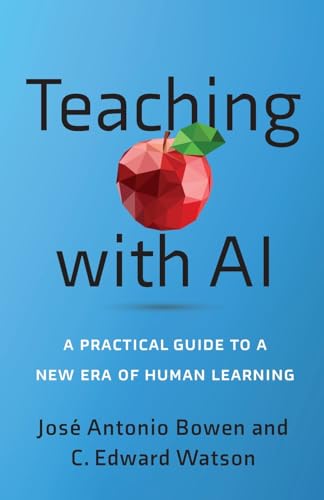

Teaching with AI : a practical guide to a new era of human learning / José Antonio Bowen and C. Edward Watson.
Idioma: Inglés Editor: Baltimore, Maryland : Johns Hopkins University Press, 2024Descripción: viii, 270 pages : illustrations ; 22 cmTipo de contenido:- text
- unmediated
- volume
- 9781421449227
- Teaching with artificial intelligence
- 371.33/4028563 23/eng/20240122
- LB1028.43 .B677 2024
- EDU015000 | EDU039000
| Imagen de cubierta | Tipo de ítem | Biblioteca actual | Biblioteca de origen | Colección | Ubicación en estantería | Signatura topográfica | Materiales especificados | Info Vol | URL | Copia número | Estado | Notas | Fecha de vencimiento | Código de barras | Reserva de ítems | Prioridad de la cola de reserva de ejemplar | Reservas para cursos | |
|---|---|---|---|---|---|---|---|---|---|---|---|---|---|---|---|---|---|---|
| Libro | Biblioteca Encarnación Valdés Colección General bev | 371.33 B7861t 2024 (Navegar estantería(Abre debajo)) | Disponible | 80000002670605 |
Descripciones mejoradas de Syndetics:
How AI is revolutionizing the future of learning and how educators can adapt to this new era of human thinking.
Artificial Intelligence (AI) is revolutionizing the way we learn, work, and think. Its integration into classrooms and workplaces is already underway, impacting and challenging ideas about creativity, authorship, and education. In this groundbreaking and practical guide, teachers will discover how to harness and manage AI as a powerful teaching tool. José Antonio Bowen and C. Edward Watson present emerging and powerful research on the seismic changes AI is already creating in schools and the workplace, providing invaluable insights into what AI can accomplish in the classroom and beyond.
By learning how to use new AI tools and resources, educators will gain the confidence to navigate the challenges and seize the opportunities presented by AI. From interactive learning techniques to advanced assignment and assessment strategies, this comprehensive guide offers practical suggestions for integrating AI effectively into teaching and learning environments. Bowen and Watson tackle crucial questions related to academic integrity, cheating, and other emerging issues.
In the age of AI, critical thinking skills, information literacy, and a liberal arts education are more important than ever. As AI continues to reshape the nature of work and human thinking, educators can equip students with the skills they need to thrive in a rapidly evolving world. This book serves as a compass, guiding educators through the uncharted territory of AI-powered education and the future of teaching and learning.
Includes bibliographical references and index.
"This work is the first book that describes how teachers can responsibly use generative AI in their classrooms"--
"How AI is revolutionizing the future of learning and how educators can adapt to this new era of human thinking.Artificial Intelligence (AI) is revolutionizing the way we learn, work, and think. Its integration into classrooms and workplaces is already underway, impacting and challenging ideas about creativity, authorship, and education. In this groundbreaking and practical guide, teachers will discover how to harness and manage AI as a powerful teaching tool. José Antonio Bowen and C. Edward Watson present emerging and powerful research on the seismic changes AI is already creating in schools and the workplace, providing invaluable insights into what AI can accomplish in the classroom and beyond.By learning how to use new AI tools and resources, educators will gain the confidence to navigate the challenges and seize the opportunities presented by AI. From interactive learning techniques to advanced assignment and assessment strategies, this comprehensive guide offers practical suggestions for integrating AI effectively into teaching and learning environments. Bowen and Watson tackle crucial questions related to academic integrity, cheating, and other emerging issues.In the age of AI, critical thinking skills, information literacy, and a liberal arts education are more important than ever. As AI continues to reshape the nature of work and human thinking, educators can equip students with the skills they need to thrive in a rapidly evolving world. This book serves as a compass, guiding educators through the uncharted territory of AI-powered education and the future of teaching and learning"--
Tabla de contenidos provista por Syndetics
- 0 Chronology
- 0 Introduction
- 0 Part I
- 1 AI Basics
- 2 A\New Era of Work
- 3 AI Literacy
- 4 Reimagining Creativity
- 0 Part II
- 5 AI-Assisted Faculty
- 6 AI Cheating and Detection
- 7 AI Policies
- 8 Grading and (Re-)Defining Quality
- 0 Part III
- 9 Feedback and Roleplaying with AI
- 10 Designing Assignments and Assessments for Human Effort
- 11 Writing and AI
- 12 AI Assignments and Assessments
- 0 Epilogue
- 0 Acknowledgments
- 0 References
- 0 Index
Reseñas proporcionadas por Syndetics
CHOICE Review
This guide to how learning and teaching will be impacted by artificial intelligence (AI), written by José Antonio Bowen and C. Edward Watson, is a natural succession to their previous research and writings. Bowen, former president of Goucher College, is the author of Teaching Naked: How Moving Technology Out of Your College Classroom Will Improve Student Learning (2012) and Teaching Change: How to Develop Independent Thinkers Using Relationships, Resilience, and Reflection (2021). Watson, Associate Vice President for Curricular and Pedagogical Innovation at the American Association of Colleges and Universities and former Director of the Center for Teaching and Learning at the University of Georgia, is the author of Playing to Learn with Reacting to the Past: Research on High Impact, Active Learning Practices (2017). Together, they are the coauthors of Teaching Naked Techniques: A Practical Guide to Designing Better Classes (2017). Their new book, Teaching with AI: A Practical Guide to the New Era of Human Learning, comes at a time of increased questioning in K--12 and higher education about how AI tools will both disrupt and enhance student learning, faculty teaching, and relationships in any learning community. This Practical Guide to a New Era of Human Learning is organized into three sections: "Thinking with AI," "Teaching with AI," and "Learning with AI." The topics include current controversies that many educators are raising: how AI will impact the nature of work, literacy, and human creativity; cheating and detection; grading and redefining quality and feedback; role-playing with AI; designing assignments and assessments for human effort; writing and AI; and the uneasy tension between what to think (content) and how to think (process). The authors leave for their next books the question, "[C]ould the revolution of AI be our opportunity to reflect and reimagine how we could most benefit our students, our society, our species, and our planet?" This book succeeds at fulfilling its goals. The first section's goal is to explain how AI works and what it is doing to the human experience. The second section's goal is to explore how AI will eliminate some jobs and very likely change the nature of work for all. The third section discusses the nature of learning and teaching; how the current understanding of "cheating" may be considered collaboration in the future; and how instructors will need to reconceptualize learning assessment at a time when information is readily accessible but may be "hallucinatory." This early-entry guide provides practical guidance for how faculty might adjust their practices to create prompts and assessments when AI detection software is not highly reliable and learners seek the path of least resistance to completing tasks. The authors also provide a list of diverse classroom activities and instructional design: AI as tutor; role-play; AI-assisted creation of video and podcasts; graphic novels; game design; social and peer work; and process assignments. Such applications seek to support more learner engagement and authentic assessment. These sections supporting curriculum development will be highly appreciated by faculty members who are convinced that students are using AI to just comply with assignments, but don't know how it might be used in support of learning and assessment. This book has been positively accepted as of this writing and has even inspired a book club led by the authors at the University of Massachusetts with educators from around the world. In Forbes, Mary Gasman writes, "José Antonio Bowen and C. Edward Watson are here to help faculty learn how to teach in the era of AI, and how to ensure that students are learning.... Although Bowen and Watson embrace AI and urge us not to be afraid, they encourage us to think about the restrictions, ethical standards, and policies that we need to put in place to ensure that we are in control and that misinformation does not run wild." This book is worthy of incorporation into an academic library's collection and discussion in academic departments for their curriculum development. AI is and will be a tool throughout the functioning of a university and will have ramifications throughout society. Already, at least 12 states have already passed legislation to regulate artificial intelligence, and all concerned citizens should read this text. With its catalog of strategies for using AI in an engaged classroom and its cautions on AI's implications for academic conduct and student learning, Teaching with AI predicts change in the values and goals of higher education. Reading and discussing this text with students, faculty, and university staff and administrators will, as the authors suggest, serve to "prepare students for a world where collaboration with AI is required rather than prevented.… [H]elping students leverage AI to produce better work should become a signature pedagogy of higher education." Summing Up: Highly recommended. Advanced undergraduates through faculty; practitioners; general readers. --David L Stoloff, Eastern Connecticut State UniversityNotas de autor provistas por Syndetics
Jose Antonio Bowen (DALLAS, TX) is the author of Teaching Naked: How Moving Technology Out of Your College Classroom Will Improve Student Learning and Teaching Change: How to Develop Independent Thinkers Using Relationships, Resilience, and Reflection. He is the former president of Goucher College.
C. Edward Watson (BLACKSBURG, VA) is the Associate Vice President for Curricular and Pedagogical Innovation at the American Association of Colleges and Universities. He is the former Director of the Center for Teaching and Learning at the University of Georgia. He is the author of Playing to Learn with Reacting to the Past: Research on High Impact, Active Learning Practices. Bowen and Watson are coauthors of Teaching Naked Techniques: A Practical Guide to Designing Better Classes.