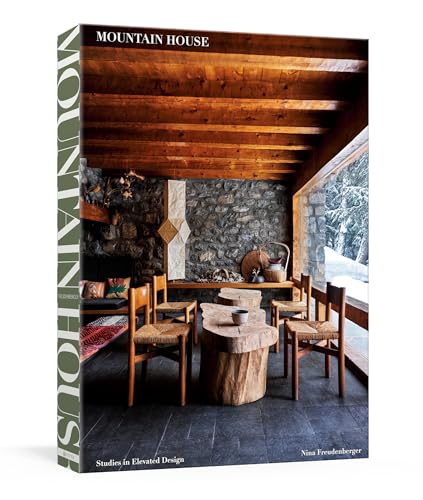
Imagen de portada de Amazon
Imagen de Amazon.com
Imagen de cubierta Syndetics
Portada de Syndetics
Imagen de OpenLibrary

Mountain house : studies in elevated design. / Nina Freudenberger with Michael Snyder ; photographs by Chris Mottalini. txt

Por: Colaborador(es): Editor: New York : Clarkson Potter/Publishers, 2023Descripción: 287 p. : ill. ; col. ; 29 cmTipo de contenido:
  • text
Tipo de medio:
  • unmediated
Tipo de soporte:
  • volume
ISBN:
  • 9780593233054
  • 0593233050
Tema(s): Clasificación CDD:
  • 23/eng/20230412 747
Clasificación LoC:
  • NK2110 F675 2023
Resumen: "A stunning photographic collection of mountain houses around the world that incorporate the surrounding ranges and vistas into their designs, from the author of Surf Shack and Bibliostyle. From Morocco to Patagonia, and Brazil to New Hampshire, interior designer Nina Freudenberger presents some of the most spectacular homes hidden in mountainous regions around the world, including modern lodges, rustic hideaways, hillside chalets, and more. Explore mountain living at its best in fall, winter, spring, and summer with 200 beautiful full-color images of each home. Among the twenty homes featured in this book, you'll find an isolated villa nestled in Switzerland's Engadin Valley; a former U.S. Forest Service cabin in California's San Gabriel Mountains; a modern concrete getaway just outside of Mexico City; and a renovated home in the Catskills built as a hotel for artists in the late 1800s. With simply designed interiors that keep the focus on the view just outside the window, these homes epitomize the tranquility and isolation we seek in the wilderness and the design ingenuity that mountain life demands"--
Valoración
    Valoración media: 0.0 (0 votos)
Existencias
Imagen de cubierta Tipo de ítem Biblioteca actual Biblioteca de origen Colección Ubicación en estantería Signatura topográfica Materiales especificados Info Vol URL Copia número Estado Notas Fecha de vencimiento Código de barras Reserva de ítems Prioridad de la cola de reserva de ejemplar Reservas para cursos
Libro Col. General CARIBET CARIBET Biblioteca Arquitectura Colección General CARIBET General NK2110 F675 2023 (Navegar estantería(Abre debajo)) 1 Disponible 91000000750018
Total de reservas: 0

Descripciones mejoradas de Syndetics:

A photographic study of more than twenty houses and the mountain landscapes, from alpine forests to urban peaks, that embrace them.

Spanning continents and climates, the twenty homes presented in interior designer Nina Freudenberger's latest book challenge and expand the idea of what a mountain house might be. Artist retreats in Morocco's High Atlas and the snowy folds of the Engadine Valley in Switzerland speak to the long tradition of mountains spaces for contemplation and creation, while modernist masterworks in Cape Town and Rio de Janeiro expand the traditional image of log cabins and rustic chalets.

Depicted in over 200 images, these houses include brutalist lodges, clapboard cottages, and minimalist prisms set down among some of the world's most dramatic landscapes. In their spectacular diversity, they express the radical ingenuity and stunning creativity that the mountains have always inspired.

Includes index.

"A stunning photographic collection of mountain houses around the world that incorporate the surrounding ranges and vistas into their designs, from the author of Surf Shack and Bibliostyle. From Morocco to Patagonia, and Brazil to New Hampshire, interior designer Nina Freudenberger presents some of the most spectacular homes hidden in mountainous regions around the world, including modern lodges, rustic hideaways, hillside chalets, and more. Explore mountain living at its best in fall, winter, spring, and summer with 200 beautiful full-color images of each home. Among the twenty homes featured in this book, you'll find an isolated villa nestled in Switzerland's Engadin Valley; a former U.S. Forest Service cabin in California's San Gabriel Mountains; a modern concrete getaway just outside of Mexico City; and a renovated home in the Catskills built as a hotel for artists in the late 1800s. With simply designed interiors that keep the focus on the view just outside the window, these homes epitomize the tranquility and isolation we seek in the wilderness and the design ingenuity that mountain life demands"--

Extracto provisto por Syndetics

Introduction As an interior designer, I have always been fascinated not only with how people live but also where they choose to live and why. This curiosity brought me to surfing locales around the world in the making of my first book Surf Shack and into the most interesting and expansive home libraries in my second book, Bibliostyle . As someone who lives in the city and loves to travel with my family, I couldn't help being interested in homes perched in the highest altitudes. How do we define a mountain house? You might imagine a quaint wooden cottage surrounded by pines, maybe with a stone chimney and billowing smoke, but what I found while working alongside the photographer Chris Mottalini and writer Michael Snyder was just how many ways there are to live with and design for the mountains. A mountain house may not even represent escape to some homeowners--several of the homes we found are primary residences. Some are even located in major world cities. People have occupied the mountains for just about as long as humans have been around. For nearly 50,000 years, we have had ancestors sheltering under rocks more than 10,000 feet above sea level, and many of our most ancient gods have resided in the mountains. Religious seekers, guerrilla warriors, and political dissidents alike have all treated mountains as retreats from the world, building stupas and monasteries into impossible rockfaces, or establishing alternative societies in the folds of hills where lowland powers can't reach. It's not a coincidence that some of the most biologically, culturally, and linguistically diverse places on earth are mountainous. Mountains seem intimidating, even scary, to those of us who were born and raised at sea level. They remind us of how small we really are, which makes them practically divine. For the most part the houses included in this book were built, in one way or another, in that ancient tradition of retreat. There are now eight billion people in the world and more than half of us live in cities, which has turned wilderness from something to marvel at or fear into something that many of us yearn for. Some of these houses bring nature close through design choices, such as using organic materials like stone and wood sourced near the homes. Other homeowners quite literally brought the outside in by erecting porous walls or, in some cases, eliminating doors and windows altogether, leaving blank apertures that open to the surrounding landscape. Some of the houses were built with the understanding--radical to city dwellers, logical to everyone else--that everything goes back into the earth. These houses will one day be part of the mountains themselves. In choosing these homes, we weren't looking for the highest altitudes or the most remote corners of the world, though some are high up and more than a few were hard to get to. Instead, we thought about how architecture and interiors can embody and reflect their surrounding environments. Maybe even more so, we wanted to explore how those environments can, through time, reshape the lives of the people who live within them. Over the course of a year, we traveled to twelve countries on five continents. We met artists and architects, chefs and designers, writers and movie producers. No two people experience their homes in quite the same way, and no two houses are exactly alike. Some are radical, others traditional, some historic and others barely complete. A few are solitary, but most of them were built with family and community in mind. All of them are creative and adaptive and beautiful. During the pandemic, I found myself, like so many others, yearning for a little space in nature, a little more exterior to explore. More recently--and more resolutely--I've wanted to distance myself from constant accessibility, one of the many downsides to our technologydriven world. These are romantic ideas and still not much easier to manifest in the country than in the city; we had internet access even in the farthest reaches of Patagonia and cell service on a mountaintop in the Austrian Tyrol. But there is something about the sheer fact of distance and the incredible beauty of these landscapes that can put in perspective the endless beeping and buzzing of our devices. In a world this big, nothing is quite so urgent. Excerpted from Mountain House: Studies in Elevated Design by Nina Freudenberger All rights reserved by the original copyright owners. Excerpts are provided for display purposes only and may not be reproduced, reprinted or distributed without the written permission of the publisher.

Notas de autor provistas por Syndetics

The author of Surf Shack and Bibliostyle , Nina Freudenberger received her BFA and Bachelor of Architecture from Rhode Island School of Design before launching a career in interior design. She is founder of the LosAngeles based interior design firm Freudenberger Design which specializes in private residential interiors and hospitality projects across the country. In addition, Nina has designed a wide array of home and lifestyle products and collaborations sold nationwide, including rugs, textiles, wall coverings, and furniture. She currently lives with her husband and two boys in California.
Compartir
logopucpr-y-vive

Contáctanos

¡Queremos saber de ti!

Tel. 787.841.2000 Ext. 1801

bibliotecavaldes@pucpr.edu

⁣Búscanos en las redes

© 2026 Desarrollado por Ignite Online • All Rights Reserved • Powered by Koha.