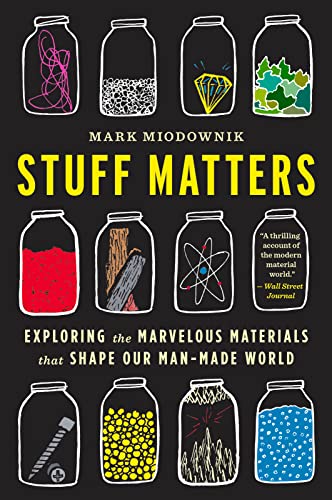
Imagen de portada de Amazon
Imagen de Amazon.com
Imagen de cubierta Syndetics
Portada de Syndetics
Imagen de OpenLibrary

Stuff matters : exploring the marvelous materials that shape our man-made world / Mark Miodownik

Por: Idioma: Inglés Editor: Houghton Mifflin Harcourt, Boston : Mariner Books, 2015Descripción: 252 pages : illustrationsTipo de contenido:
  • text
Tipo de medio:
  • unmediated
Tipo de soporte:
  • volume
ISBN:
  • 9780544483941
Tema(s): Clasificación CDD:
  • 23 620
Contenidos:
Indomitable -- Trusted -- Fundamental -- Delicious -- Marvelous -- Imaginative -- Invisible -- Unbreakable -- Refined -- Immortal.
Resumen: "Why is glass see-through? What makes elastic stretchy? Why does a paper clip bend? Why does any material look and behave the way it does? With clarity and humor, world-leading materials scientist Mark Miodownik answers all the questions you've ever had about your pens, spoons, and razor blades, while also introducing a whole world full of materials you've never even heard of: the diamond five times the size of Earth; concrete cloth that can be molded into any shape; and graphene, the thinnest, strongest, stiffest material in existence--only a single atom thick. Stuff Matters tells enthralling stories that explain the science and history of materials. From the teacup to the jet engine, the silicon chip to the paper clip, the plastic in our appliances to the elastic in our underpants, Miodownik reveals the miracles of engineering that permeate our lives. As engaging as it is incisive, Stuff Matters will make you see the materials that surround you with new eyes"--Provided by publisher
Valoración
    Valoración media: 0.0 (0 votos)
Existencias
Imagen de cubierta Tipo de ítem Biblioteca actual Biblioteca de origen Colección Ubicación en estantería Signatura topográfica Materiales especificados Info Vol URL Copia número Estado Notas Fecha de vencimiento Código de barras Reserva de ítems Prioridad de la cola de reserva de ejemplar Reservas para cursos
Libro Biblioteca Encarnación Valdés Colección General bev 620.11 M669s (Navegar estantería(Abre debajo)) Disponible 80000002670548
Total de reservas: 0

Descripciones mejoradas de Syndetics:

In this New York Times Notable Book, "Mark Miodownik, a materials scientist, explains the history and science behind things such as paper, glass, chocolate, and concrete with an infectious enthusiasm."--Scientific American


Winner of the Royal Society Winton Prize for Science Books


Why is glass see-through? What makes elastic stretchy? Why does any material look and behave the way it does? These are the sorts of questions that renowned materials scientist and New York Times bestselling author Mark Miodownik constantly asks himself. Studying objects as ordinary as an envelope and as unexpected as concrete cloth, he uncovers the fascinating secrets that hold together our physical world.


In Stuff Matters, Miodownik explores the materials he encounters in a typical morning, from the steel in his razor to the foam in his sneakers. Full of enthralling tales of the miracles of engineering that permeate our lives, his stories of analysis will make you see stuff in a whole new way.


"Stuff Matters is about hidden wonders, the astonishing properties of materials we think boring, banal, and unworthy of attention...It's possible this science and these stories have been told elsewhere, but like the best chocolatiers, Miodownik gets the blend right."--New York Times Book Review

Includes bibliographical references and index.

Indomitable -- Trusted -- Fundamental -- Delicious -- Marvelous -- Imaginative -- Invisible -- Unbreakable -- Refined -- Immortal.

"Why is glass see-through? What makes elastic stretchy? Why does a paper clip bend? Why does any material look and behave the way it does? With clarity and humor, world-leading materials scientist Mark Miodownik answers all the questions you've ever had about your pens, spoons, and razor blades, while also introducing a whole world full of materials you've never even heard of: the diamond five times the size of Earth; concrete cloth that can be molded into any shape; and graphene, the thinnest, strongest, stiffest material in existence--only a single atom thick. Stuff Matters tells enthralling stories that explain the science and history of materials. From the teacup to the jet engine, the silicon chip to the paper clip, the plastic in our appliances to the elastic in our underpants, Miodownik reveals the miracles of engineering that permeate our lives. As engaging as it is incisive, Stuff Matters will make you see the materials that surround you with new eyes"--Provided by publisher

Tabla de contenidos provista por Syndetics

  • Introduction(p. ix)
  • 1 Indomitable(p. 1)
  • 2 Trusted(p. 21)
  • 3 Fundamental(p. 51)
  • 4 Delicious(p. 73)
  • 5 Marvelous(p. 91)
  • 6 Imaginative(p. 111)
  • 7 Invisible(p. 139)
  • 8 Unbreakable(p. 159)
  • 9 Refined(p. 179)
  • 10 Immortal(p. 195)
  • 11 Synthesis(p. 215)
  • Acknowledgments(p. 229)
  • Photo Credits(p. 232)
  • Further Reading(p. 233)
  • Index(p. 234)

Extracto provisto por Syndetics

Introduction As I stood on a train bleeding from what would later be classified as a thirteen-centimeter stab wound, I wondered what to do. It was May 1985, and I had just jumped on to a London Tube train as the door closed, shutting out my attacker, but not before he had slashed my back. The wound stung like a very bad paper cut, and I had no idea how serious it was, but being a schoolboy at the time, embarrassment overcame any sort of common sense. So instead of getting help, I decided the best thing would be to sit down and go home, and so, bizarrely, that is what I did. To distract myself from the pain, and the uneasy feeling of blood trickling down my back, I tried to work out what had just happened. My assailant had approached me on the platform asking me for money. When I shook my head he got uncomfortably close, looked at me intently, and told me he had a knife. A few specks of spit from his mouth landed on my glasses as he said this. I followed his gaze down to the pocket of his blue anorak. I had a gut feeling that it was just his index finger that was creating the pointed bulge. Even if he did have a knife, it must be so small to fit in that pocket that there was no way it could do me much damage. I owned penknives myself and knew that such a knife would find it very hard to pierce the several layers that I was wearing: my leather jacket, of which I was very proud, my gray wool school blazer beneath it, my nylon V-neck sweater, my cotton white shirt with obligatory striped school tie half knotted, and cotton vest. A plan formed quickly in my head: keep him talking and then push past him on to the train as the doors were closing. I could see the train arriving and was sure he wouldn't have time to react. Funnily enough I was right about one thing: he didn't have a knife. His weapon was a razor blade wrapped in tape. This tiny piece of steel, not much bigger than a postage stamp, had cut through five layers of my clothes, and then through the epidermis and dermis of my skin in one slash without any problem at all. When I saw that weapon in the police station later, I was mesmerized. I had seen razors before of course, but now I realized that I didn't know them at all. I had just started shaving at the time, and had only seen them encased in friendly orange plastic in the form of a Bic safety razor. As the police quizzed me about the weapon, the table between us wobbled and the razor blade sitting on it wobbled too. In doing so it glinted in the fluorescent lights, and I saw clearly that its steel edge was still perfect, unaffected by its afternoon's work. Later I remember having to fill in a form, with my parents anxiously sitting next to me and wondering why I was hesitating. Perhaps I had forgotten my name and address? In truth I had started to fixate on the staple at the top of the first page. I was pretty sure this was made of steel too. This seemingly mundane piece of silvery metal had neatly and precisely punched its way through the paper. I examined the back of the staple. Its two ends were folded snugly against one another, holding the sheaf of papers together in a tight embrace. A jeweler could not have made a better job of it. (Later I found out that the first stapler was hand-made for King Louis XV of France with each staple inscribed with his insignia. Who would have thought that staplers have royal blood?) I declared it "exquisite" and pointed it out to my parents, who looked at each other in a worried way, thinking no doubt that I was having a nervous breakdown. Which I suppose I was. Certainly something very odd was going on. It was the birth of my obsession with materials--starting with steel. I suddenly became ultra-sensitive to its being present everywhere. I saw it in the tip of the ballpoint pen I was using to fill out the police form; it jangled at me from my dad's key ring while he waited, fidgeting; later that day it sheltered and took me home, covering the outside of our car in a layer no thicker than a postcard. Strangely, I felt that our steel Mini, usually so noisy, was on its best behavior that day, materially apologizing for the stabbing incident. When we got home I sat down next to my dad at the kitchen table, and we ate my mum's soup together in silence. Then I paused, realizing I even had a piece of steel in my mouth. I consciously sucked the stainless steel spoon I had been eating my soup with, then took it out and studied its bright shiny appearance, so shiny that I could even see a distorted reflection of myself in it. "What is this stuff?" I said, waving the spoon at my dad. "And why doesn't it taste of anything?" I put it back in my mouth to check, and sucked it assiduously. Then a million questions poured out. How is it that this one material does so much for us, and yet we hardly talk about it? It is an intimate character in our lives--we put it in our mouths, use it to get rid of unwanted hair, drive around in it--it is our most faithful friend, and yet we hardly know what makes it tick. Why does a razor blade cut while a paper clip bends? Why are metals shiny? Why, for that matter, is glass transparent? Why does everyone seem to hate concrete but love diamond? And why is it that chocolate tastes so good? Why does any material look and behave the way it does? Since the stabbing incident, I have spent the vast majority of my time obsessing about materials. I've studied materials science at Oxford University, I've earned a PhD in jet engine alloys, and I've worked as a materials scientist and engineer in some of the most advanced laboratories around the world. Along the way, my fascination with materials has continued to grow--and with it my collection of extraordinary samples of them. These samples have now been incorporated into a vast library of materials built together with my friends and colleagues Zoe Laughlin and Martin Conreen. Some are impossibly exotic, such as a piece of NASA aerogel, which being 99.8 percent air resembles solid smoke; some are radioactive, such as the uranium glass I found at the back of an antique shop in Australia; some are small but stupidly heavy, such as ingots of the metal tungsten extracted painstakingly from the mineral wolframite; some are utterly familiar but have a hidden secret, such as a sample of self-healing concrete. Taken together, this library of more than a thousand materials represents the ingredients that built our world, from our homes, to our clothes, to our machines, to our art. The library is now located and maintained at the Institute of Making which is part of University College London. You could rebuild our civilization from the contents of this library, and destroy it too. Yet there is a much bigger library of materials containing millions of materials, the biggest ever known, and it is growing at an exponential rate: the manmade world itself. Consider the photograph opposite. It pictures me drinking tea on the roof of my flat. It is unremarkable in most ways, except that when you look carefully it provides a catalog of the stuff from which our whole civilization is made. This stuff is important. Take away the concrete, the glass, the textiles, the metal, and the other materials from the scene, and I am left naked shivering in midair. We may like to think of ourselves as civilized, but that civilization is in a large part bestowed by material wealth. Without this stuff, we would quickly be confronted by the same basic struggle for survival that animals are faced with. To some extent, then, what allows us to behave as humans are our clothes, our homes, our cities, our stuff, which we animate through our customs and language. (This becomes very clear if you ever visit a disaster zone.) The material world is not just a display of our technology and culture, it is part of us. We invented it, we made it, and in turn it makes us who we are. Excerpted from Stuff Matters: Exploring the Marvelous Materials That Shape Our Man-Made World by Mark Miodownik All rights reserved by the original copyright owners. Excerpts are provided for display purposes only and may not be reproduced, reprinted or distributed without the written permission of the publisher.

Reseñas proporcionadas por Syndetics

Library Journal Review

Starred Review. Ever wonder how concrete is made? Why chocolate gets white spots when it heats up then cools down again? What makes diamond and graphite, two allotropes of carbon, behave so differently? Miodownik (materials and society, Univ. Coll. of London; Computational Materials Engineering) answers all of these questions and more through relating his personal experiences with each type of material. The author explores the worlds of the grandiose as he watches the construction of the Shard in London, Europe's tallest building; and the miniscule, as he examines how small pores can lead to fractures in terra cotta, but similar fractures can be stopped in plaster (like that in a cast) by applying it over cloth. Miodownik introduces enough chemistry to explain, as his title suggests, the stuff that matters, but relates the science in such a way that the book should be accessible to all readers. VERDICT Recommended for anyone who wants to learn more about the materials that make up the world around them. John Kromer, Miami Univ. of Ohio Lib., Oxford, OH (c) Copyright 2014. Library Journals LLC, a wholly owned subsidiary of Media Source, Inc. No redistribution permitted.

Publishers Weekly Review

Miodownik, director of the Institute of Making at University College London, writes a fascinating introduction to materials science, a discipline unfamiliar to most outside it. To "tell the story of stuff" he takes a photo of himself enjoying a cup of tea on his London rooftop, and proceeds to examine 10 of the materials in the photo. These materials (concrete, glass, plastics, etc.) are ubiquitous in the modern world and possess their own chemistry and history. Miodownik includes himself in his discussions so that, in the chapter on biomaterials, readers learn about his fillings as well as his disappointment that when he broke a leg as a child he didn't receive the same upgrades as the Six Million Dollar Man. His humor helps highlight such facts as we are one of the first generations to not taste our cutlery, due to the properties of stainless steel, or that "the biggest diamond yet discovered... is orbiting a pulsar star" and is "five times the size of Earth." In his chapter on paper, he describes the book as "a fortress for words," while he regards chocolate as "one of our greatest engineering creations." Miodownik's infectious curiosity and explanatory gifts will inspire readers to take a closer look at the materials around them. (June) (c) Copyright PWxyz, LLC. All rights reserved.

CHOICE Review

Inventories of failure emerge with each catastrophe, alerting people to not take materials for granted: Challenger fell from the sky, and the World Trade Center collapsed. The Mianus River bridge disappeared into darkness and cars and trucks followed, and the fuselage on the British Comet failed. Tires wear out, blow out, and peel off. Meanwhile, people's skin loses elasticity and slowly wrinkles because of the long-term effects of gravity. Human life depends on materials that support and sustain, protect, and provide for it. As the title indicates, stuff does matter! Nowhere has that message been better written or with more style and charm than by Miodownik (materials science, Univ. College London, UK). He relates his version of the facts in chapters such as "Fundamental" (about concrete), "Delicious" (about chocolate), "Indomitable" (about steel), and "Trusted" (about paper). In a dozen chapters, including a scary-dare one say-"cutting edge" introduction, the author has seductively interwoven literary and scientific magic. It is just right for scientists and engineers and for real people too, who live in a materials world. Everyone will be pleased. Do not miss a word. --L. W. Fine, Columbia University

Booklist Review

University professor Miodownik accomplishes a bit of a miracle here by making a discussion of materials science not only accessible but witty as well. Spinning out of a surprisingly personal introduction, this Bill Brysonesque study of steel, paper, chocolate, and more takes readers deeply inside the history of the 11 common materials captured in a photograph taken of the author relaxing on his outdoor deck. Miodownik has a genial style as he dives into the science of chemical compositions with aplomb, then pivots into thoughtful considerations of wine glasses, wrapping paper, joint replacements, and the concrete construction of the John F. Kennedy International Airport. With boundless enthusiasm, he turns considerations of the most mundane of topics into dazzling tours of ancient Rome and Willy Wonka's factory, along with a look at the intricacies of Samurai sword making. At a time when science is maligned, first-rate storyteller Miodownik entertains and educates with pop-culture references, scholarly asides, and nods to everyone from the Six Million Dollar Man to the Luminere brothers. A delight for the curious reader.--Mondor, Colleen Copyright 2010 Booklist

Notas de autor provistas por Syndetics

Mark Miodownik is a professor of material and society at University College London. He is the director of the Institute of Making, which is home to a materials library containing some of the most wondrous matter on earth. He lives in London.
Compartir
logopucpr-y-vive

Contáctanos

¡Queremos saber de ti!

Tel. 787.841.2000 Ext. 1801

bibliotecavaldes@pucpr.edu

⁣Búscanos en las redes

© 2026 Desarrollado por Ignite Online • All Rights Reserved • Powered by Koha.