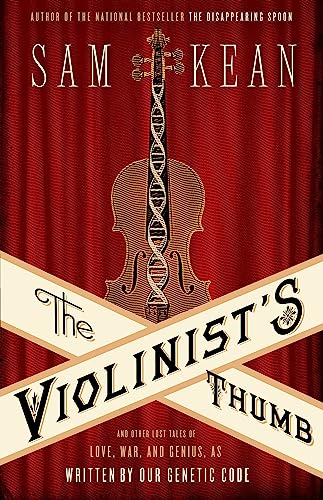

The violinist's thumb : and other lost tales of love, war, and genius, as written by our genetic code / Sam Kean.
Idioma: Inglés Editor: New York, New York : Little, Brown and Co., 2012Descripción: ix, 401 pages; 25 cmTipo de contenido:- text
- unmediated
- volume
- 9780316182317 (hardback)
- 572.8 23
- QH431 .K24 2012
- SCI029000 | SCI008000
| Imagen de cubierta | Tipo de ítem | Biblioteca actual | Biblioteca de origen | Colección | Ubicación en estantería | Signatura topográfica | Materiales especificados | Info Vol | URL | Copia número | Estado | Notas | Fecha de vencimiento | Código de barras | Reserva de ítems | Prioridad de la cola de reserva de ejemplar | Reservas para cursos | |
|---|---|---|---|---|---|---|---|---|---|---|---|---|---|---|---|---|---|---|
| Libro | Biblioteca Encarnación Valdés Colección General bev | 572.8 K242v (Navegar estantería(Abre debajo)) | Disponible | 80000002670589 |
Descripciones mejoradas de Syndetics:
From New York Times bestselling author Sam Kean comes incredible stories of science, history, language, and music, as told by our own DNA.
In The Disappearing Spoon , bestselling author Sam Kean unlocked the mysteries of the periodic table. In The Violinist's Thumb , he explores the wonders of the magical building block of life: DNA.
There are genes to explain crazy cat ladies, why other people have no fingerprints, and why some people survive nuclear bombs. Genes illuminate everything from JFK's bronze skin (it wasn't a tan) to Einstein's genius. They prove that Neanderthals and humans bred thousands of years more recently than any of us would feel comfortable thinking. They can even allow some people, because of the exceptional flexibility of their thumbs and fingers, to become truly singular violinists.
Kean's vibrant storytelling once again makes science entertaining, explaining human history and whimsy while showing how DNA will influence our species' future. AN ENTERTAINMENT WEEKLY BEST BOOK OF THE YEAR
Includes bibliographical references (p. 385-389) and index.
"In The Disappearing Spoon, bestselling author Sam Kean unlocked the mysteries of the periodic table. In THE VIOLINIST'S THUMB, he explores the wonders of the magical building block of life: DNA. There are genes to explain crazy cat ladies, why other people have no fingerprints, and why some people survive nuclear bombs. Genes illuminate everything from JFK's bronze skin (it wasn't a tan) to Einstein's genius. They prove that Neanderthals and humans bred thousands of years more recently than any of us would feel comfortable thinking. They can even allow some people, because of the exceptional flexibility of their thumbs and fingers, to become truly singular violinists. Kean's vibrant storytelling once again makes science entertaining, explaining human history and whimsy while showing how DNA will influence our species' future"--
Tabla de contenidos provista por Syndetics
- Introduction(p. 3)
- Part I A, C, G, T, and You: How to Read a Genetic Score
- 1 Genes, Freaks, DNA: How Do Living Things Pass Down Traits to Their Children?(p. 13)
- 2 The Near Death of Darwin: Why Did Geneticists Try to Kill Natural Selection?(p. 31)
- 3 Them's the DNA Breaks: How Does Nature Read-and Misread-DNA?(p. 54)
- 4 The Musical Score of DNA: What Kinds of Information Does DNA Store?(p. 72)
- Part II Our Animal Past: Making things that Crawl and Frolic and Kill
- 5 DNA Vindication: Why Did Life Evolve So Slowly-Then Explode in Complexity?(p. 95)
- 6 The Survivors, the Livers: What's Our Most Ancient and Important DNA?(p. 118)
- 7 The Machiavelli Microbe: How Much Human DNA Is Actually Human?(p. 138)
- 8 Love and Atavisms: What Genes Make Mammals Mammals?(p. 157)
- 9 Humanzees and Other Near Misses: When Did Humans Break Away from Monkeys, and Why?(p. 178)
- Part III Genes and Geniuses : How Humans Became all too Human
- 10 Scarlet A's, C's, G's, and T's: Why Did Humans Almost Go Extinct?(p. 203)
- 11 Size Matters: How Did Humans Get Such Grotesquely Large Brains?(p. 226)
- 12 The Art of the Gene: How Deep in Our DNA Is Artistic Genius?(p. 245)
- Part IV The Oracle of Dna: Genetics in the Past, Present, and Future
- 13 The Past Is Prologue-Sometimes: What Can (and Can't) Genes Teach Us About Historical Heroes?(p. 271)
- 14 Three Billion Little Pieces: Why Don't Humans Have More Genes Than Other Species?(p. 294)
- 15 Easy Come, Easy Go? How Come Identical Twins Aren't Identical?(p. 314)
- 16 Life as We Do (and Don't) Know It: What the Heck Will Happen Now?(p. 336)
- Epilogue: Genomics Gets Personal(p. 355)
- Acknowledgments(p. 361)
- Notes and Errata(p. 363)
- Selected Bibliography(p. 385)
- Index(p. 391)
Reseñas proporcionadas por Syndetics
Library Journal Review
Many considered the Human Genome Project complete in 2003, when a complete draft of the human genetic code was released, though scientists continue to revise and analyze their findings. Best-selling author Kean (The Disappearing Spoon) attempts to take the mystery out of DNA by explaining its structure, its historical impact, and how the science of genetics continues to influence our lives. A good portion of the book examines how modern genetic breakthroughs have helped to explain our evolutionary and historical past and discusses the often quirky stories associated with the major players in genetics research. The latter part of the book concentrates on what the future may hold as computer technology and our base of genetic knowledge expands. Kean aptly illustrates the tremendous amount of work that still remains to be done before we can hope to truly understand DNA. VERDICT Throughout, Kean writes in a relatively unbiased, down-to-earth tone and goes beyond the basic biology to emphasize the social implications of DNA research. Light and witty if rambling at times, this book is recommended for all general readers.-Tina Neville, Univ. of South Florida at St. Petersburg Lib. (c) Copyright 2012. Library Journals LLC, a wholly owned subsidiary of Media Source, Inc. No redistribution permitted.Publishers Weekly Review
As he did in his debut bestseller, The Disappearing Spoon, Kean educates readers about a facet of science, in this case, genetics, with wonderfully witty prose and enthralling anecdotes. The book's title, for instance, refers to the genetic disorder that afflicted-and aided-virtuoso violinist Niccolo Paganini, giving him "freakishly flexible fingers" and enabled him to play in ways most others could not. (It also caused him joint pain, poor vision, and other problems). Kean explains how scientists use DNA to better understand evolutionary relationships across the animal kingdom, to examine Homo sapiens's relationship (both genetic and sexual) with Neanderthals. When Kean discusses the work of pioneers like Darwin, Mendel, Watson, Venter, and McClintock, he illuminates both the science and the politics of science. But he also reminds us to be wary of attributing too much to our genes. "We tend to treat DNA as a secular soul, our chemical essence. But even a full rendering of someone's DNA reveals only so much." Kean's thoughtful, humorous book is a joy to read. Agent: Rick Broadhead, Rick Broadhead & Associates. (July) (c) Copyright PWxyz, LLC. All rights reserved.Booklist Review
The violinist alluded to in the title of this comprehensive survey of DNA's many surprising attributes is the late Niccolo Paganini, whose own genetic anomaly of extraordinary finger dexterity contributed to his famous musical virtuosity. Best-selling science-author Kean follows his acclaimed debut, The Disappearing Spoon (2010), about the periodic table, with an equally engrossing collection of facts and anecdotes that, along with the Paganini snippet, includes a wealth of information from the front lines of contemporary genetic research. In addition to revisiting and enlivening many seminal moments leading to DNA's discovery, such as Augustinian friar Gregor Mendel's pea experiments and the cutting backlash Darwin endured regarding natural selection, Kean also focuses on the many secrets forensic gene mapping discloses about human evolution. Some highlights include the revelations that Homo sapiens almost went extinct twice and the unnerving fact that one's ability to survive a nuclear war can actually be inherited. Kean's superlatively readable, jargon-free prose will captivate even normally science-phobic readers.--Hays, Carl Copyright 2010 BooklistNotas de autor provistas por Syndetics
Sam Kean is the author of The Disappearing Spoon, The Violinist's Thumb, and The Tale of the Dueling Neurosurgeons: The History of the Human Brain as Revealed by True Stories of Trauma, Madness, and Recovery all of which were national bestsellers. The Disappearing Spoon was nominated by the Royal Society for one of the top science books of 2010, while The Violinist's Thumb was a finalist for PEN's literary science writing award.Kean's stories have appeared in The New York Times Magazine, Slate, Psychology Today, and The New Scientist, among other places, and his work has been featured on "Radiolab" and NPR's "All Things Considered," among other shows.
(Bowker Author Biography)