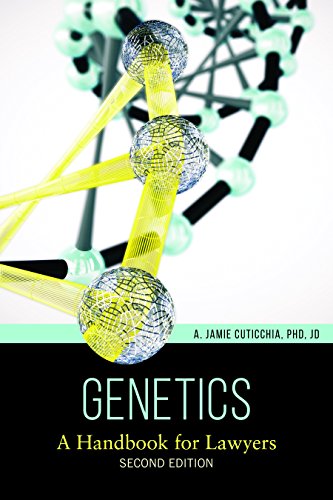

Genetics : a handbook for lawyers / A. James Cuticchia, PhD, JD.
Lenguaje original: Inglés Editor: Chicago, Illinois : American Bar Association, ©2018Edición: Second editionDescripción: xiv, 241 pages : illustrations ; 23 cmTipo de contenido:- text
- unmediated
- volume
- 9781641050340
- KF 9666 .5 .C88 2018
| Imagen de cubierta | Tipo de ítem | Biblioteca actual | Biblioteca de origen | Colección | Ubicación en estantería | Signatura topográfica | Materiales especificados | Info Vol | URL | Copia número | Estado | Notas | Fecha de vencimiento | Código de barras | Reserva de ítems | Prioridad de la cola de reserva de ejemplar | Reservas para cursos | |
|---|---|---|---|---|---|---|---|---|---|---|---|---|---|---|---|---|---|---|
| Libro | Biblioteca de Derecho Mons. Fremiot Torres Oliver Referencia biblioteca derecho | KF 9666.5 .C88 2018 (Navegar estantería(Abre debajo)) | Disponible | 70000000906136 |
Descripciones mejoradas de Syndetics:
Genetics: A Handbook for Lawyers, Second Edition covers a wide range of relevant topics including: - Molecular Biology- History of Genetics- Cutting Edge Technology and Evidentiary Value- Role of Genetics in Health- Forensic Collection and Analysis of DNA- Paternity Testing- Consumer Genetics- Computational Tools to Validate Data- Ethical Issues- Discrimination- Malpractice- Intellectual Property- Explaining Genetic Issues to a Jury The information contained in this reference book will better enable the law practitioner to be learned in the discipline, point out relevant and interesting legal issues to clients and the court, and help expert witnesses be as clear and effective as possible. This book is heavily annotated, through citations to statutes, case law, and scientific discoveries, for those wishing to explore a topic more deeply.It's a valuable resource for litigators, family or health lawyers, patent attorneys, or law students.
Includes bibliographical references and index.
Chapter 1. All living things -- Chapter 2. Foundations of genetics -- Chapter 3. Genetic variation -- Chapter 4. Collecting DNA evidence -- Chapter 5. Liabilities -- Chapter 6. Testing genetic variation: history and forensics -- Chapter 7. DNA sequencing -- Chapter 8. Bioinformatics -- Chapter 9. The human genome project -- Chapter 10. Medical genetics -- Chapter 11. Genetic discrimination and privacy -- Chapter 12. Patents -- Chapter 13. Unexpected genetics -- Chapter 14. Jury explanations.
Tabla de contenidos provista por Syndetics
- Acknowledgments(p. xi)
- Preface(p. xiii)
- Chapter 1 All Living Things(p. 1)
- 1.1 The Prokaryotic Cell(p. 1)
- 1.2 The Eukaryotic Cell(p. 3)
- 1.3 Blood Cells(p. 3)
- 1.4 Chromosomal DNA Packing(p. 5)
- Chapter 2 Foundations of Genetics(p. 7)
- 2.1 General Introduction to Genetics(p. 7)
- 2.2 Sexual Reproduction(p. 8)
- 2.3 Concentrating on Human Sexual Reproduction(p. 9)
- 2.4 Molecules of Heredity(p. 10)
- 2.5 Aneuploidy(p. 11)
- 2.6 Proving DNA Is the Carrier of Heredity(p. 12)
- 2.7 DNA Double Helix(p. 14)
- 2.8 Proteins(p. 16)
- 2.9 Heredity(p. 18)
- Chapter 3 Genetic Variation(p. 27)
- 3.1 Basic Concepts(p. 27)
- 3.2 Variation in Human Populations(p. 29)
- 3.3 Variations in Identical Twins(p. 30)
- 3.4 Population Genetics and Evolution(p. 31)
- 3.5 Legal Implications of Hardy-Weinberg Equilibrium(p. 36)
- 3.6 Genetic Mapping(p. 41)
- 3.7 Legal Implications of Hardy-Weinberg(p. 43)
- Chapter 4 Collecting DNA Evidence(p. 49)
- 4.1 Discover What Makes You Uniquely You(p. 49)
- 4.2 DNA Is a Resilient Molecule(p. 51)
- 4.3 Forensic Collection of DNA(p. 51)
- 4.4 Touch DNA(p. 52)
- 4.5 Legal Challenges to Collecting DNA(p. 54)
- Chapter 5 Civil Liabilities(p. 63)
- 5.1 Negligent DNA Testing(p. 63)
- 5.2 Failure to Test(p. 64)
- 5.3 Medical Malpractice(p. 66)
- 5.4 Negligent Reporting of Prenatal Tests(p. 67)
- 5.5 Wrongful Birth(p. 68)
- 5.6 Genetic Testing and Sports(p. 70)
- Chapter 6 Testing Genetic Variation: History and Forensics(p. 79)
- 6.1 Early Examples of Genotypes Inferred from Phenotypes of DNA Testing(p. 79)
- 6.2 Early Laboratory Methods for DNA Testing(p. 81)
- 6.3 RFLP Analysis Leads to DNA Fingerprinting(p. 83)
- 6.4 CODIS Markers(p. 86)
- 6.5 PCR(p. 88)
- 6.6 Paternity Analysis(p. 90)
- 6.7 Mitochondrial DNA and Lineage(p. 97)
- Chapter 7 DNA Sequencing(p. 101)
- 7.1 DNA Sequencing(p. 101)
- 7.2 Next Generation Sequencing(p. 104)
- 7.3 A Simplified Overview of DNA Base Calling(p. 105)
- Chapter 8 Bioinformatics(p. 107)
- 8.1 Databases(p. 108)
- 8.2 Software(p. 114)
- 8.3 Offshoot of Bioinformatics: Biomedical and Health Informatics(p. 116)
- Chapter 9 The Human Genome Project(p. 121)
- 9.1 DOE as the Catalyst(p. 122)
- 9.2 HGP "Completion"(p. 125)
- 9.3 Official Completion(p. 127)
- 9.4 The Triad: Map-Sequence-Function(p. 128)
- 9.5 HAPMAP Project(p. 132)
- 9.6 Birth of Genomics(p. 133)
- 9.7 Direct to Consumer DNA Testing(p. 136)
- Chapter 10 Medical Genetics(p. 141)
- 10.1 Genetic Mapping of Human Disease Genes(p. 142)
- 10.2 Single Gene Diseases(p. 143)
- 10.3 Diagnostics(p. 145)
- 10.4 Personal and Predictive Medicine(p. 146)
- 10.5 Regulation and Malpractice(p. 151)
- Chapter 11 Genetic Discrimination and Privacy(p. 157)
- 11.1 Genetic Diseases Ripe for Discrimination(p. 158)
- 11.2 GINA in the Courtroom(p. 159)
- 11.3 Antidiscrimination and the Law(p. 160)
- 11.4 The Genetic Information and Nondiscrimination Act: GINA(p. 162)
- 11.5 HIPAA and Genetics(p. 168)
- 11.6 Americans with Disabilities Act of 1990(p. 170)
- 11.7 Genomics and Personalized Medicine Act of 2008(p. 170)
- 11.8 Whistleblower Protection Act(p. 174)
- Chapter 12 Patents(p. 179)
- 12.1 Overview of Patent Law(p. 179)
- 12.2 Ethics of Gene Patenting(p. 180)
- 12.3 The Myriad Case(p. 181)
- 12.4 CRISPR-Editing DNA(p. 183)
- Chapter 13 Unexpected Genetics(p. 189)
- 13.1 Definition of Man(p. 189)
- 13.2 Nondisjunction(p. 190)
- 13.3 Biological Gender and Chromosomes(p. 198)
- 13.4 Transfusion Confusion(p. 199)
- 13.5 Chimeras(p. 199)
- .13.6 Somatic Mutations(p. 200)
- Chapter 14 Jury Explanations(p. 205)
- 14.1 Pattern Jury Instructions(p. 206)
- 14.2 In Summation(p. 206)
- 14.3 Molecular Biology 101(p. 207)
- 14.4 Genetics(p. 207)
- 14.5 Basic Allelic Frequencies(p. 208)
- 14.6 The Cell(p. 209)
- 14.7 DNA(p. 211)
- 14.8 DNA Replication(p. 211)
- 14.9 Transcription and Translation(p. 212)
- 14.10 Population Genetics(p. 214)
- 14.11 Mutations and Carcinogens(p. 215)
- 14.12 PCR(p. 215)
- 14.13 DNA Sequencing(p. 217)
- 14.14 DNA Fingerprinting(p. 218)
- 14.15 Databases(p. 219)
- Closing(p. 221)
- Glossary(p. 223)
- Index(p. 229)
Notas de autor provistas por Syndetics
A. Jamie Cuticchia, PhD, JD, has more than 25 years of experience in biomedical research. Dr. Cuticchia earned his doctorate in genetics from the University of Georgia. He has served on the faculty of Johns Hopkins University. School of Medicine, University of Toronto Faculty of Medicine, and, most recently, the Duke University School of Medicine.In 2009, he graduated magna cum laude from the North Carolina Central University School of Law where he was Managing Editor of the Biotechnology and Pharmaceutical Law Review. He is the founder of AJC Legal Services, where he practices patent law and helps biotechnology companies grow. Moreover, he serves as a consultant in the biomedical field and is a frequent presenter on topics such as the Human Genome Project, personal and precision medicine, and legal and ethical issues surrounding modern medical science. He is a Fellow of the American Bar Foundation, Vice-Chair of the Biotechnology Law Committee of the Section of Science Technology Law of the American Bar Association, Member of the Standing Committee on Medical Professional Liability, and an awardee of numerous honors. This is the author's ninth book.