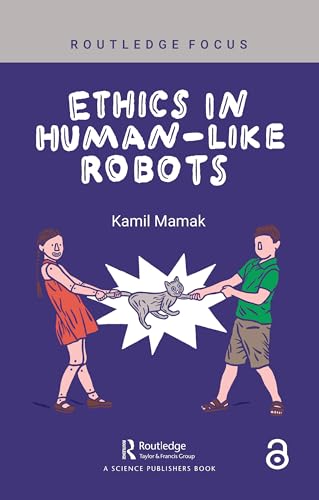

Ethics in human-like robots / Kamil Mamak, Department of Practical Philosophy, RADAR, University of Helsinki, Finland and Department of Criminal Law, Jagiellonian University, Kraków, Poland.
Editor: Boca Raton, FL : Routledge, Taylor & Francis Group, 2025Edición: First editionDescripción: vi, 134 pages ; 23 cmTipo de contenido:- text
- unmediated
- volume
- 9781032656236
- 9781032671048
- 303.48/34 23/eng/20241122
- TJ211.28 .M36 2025
| Imagen de cubierta | Tipo de ítem | Biblioteca actual | Biblioteca de origen | Colección | Ubicación en estantería | Signatura topográfica | Materiales especificados | Info Vol | URL | Copia número | Estado | Notas | Fecha de vencimiento | Código de barras | Reserva de ítems | Prioridad de la cola de reserva de ejemplar | Reservas para cursos | |
|---|---|---|---|---|---|---|---|---|---|---|---|---|---|---|---|---|---|---|
| Libro | Biblioteca de Mayagüez Colección General mb | TJ211.28 .M36 2025 (Navegar estantería(Abre debajo)) | c. 1 | Disponible | 50000003298550 |
Descripciones mejoradas de Syndetics:
The idea of creating artificial humans can be found at the beginning of the human culture. Ancient myths contain the stories of artificial humans brought to life by gods. The word robot originates from a play that was about artificial humans made from artificial flesh that aims to serve real humans. With advancements in robotics, the materialization of this idea is more real than ever before. We are witnessing attempts to create humanoid robots that might be deployed in many spheres of our life - policing, healthcare, and even for love and sex.
The book focuses on the ethical issues of human likeness of robots and human tendency to anthropomorphize. It is built on the assumption that design choices are not neutral, and they need to be discussed to align robots with human values. With robots operating in the physical world, they bring ideas and risks that should be addressed before widespread deployment. The book reviews specific issues and provides suggestions and recommendations for improving robots to serve humans better. It draws on literature from Human-Robot Interactions, ethics of AI and robotics, and the philosophy of technology.
The Open Access version of this book, available at http://www.taylorfrancis.com, has been made available under a Creative Commons Attribution-NonCommercial-NoDerivatives (CC-BY-NC-ND) 4.0 International license.
Includes bibliographical references and index.
1. Introduction -- 2. Risks of Living with Human-like Robots -- 3. Representational Issues of Human-like Robots -- 4. Human-like Ethics and Responsibility of Robots -- 5. Human Likeness of Robots and Moral Patiency -- 6. Conclusion: Towards Ethical Design of Human-like Robots
"The idea of creating artificial humans can be found at the beginning of human culture. Ancient myths contain the stories of artificial humans brought to life by gods. Also, the word "robot" originates from the play that was about artificial humans made from artificial flesh that aims to serve real humans. Due to the advancement in robotics, the materialization of this idea is more real than ever. We are witnessing the tries to create humanoid robots that might be deployed in many spheres of our life - police, healthcare but also love and sex. This book focuses on the ethical issues resulting from the human likeness of robots and the human tendency to anthropomorphize. It is built on the assumption that the design choices are not neutral, and we should discuss them to align robots with human values fully. With their bodies operating in the physical world, robots bring ideas and risks that need to be addressed before their broader deployment. This book reviews specific issues and provides suggestions and recommendations for improving robots to serve humans better. This book draws on the literature from Human-Robot Interactions, ethics of AI and robotics, and the philosophy of technology"-- Provided by publisher.
Notas de autor provistas por Syndetics
Kamil Mamak is a philosopher and a lawyer. He is a postdoctoral researcher at Robophilosophy, AI ethics and Datafication Research group at University of Helsinki and an assistant professor at the Department of Criminal Law at the Jagiellonian University, Cracow, Poland. He is also a board member at the Cracow Institute of Criminal Law. He holds PhDs in law (2018) from Jagiellonian University and philosophy (2020) from the Pontifical University of John Paul II in Cracow. He has authored 4 monographs. He has published more than 40 peer-reviewed journal articles and contributed chapters. His works have been published in reputed journals, including the European Journal of Criminology; Ethics and Information Technology; International Journal of Social Robotics; AI & Society; Medicine, Healthcare, and Philosophy; Science and Engineering Ethics; European Journal of Crime, Criminal Law and Criminal Justice; Frontiers in Robotics and AI, and Criminal Justice Studies. He received a research grant from the National Science Center in Poland. He is a recipient of the Minister's scholarship for outstanding young scientists.