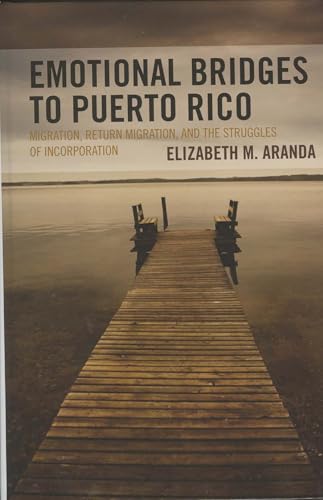

Emotional bridges to Puerto Rico : migration, return migration, and the struggles of incorporation / Elizabeth M. Aranda.
Idioma: Inglés Lanham, Md. : Rowman & Littlefield Publishers, c2007Descripción: xvi, 193 pages ; 24 cmTipo de contenido:- text
- unmediated
- volume
- 9780742543249 (cloth : alk. paper)
- Migration, return migration, and the struggles of incorporation
- Puerto Ricans -- Cultural assimilation -- United States
- Puerto Ricans -- United States -- Psychology
- Puerto Ricans -- United States -- Social conditions
- Immigrants -- United States -- Social conditions
- Middle class -- United States
- Return migration -- Puerto Rico
- Racism -- United States
- Puerto Rico -- Emigration and immigration
- United States -- Emigration and immigration
- United States -- Race relations
- 305.868/7295073 23
- E184.P85 A73 2007
| Imagen de cubierta | Tipo de ítem | Biblioteca actual | Biblioteca de origen | Colección | Ubicación en estantería | Signatura topográfica | Materiales especificados | Info Vol | URL | Copia número | Estado | Notas | Fecha de vencimiento | Código de barras | Reserva de ítems | Prioridad de la cola de reserva de ejemplar | Reservas para cursos | |
|---|---|---|---|---|---|---|---|---|---|---|---|---|---|---|---|---|---|---|
| Libro | Biblioteca Encarnación Valdés Colección de Puerto Rico | P.R. 305.868 A321e (Navegar estantería(Abre debajo)) | Disponible | 80000002616046 |
Descripciones mejoradas de Syndetics:
Emotional Bridges to Puerto Rico examines the experiences of incorporation among two groups of middle-class Puerto Ricans: one that currently lives in the U.S. mainland and one that has resettled in Puerto Rico. The analysis focuses on their subjective interpretations of incorporation and the conditions under which they decide to move back and forth between the mainland and island. Findings reveal that migration to the mainland results in educational, occupational and economic gains in the U.S., which also help return migrants re-enter Island labor markets. U.S. settlement brings its own set of struggles. Puerto Ricans see themselves as members of transnational families, yet the struggles of leading dual lives result in settlement decisions that reflect desires to live locally with roots in one place instead of feeling split between the two. Experiences with U.S. racism complicate these decisions, given Puerto Ricans' struggles with racial identity and exclusion in spite of their economic, occupational, and residential integration into mainland society. This study illustrates the conditions under which various patterns of attachments to place-or emotional anchoring-develop, and how these feelings impact future Puerto Rican settlement.
Includes bibliographical references (p. 177-184) and index.