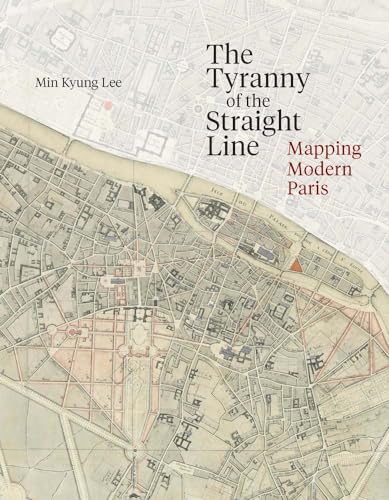

The tyranny of the straight line : mapping modern Paris. / Min Kyung Lee. txt
Editor: New Haven ; London : Yale University Press, 2024Descripción: xiii, 192 p. : ill. ; maps ; col. ; 29 cmTipo de contenido:- text
- still image
- unmediated
- volume
- 9780300267648
- 0300267649
- 23 526.094436109034
- GA865.P37 L44 2024
| Imagen de cubierta | Tipo de ítem | Biblioteca actual | Biblioteca de origen | Colección | Ubicación en estantería | Signatura topográfica | Materiales especificados | Info Vol | URL | Copia número | Estado | Notas | Fecha de vencimiento | Código de barras | Reserva de ítems | Prioridad de la cola de reserva de ejemplar | Reservas para cursos | |
|---|---|---|---|---|---|---|---|---|---|---|---|---|---|---|---|---|---|---|
| Libro Col. General CARIBET | CARIBET Biblioteca Arquitectura Colección General CARIBET | General GA865.P37 L44 2024 (Navegar estantería(Abre debajo)) | 1 | Disponible | 91000000073742 |
Descripciones mejoradas de Syndetics:
A revolutionary study of nineteenth-century Parisian cartography and its role in shaping a modern conception of space
Maps are rarely given the same attention as other print media or art forms in urban history. Author Min Kyung Lee shows their rich potential in this lavishly illustrated study, which brings together maps and other archival materials along with drawings and paintings. She works across disciplines to examine mapping practices in the development of nineteenth-century Paris and the transformative role that urban mapping had on the city's modernization. Lee investigates Paris's formation as a modern city, ultimately framing the practice of cartography as a catalyst for the emergence of new spatial and compositional theories.
Beginning with an examination of the emblematic urban plan that Napoléon III gave to the prefect of the Seine, Georges-Eugène Haussmann, in 1853, Lee explores the significance of the map itself; the means of its production through surveying; the methods of its use and reception by architects, engineers, and administrators; and its place in the visual culture of Paris's modernization. At the heart of this exploration is a focus on orthography in architecture and the new quality of exactitude in modern mapping practices. The precise grid structure of orthographic maps and plans evinced a sense of objectivity, yet it was not without political context and social consequences, as Lee demonstrates throughout.
Includes bibliographical references (pages 169-185) and index.
Master plans --
Triangulating the city --
Drawing grids --
The bureaucracy of plans --
Cartographic presentations --
The total view of the city --
"Maps are rarely given the same attention as other print media or art forms in urban history. Author Min Kyung Lee shows their rich potential in this lavishly illustrated study, which brings together maps and other archival materials along with drawings and paintings. She works across disciplines to examine mapping practices in the development of nineteenth-century Paris and the transformative role that urban mapping had on the city’s modernization. Lee investigates Paris’s formation as a modern city, ultimately framing the practice of cartography as a catalyst for the emergence of new spatial and compositional theories." -- Provided by publisher
Tabla de contenidos provista por Syndetics
- Preface(xi)
- Acknowledgments(xii)
- Introduction(1)
- Chapter 1 Master Plans(11)
- Chapter 2 Triangulating the City(29)
- Chapter 3 Drawing Grids(63)
- Chapter 4 The Bureaucracy of Plans(105)
- Chapter 5 Cartographic Presentations(127)
- Conclusion: The Total View of the City(153)
- Notes(157)
- Bibliography(169)
- Index(187)