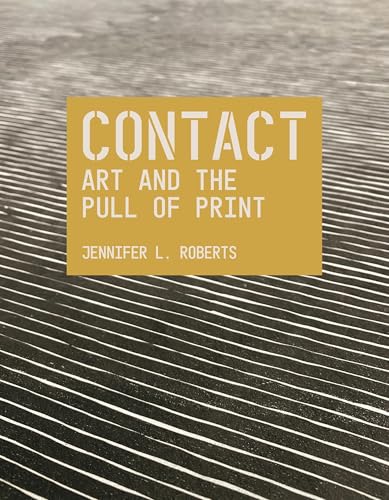

Contact : art and the pull of print. / Jennifer L. Roberts. txt
Series The A.W. Mellon lectures in the fine arts. Bollingen series ; XXXV:70 | A.W. Mellon lectures in the fine arts ; 2021. | Bollingen series ; 70.Editor: Princeton ; Oxford : Princeton University Press, 2024Descripción: ix, 220 p. : ill. ; col. ; 24 cmTipo de contenido:- text
- still image
- unmediated
- volume
- 0691255857
- 9780691255859
- NE850 R56 2024
| Imagen de cubierta | Tipo de ítem | Biblioteca actual | Biblioteca de origen | Colección | Ubicación en estantería | Signatura topográfica | Materiales especificados | Info Vol | URL | Copia número | Estado | Notas | Fecha de vencimiento | Código de barras | Reserva de ítems | Prioridad de la cola de reserva de ejemplar | Reservas para cursos | |
|---|---|---|---|---|---|---|---|---|---|---|---|---|---|---|---|---|---|---|
| Libro Col. General CARIBET | CARIBET Biblioteca Arquitectura Colección General CARIBET | General NE850 R56 2024 (Navegar estantería(Abre debajo)) | 1 | Disponible | 91000000073718 |
Descripciones mejoradas de Syndetics:
A leading art historian presents a new grammar for understanding the meaning and significance of print
In process and technique, printmaking is an art of physical contact. From woodcut and engraving to lithography and screenprinting, every print is the record of a contact event: the transfer of an image between surfaces, under pressure, followed by release. Contact reveals how the physical properties of print have their own poetics and politics and provides a new framework for understanding the intelligence and continuing relevance of printmaking today.
The seemingly simple physics of printmaking brings with it an array of metamorphoses that give expression to many of the social and conceptual concerns at the heart of modern and contemporary art. Exploring transformations such as reversal, separation, and interference, Jennifer Roberts explores these dynamics in the work of Christiane Baumgartner, David Hammons, Edgar Heap of Birds, Jasper Johns, Corita Kent, Glenn Ligon, Julie Mehretu, Robert Rauschenberg, and many other leading artists who work at the edge of the medium and beyond.
Focusing on the material and spatial transformations of the printmaking process rather than its reproducibility, this beautifully illustrated book explores the connections between print, painting, and sculpture, but also between the fine arts, industrial arts, decorative arts, and domestic arts. Throughout, Roberts asks what artists are learning from print, and what we, in turn, can learn from them.
Published in association with the Center for Advanced Study in the Visual Arts, National Gallery of Art, Washington
Includes bibliographical references (pages 200-208) and index.
1. Pressure --
2. Reversal --
3. Separation --
4. Strain --
5. Interference --
6. Alienation --
A leading art historian presents a new grammar for understanding the meaning and significance of print: In process and technique, printmaking is an art of physical contact. From woodcut and engraving to lithography and screenprinting, every print is the record of a contact event: the transfer of an image between surfaces, under pressure, followed by release. Contact reveals how the physical properties of print have their own poetics and politics and provides a new framework for understanding the intelligence and continuing relevance of printmaking today. The seemingly simple physics of printmaking brings with it an array of metamorphoses that give expression to many of the social and conceptual concerns at the heart of modern and contemporary art. Exploring transformations such as reversal, separation, and interference, Jennifer Roberts explores these dynamics in the work of Christiane Baumgartner, David Hammons, Edgar Heap of Birds, Jasper Johns, Corita Kent, Glenn Ligon, Julie Mehretu, Robert Rauschenberg, and many other leading artists who work at the edge of the medium and beyond. Focusing on the material and spatial transformations of the printmaking process rather than its reproducibility, this beautifully illustrated book explores the connections between print, painting, and sculpture, but also between the fine arts, industrial arts, decorative arts, and domestic arts. Throughout, Roberts asks what artists are learning from print, and what we, in turn, can learn from them.
Tabla de contenidos provista por Syndetics
- Preface(VIII)
- Introduction(2)
- 1 Pressure(12)
- 2 Reversal(40)
- 3 Separation(70)
- 4 Strain(102)
- 5 Interference(132)
- 6 Alienation(166)
- Acknowledgments(196)
- Notes(200)
- Credits(209)
- Index(211)