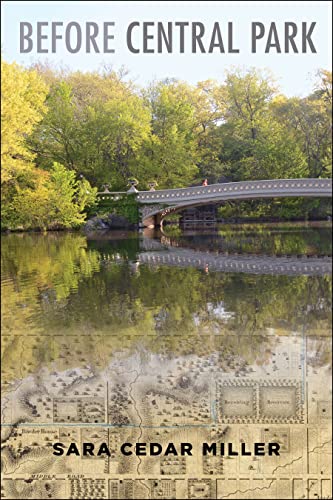

Before Central Park / Sara Cedar Miller. txt
Editor: New York : Columbia University Press, 2022Descripción: x, 611 p. : ill. ; photo. ; col. ; maps ; 25 cmTipo de contenido:- text
- unmediated
- volume
- 9780231181945
- 0231543905
- 23 974.7/1
- F128.65.C3 M54 2022
| Imagen de cubierta | Tipo de ítem | Biblioteca actual | Biblioteca de origen | Colección | Ubicación en estantería | Signatura topográfica | Materiales especificados | Info Vol | URL | Copia número | Estado | Notas | Fecha de vencimiento | Código de barras | Reserva de ítems | Prioridad de la cola de reserva de ejemplar | Reservas para cursos | |
|---|---|---|---|---|---|---|---|---|---|---|---|---|---|---|---|---|---|---|
| Libro Col. General CARIBET | CARIBET Biblioteca Arquitectura Colección General CARIBET | General F128.65.C3 M54 2022 (Navegar estantería(Abre debajo)) | 1 | Disponible | 91000000073668 |
Descripciones mejoradas de Syndetics:
Winner - 2023 John Brinkerhoff Jackson Book Prize, UVA Center for Cultural Landscapes
With more than eight hundred sprawling green acres in the middle of one of the world's densest cities, Central Park is an urban masterpiece. Designed in the middle of the nineteenth century by the landscape architects Frederick Law Olmsted and Calvert Vaux, it is a model for city parks worldwide. But before it became Central Park, the land was the site of farms, businesses, churches, wars, and burial grounds--and home to many different kinds of New Yorkers.
This book is the authoritative account of the place that would become Central Park. From the first Dutch family to settle on the land through the political crusade to create America's first major urban park, Sara Cedar Miller chronicles two and a half centuries of history. She tells the stories of Indigenous hunters, enslaved people and enslavers, American patriots and British loyalists, the Black landowners of Seneca Village, Irish pig farmers, tavern owners, Catholic sisters, Jewish protesters, and more. Miller unveils a British fortification and camp during the Revolutionary War, a suburban retreat from the yellow fever epidemics at the turn of the nineteenth century, and the properties that a group of free Black Americans used to secure their right to vote. Tales of political chicanery, real estate speculation, cons, and scams stand alongside democratic idealism, the striving of immigrants, and powerfully human lives. Before Central Park shows how much of the history of early America is still etched upon the landscapes of Central Park today.
Includes bibliographical references (pages 575-592) and index.
Preface vii --
Introduction 3 --
Part I: Topography
1 The First Settlers, 1625-1664 19 --
2 Along the Kingsbridge Road, 1683-1845 44 --
3 The Enslaved Bensons, 1754-1846 62 --
4 The War at McGowan’s Pass, 1776-1784 72 --
5 Valentine Nutter, 1760-1814 91 --
6 The War of 1812, 1805-1814 103 --
Part II: Real Estate
7 Dividing Bloomingdale, 1667-1790s 131 --
8 Dividing Bloomingdale, 1790-1824 149 --
9 Dividing Bloomingdale, Seneca Village: The Residents, 1825-1857 170 --
10 Dividing Bloomingdale, Seneca Village: The Black Leaders, 1825-1857 208 --
11 Dividing Harlem, 1825-1843 234 --
12 Dividing Yorkville, 1785-1835 244 --
13 The Receiving Reservoir, 1835-1842 275 --
14 A Changing Land, 1845-1853 289 --
Part III: The Idea of a Park
15 The Battle of the Parks, 1844-1852 323 --
16 Becoming Central Park, 1853-1856 340 --
17 The First Commission, 1855-1857 365 --
18 Designing Central Park, 1857-1858 386 --
19 Extending the Park, 1859-1863 420 --
Epilogue: America’s Park 437 --
Afterword by Elizabeth W. Smith, President and CEO of the Central Park Conservancy 445 --
Acknowledgments 451 --
Notes 457 --
Selected Bibliography 575 --
Index 593 --
"With more than eight hundred sprawling green acres in the middle of one of the world's densest cities, Central Park is an urban masterpiece. Designed in the middle of the nineteenth century by the landscape architects Frederick Law Olmsted and Calvert Vaux, it is a model for city parks worldwide. But before it became Central Park, the land was the site of farms, businesses, churches, wars, and burial grounds-and home to many different kinds of New Yorkers. This book is the authoritative account of the place that would become Central Park. From the first Dutch family to settle on the land through the political crusade to create America's first major urban park, Sara Cedar Miller chronicles two and a half centuries of history. She tells the stories of Indigenous hunters, enslaved people and enslavers, American patriots and British loyalists, the Black landowners of Seneca Village, Irish pig farmers, tavern owners, Catholic sisters, Jewish protesters, and more. Miller unveils a British fortification and camp during the Revolutionary War, a suburban retreat from the yellow fever epidemics at the turn of the nineteenth century, and the properties that a group of free Black Americans used to secure their right to vote. Tales of political chicanery, real estate speculation, cons, and scams stand alongside democratic idealism, the striving of immigrants, and powerfully human lives. Before Central Park shows how much of the history of early America is still etched upon the landscapes of Central Park today"--
Tabla de contenidos provista por Syndetics
- Preface(p. vii)
- Introduction(p. 3)
- Part I Topography
- 1 The First Settlers, 1625-1664(p. 19)
- 2 Along the Kingsbridge Road, 1683-1845(p. 44)
- 3 The Enslaved Bensons, 1754-1846(p. 62)
- 4 The War at McGowan's Pass, 1776-3784(p. 72)
- 5 Valentine Nutter, 1760-1814(p. 91)
- 6 The War of 1812, 1805-1814(p. 103)
- Part II Real Estate
- 7 Dividing Bloomingdale, 1667-1790s(p. 131)
- 8 Dividing Bloomingdale, 1790-1824(p. 149)
- 9 Dividing Bloomingdale, Seneca Village: The Residents, 1825-1857(p. 170)
- 10 Dividing Bloomingdale. Seneca Village: The Black Leaders, 1825-1857(p. 208)
- 11 Dividing Harlem, 1825-1843(p. 234)
- 12 Dividing Yorkville, 1785-1835(p. 244)
- 13 The Receiving Reservoir, 1835-1842(p. 275)
- 14 A Changing Land, 1845-1853(p. 289)
- Part III The Idea of a Park
- 15 The Battle of the Parks, 1844-1852(p. 323)
- 16 Becoming Central Park, 1853-1856(p. 340)
- 17 The First Commission, 1855-1857(p. 365)
- 18 Designing Central Park, 1857-1858(p. 386)
- 19 Extending the Park, 1859-1863(p. 420)
- Epilogue: America's Park(p. 437)
- Afterword(p. 445)
- Acknowledgments(p. 451)
- Notes(p. 457)
- Selected Bibliography(p. 575)
- Index(p. 593)