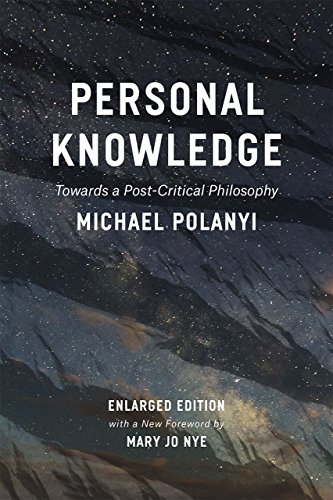

Personal knowledge : towards a post-critical philosophy / Michael Polanyi.
Editor: Chicago, Illinois : University of Chicago Press, [2015]Edición: Enlarged edition / with a new foreword by Mary Jo NyeDescripción: xxx, 428 pages ; 23 cmTipo de contenido:- text
- unmediated
- volume
- 9780226232621 (paperback : alkaline paper)
- 022623262X (paperback : alkaline paper)
- 501 23
- Q175 .P82 2015
| Imagen de cubierta | Tipo de ítem | Biblioteca actual | Biblioteca de origen | Colección | Ubicación en estantería | Signatura topográfica | Materiales especificados | Info Vol | URL | Copia número | Estado | Notas | Fecha de vencimiento | Código de barras | Reserva de ítems | Prioridad de la cola de reserva de ejemplar | Reservas para cursos | |
|---|---|---|---|---|---|---|---|---|---|---|---|---|---|---|---|---|---|---|
| Libro | Biblioteca Encarnación Valdés Colección General bev | 501 P762p 2015 (Navegar estantería(Abre debajo)) | Disponible | 80000002657164 |
Descripciones mejoradas de Syndetics:
An expanded edition of a landmark work in the philosophy of science The publication of Personal Knowledge in 1958 shook the science world, as Michael Polanyi took aim at the long-standing ideals of rigid empiricism and rule-bound logic. Today, Personal Knowledge remains one of the most significant philosophy of science books of the twentieth century, bringing the crucial concepts of "tacit knowledge" and "personal knowledge" to the forefront of inquiry.
In this remarkable treatise, Polanyi attests that our personal experiences and ways of sharing knowledge have a profound effect on scientific discovery. He argues against the idea of the wholly dispassionate researcher, pointing out that even in the strictest of sciences, knowing is still an art, and that personal commitment and passion are logically necessary parts of research. In our technological age where fact is split from value and science from humanity, Polanyi's work continues to advocate for the innate curiosity and scientific leaps of faith that drive our most dazzling ingenuity.
For this expanded edition, Polyani scholar Mary Jo Nye set the philosopher-scientist's work into contemporary context, offering fresh insights and providing a helpful guide to critical terms in the work. Used in fields as diverse as religious studies, chemistry, economics, and anthropology, Polanyi's view of knowledge creation is just as relevant to intellectual endeavors today as when it first made waves more than fifty years ago.
Includes index.
Objectivity -- Probability -- Order -- Skills -- Articulation -- Intellectual passions -- Conviviality -- The logic of affirmation -- The critique of doubt -- Commitment -- The logic of achievement -- Knowing life -- The rise of man.