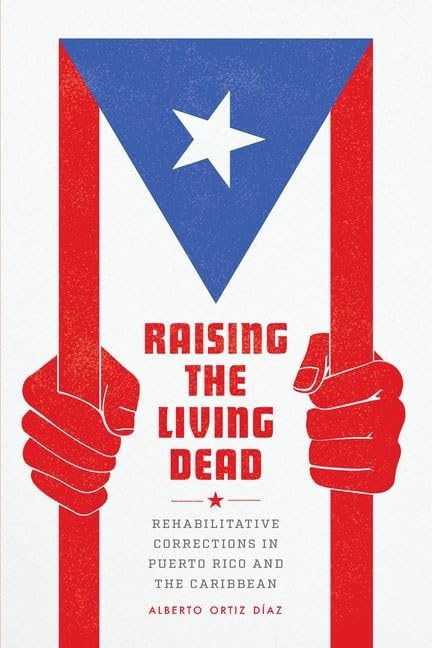

Raising the living dead : rehabilitative corrections in Puerto Rico and the Caribbean / Alberto Ortiz Díaz.
Editor: Chicago ; London : The University of Chicago Press, [2023]Descripción: 1 online resource (xv, 253 pages) : illustrationsTipo de contenido:- text
- computer
- online resource
- 9780226824499
- 9780226824512
- Rehabilitative corrections in Puerto Rico and the Caribbean
- 365/.97295
- HV9572 .O78 2023
| Imagen de cubierta | Tipo de ítem | Biblioteca actual | Biblioteca de origen | Colección | Ubicación en estantería | Signatura topográfica | Materiales especificados | Info Vol | URL | Copia número | Estado | Notas | Fecha de vencimiento | Código de barras | Reserva de ítems | Prioridad de la cola de reserva de ejemplar | Reservas para cursos | |
|---|---|---|---|---|---|---|---|---|---|---|---|---|---|---|---|---|---|---|
| Libro electrónico | Biblioteca de Mayagüez Acceso en línea | HV9572 .O78 2023 (Navegar estantería(Abre debajo)) | Ebook | Disponible | 50000003296745 |
Descripciones mejoradas de Syndetics:
An eye-opening look at how incarcerated people, health professionals, and others behind and beyond bars came together to problem-solve incarceration.
Raising the Living Dead is a history of Puerto Rico's carceral rehabilitation system that brings to life the interactions of incarcerated people, their wider social networks, and health care professionals. Alberto Ortiz Díaz describes the ways that multiple communities of care came together both inside and outside of prisons to imagine and enact solution-oriented cultures of rehabilitation from the 1930s to the 1960s. Scientific and humanistic approaches to well-being were deliberately fused to raise the "living dead," an expression that reemerged in the modern Caribbean to refer to prisoners. These reform groups sought to raise incarcerated people physically, mentally, socially, spiritually, and civically.
The book is based on deep, original archival research into the Oso Blanco (White Bear) penitentiary in Puerto Rico, yet it situates its study within Puerto Rico's broader carceral archipelago and other Caribbean prisons. The agents of this history include not only physical health professionals, but also psychologists and psychiatrists, social workers, spiritual and religious practitioners, and, of course, the prisoners and their families. By following all these groups and emphasizing the interpersonal exercise of power, Ortiz Díaz tells a story that goes beyond debates about structural and social control.
The book addresses key issues in the history of prisons and the histories of medicine and belief, including how prisoners' different racial, class, and cultural identities shaped their incarceration and how professionals living in a colonial society dealt with the challenge of rehabilitating prisoners for citizenship.
Raising the Living Dead is not just about convicts, their immediate interlocutors, and their contexts, however, but about how together these open a window into the history of social uplift projects within the (neo)colonial societies of the Caribbean. There is no book like this in Caribbean historiography; few examine these themes in the larger literature on the history of prisons.
Includes bibliographical references (pages 161-242) and index.
Introduction : toward a holistic history of incarceration -- Under a microscope : convict bodies and prison biomedicine -- To classify and treat : correctional psychology and psychiatry -- Interactional care : social workers, parole officers, and social rehabilitation -- More than flesh : sacred knowledge and experiential healing -- In pursuit of awakening : carceral therapeutic humanities -- Health activism : executive clemency on the Mona Passage -- Conclusion : a rehabilitative dream turnd punitive nightmare.
"Raising the Living Dead is a new history of Puerto Rico's carceral rehabilitation system in the middle decades of the twentieth century that brings to life the interactions of incarcerated people, their wider social networks, and health care professionals. The book addresses key issues in the history of prisons and the histories of medicine and belief, including how prisoners' different racial, class, and cultural identities shaped their incarceration and how professionals living in a colonial society dealt with the challenge of rehabilitating prisoners for citizenship. The main idea of the book is that, in the region, multiple communities of care came together both inside and outside of prisons to imagine and imperfectly enact solution-oriented cultures of rehabilitation. Specifically, Alberto Ortiz Díaz argues that scientific and humanistic approaches to well-being were deliberately fused to raise the "living dead" (an expression that reemerged in the modern Caribbean to refer to prisoners). These reform groups sought to raise incarcerated people physically, mentally, socially, spiritually, and civically. The book is based on deep, original archival research into the Oso Blanco (White Bear) penitentiary in Puerto Rico, yet it situates its study within Puerto Rico's broader carceral archipelago and other Caribbean prisons. The agents of this history include not only physical health professionals, but also their mental health counterparts (psychologists and psychiatrists), social workers, spiritual and religious practitioners, and, of course, the prisoners and their families. By following all these groups and emphasizing the interpersonal exercise of power, Ortiz Díaz is able to tell a story that goes beyond structural and social control debates. Raising the Living Dead is not just about convicts, their immediate interlocutors, and their contexts, however, but about how together these open a window into the history of social uplift projects within the (neo)colonial societies of the Caribbean. There is no book like this in Caribbean historiography and few examine these themes in the larger literature on the history of prisons"-- Provided by publisher.