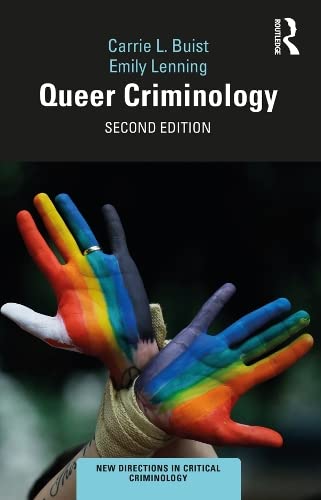

Queer criminology / Carrie L. Buist and Emily Lenning.
Editor: London ; New York : Routledge, Taylor and Francis Group, 2023Edición: Second EditionDescripción: 1 online resource (xvii, 211 pages)Tipo de contenido:- text
- computer
- online resource
- 9781000631319
- 9781000631296
- 306.76 23/eng/20220303
- HQ73 .B857 2023
| Imagen de cubierta | Tipo de ítem | Biblioteca actual | Biblioteca de origen | Colección | Ubicación en estantería | Signatura topográfica | Materiales especificados | Info Vol | URL | Copia número | Estado | Notas | Fecha de vencimiento | Código de barras | Reserva de ítems | Prioridad de la cola de reserva de ejemplar | Reservas para cursos | |
|---|---|---|---|---|---|---|---|---|---|---|---|---|---|---|---|---|---|---|
| Libro electrónico | Biblioteca de Mayagüez Acceso en línea | HQ73 .B857 2023 (Navegar estantería(Abre debajo)) | Ebook | Disponible | 50000003294252 |
Descripciones mejoradas de Syndetics:
This book surveys the growing field of Queer Criminology. It reflects on its origins, reviews its foundational research and scholarship and offers suggestions for future directions. Moreover, this book emphasizes the importance of Queer Criminology in the field and the need to move LGBTQ+ issues from the margins to the center of criminological research. Core content includes:
* Contested definitions of and conceptual frameworks for Queer Criminology
* The criminalization of queerness and gender identity in historical and contemporary context
* The relationship between LGBTQ+ communities and law enforcement
* The impact of legislation and court decisions on LGBTQ+ communities
* The experiences of queer victims and offenders under correctional supervision
This revised and updated edition includes new developments in theory and research, further coverage of international issues and a new chapter on victimization and offending. It is essential reading for those engaged with queer, critical, and feminist criminologies, gender studies, diversity, and criminal justice.
Includes bibliographical references and index.
Queer(ing) criminology -- Criminalizing queerness -- Queer criminology at the intersections: victimization and offending -- Queer criminology and law enforcement -- Queer criminology and legal systems -- Queer criminology and corrections -- Future directions in queer criminology.
"This book introduces the growing field of Queer Criminology. It reflects on its origins, surveys its foundational research and scholarship, and offers suggestions for future directions. Moreover, this book emphasises the importance of Queer Criminology to the field and the need to move LGBTQ issues from the margins to the centre of criminological research. Core content includes: -Contested definitions of and conceptual frameworks for Queer Criminology; -The criminalisation of queerness and gender identity in historical and contemporary context; -The relationship between LGBTQ communities and law enforcement; -The impact of legislation and court decisions on LGBTQ communities, including the issue of sentencing disparity; -The experiences of queer victims and offenders under correctional supervision, and the impact the criminal legal system has on both of these populations. This revised and updated edition includes new developments in theory and research, further coverage of international issues and a new chapter on victimization and offending. It is essential reading for those engaged with queer and feminist criminologies, gender studies, diversity, and criminal justice"-- Provided by publisher.
Description based on print version record and CIP data provided by publisher; resource not viewed.
Reseñas proporcionadas por Syndetics
CHOICE Review
The manner in which criminal justice institutions and organizations worldwide regard and treat queer people has only recently emerged as a focus of study within the discipline of critical criminology, and this concise and well-written volume sets forth the rationale for and subjects of study of this new subfield. Buist (Univ. of North Carolina, Wilmington) and Lenning (Fayetteville State Univ.) open with a consideration of the philosophical influences of feminism and queer theory on criminology's evolution, then move to examine "the experiences of Queer people as victims, offenders, and as practitioners." Topics include the criminalization of queer sexuality by legal systems (in many cases, as a homophobic legacy of colonialism), the failure of law enforcement agencies to serve and protect both juvenile and adult queer people, types of discrimination against openly LGBT police officers, the ways in which formal systems of criminal justice fall short in matters of equality before the law and equitable representation for LGBTQ people in court, and adult and juvenile correctional facilities and how both correctional policies and personnel define and treat queer people. Summing Up: Essential. All college and university library collections. --Robert B. Ridinger, Northern Illinois UniversityNotas de autor provistas por Syndetics
Carrie L. Buist is Associate Professor at Grand Valley State University's School of Criminology, Criminal Justice, and Legal Studies. Dr. Buist has been published in several notable journals such as Critical Criminology, University of Richmond Law Review, Crime and Justice, and Culture, Health, and Sexuality. Dr. Buist, along with Queer Criminology, has edited, with Lindsay K. Semprevivo, Queering Criminology in Theory and Praxis: Re-imagining Justice in the Criminal Legal System and Beyond. Dr. Buist has been recognized for her contributions to the discipline with multiple awards in research, teaching, and mentoring.
Emily Lenning is Professor of Criminal Justice at Fayetteville State University. Her publications cover a diverse range of topics, from state-sanctioned violence against women to queer experiences in the criminal legal system to creative advances in pedagogy. Her accomplishments in and out of the classroom have been recognized by several awards, including the 2017-2018 UNC Board of Governors Award for Excellence in Teaching and the 2016 Book Award from the American Society of Criminology's Division on Critical Criminology & Social Justice, for the first edition of this book.