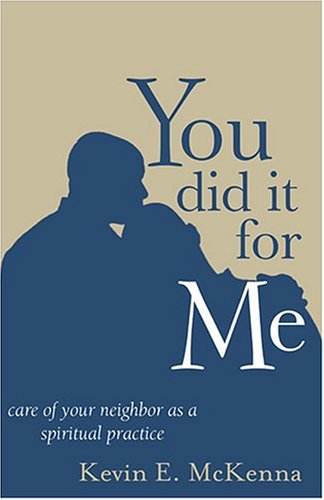

You did it for me : care of your neighbor as a spiritual practice / Kevin E. McKenna.
Detalles de publicación: Notre Dame, Ind. : Ave Maria Press, ©2005.Descripción: 190 pages ; 22 cmTipo de contenido:- text
- unmediated
- volume
- 1594710392 (pbk.)
- 261.8/088/282 22
- BX 1753 .M233 2005
| Imagen de cubierta | Tipo de ítem | Biblioteca actual | Biblioteca de origen | Colección | Ubicación en estantería | Signatura topográfica | Materiales especificados | Info Vol | URL | Copia número | Estado | Notas | Fecha de vencimiento | Código de barras | Reserva de ítems | Prioridad de la cola de reserva de ejemplar | Reservas para cursos | |
|---|---|---|---|---|---|---|---|---|---|---|---|---|---|---|---|---|---|---|
| Libro BET | Biblioteca Escuela de Teología Colección General BET | BX 1753 .M233 2005 (Navegar estantería(Abre debajo)) | Disponible | 41000000013095 |
Descripciones mejoradas de Syndetics:
Most books dealing with the social teachings of the Catholic Church simply relate those teachings and comment on them. You Did It for Me breaks the mold and shows that when you live the social gospel you live the spiritual life. Author Kevin McKenna explains that his "underlying reason for writing this book is my belief that spirituality and social concern go hand in hand and that Jesus is our model. He spent much time in prayer, and then went forth in action." This model of prayer and action also helps dispel the commonly held understanding that only by praying and escaping from the world can we live a spiritual life. McKenna explores numerous aspects of the Church's social teaching-including care of creation, human life and dignity, call to community, and the dignity of work-and shows through example and reflection, how you too can grow spiritually in the midst of the world. Book jacket.
Includes bibliographical references (p. 185-190).
Most books dealing with the social teachings of the Catholic Church simply relate those teachings and comment on them. You Did It for Me breaks the mold and shows that when you live the social gospel you live the spiritual life. Author Kevin McKenna explains that his "underlying reason for writing this book is my belief that spirituality and social concern go hand in hand and that Jesus is our model. He spent much time in prayer, and then went forth in action". This model of prayer and action also helps dispel the commonly held understanding that only by praying and escaping from the world can we live a spiritual life. McKenna explores numerous aspects of the Church's social teaching–including care of creation, human life and dignity, call to community, and reflection, how you too can grow spiritually in the midst of the world.
Tabla de contenidos provista por Syndetics
- Introduction(p. 13)
- Abbreviations(p. 21)
- Chapter 1 Care for God's Creation(p. 23)
- Our efforts to serve the poor and vulnerable must be accompanied by concrete efforts to address the causes of human suffering and injustice(p. 27)
- We are called to transform our hearts and our social structures, to renew the face of the earth(p. 39)
- We cannot celebrate a faith we do not practice(p. 40)
- We cannot proclaim a gospel we do not live(p. 42)
- Reflection Questions(p. 44)
- Chapter 2 Life and the Dignity of the Human Person(p. 45)
- In the Catholic social vision, the human person is central(p. 49)
- All people are a reflection of the image of God and thus all human life, at all its stages from conception through death, is sacred(p. 50)
- The human person is the clearest reflection of God among us(p. 53)
- Each person possesses a basic human dignity that comes from God(p. 57)
- The test of every institution or policy is whether it enhances or threatens human life and human dignity(p. 58)
- People take precedence over things and structures(p. 63)
- Reflection Questions(p. 65)
- Chapter 3 Call to Family, Community, and Participation(p. 67)
- The mystery of the Trinity involves the relationship of complete love among the three divine Persons-Father, Son, and Holy Spirit(p. 71)
- As people made in God's image, we must model divine love(p. 74)
- The human person is not only sacred, but also social(p. 77)
- We realize our dignity and rights in relationship with others, in community(p. 79)
- The family has major contributions to make in addressing questions of social justice(p. 80)
- The family is where we learn and act on our values(p. 82)
- We have the right and the responsibility to participate in and contribute to the broader communities in society(p. 84)
- A central test of political, legal, and economic institutions is what they do to people, what they do for people, and how people participate in them(p. 84)
- Reflection Questions(p. 86)
- Chapter 4 Rights and Responsibilities of the Human Person(p. 87)
- Flowing from our God-given dignity, each person has basic rights and responsibilities(p. 91)
- People have a fundamental right to life and to those things that make life truly human: food, clothing, housing, health care, education, security, social services, and employment(p. 97)
- Corresponding to these rights are duties and responsibilities-to one another, to our families, and to the larger society, to respect the rights of others, and to work for the common good(p. 99)
- Reflection Questions(p. 106)
- Chapter 5 Option for and With the Poor and Vulnerable(p. 107)
- The poor and vulnerable have a special place in Catholic social teaching(p. 109)
- The gospel calls Christians to put the needs of the poor first(p. 111)
- A basic moral test for society is how its most vulnerable members are faring(p. 112)
- The lesson of the parable of the Last Judgment (Mt 25)(p. 115)
- Our tradition calls us to put the needs of the poor and the vulnerable first(p. 116)
- As Christians, we are called to respond to the needs of all our sisters and brothers, but those with the greatest needs require the greatest response(p. 117)
- Whenever there is structural injustice, Christians are called to oppose it(p. 119)
- Reflection Questions(p. 126)
- Chapter 6 Dignity of Work and the Rights of Workers(p. 127)
- Work is an expression of our dignity and our involvement in God's creation(p. 134)
- Work is more than a way to make a living; it is an expression of our dignity and a form of continuing participation in God's creation(p. 136)
- People have the right to decent and productive work, to decent and fair wages, to private property and economic initiative(p. 139)
- Workers have the strong support of the church in forming and joining union and worker associations of their choosing in the exercise of their dignity and rights(p. 141)
- These values are at the heart of Rerum Novarum, and other encyclicals on economic justice(p. 142)
- In Catholic teaching, the economy exists to serve people, not the other way around(p. 143)
- Reflection Questions(p. 145)
- Chapter 7 Solidarity(p. 147)
- We are one human family, whatever our national, racial, ethnic, economic and ideological differences(p. 150)
- We are our brothers' and sisters' keepers (Gn 4:9)(p. 152)
- In a linked and limited world, our responsibilities to one another cross national and other boundaries(p. 152)
- Violent conflict and the denial of dignity and rights to people anywhere in the globe diminish each of us(p. 155)
- This emerging theme of solidarity, so strongly articulated by Pope John Paul II, expresses the core of the church's concern for world peace, global development, environment and international human rights(p. 158)
- It is the contemporary expression of the traditional Catholic image of the Mystical Body(p. 161)
- Because we realize our dignity, rights, and responsibilities, in relationship with others, we need to continue to build a community that empowers people to attain their full human potential(p. 162)
- Reflection Questions(p. 165)
- Conclusion(p. 167)
- Notes(p. 171)
- Sources and Suggested Readings(p. 185)