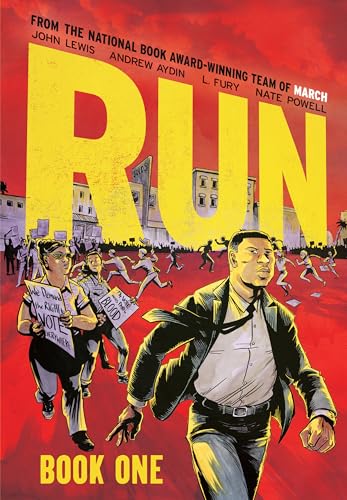

Run / written by John Lewis and Andrew Aydin ; art by L. Fury with Nate Powell.
Idioma: Inglés Editor: New York, New York : Abrams ComicArts, 2021Descripción: vi, 152 pages : illustrations ; 25 cmTipo de contenido:- text
- unmediated
- volume
- 9781419730696
- Run (Book One)
- Run 1
- 328.73/092 B 23
- E840.8.L43 A3 2021
| Imagen de cubierta | Tipo de ítem | Biblioteca actual | Biblioteca de origen | Colección | Ubicación en estantería | Signatura topográfica | Materiales especificados | Info Vol | URL | Copia número | Estado | Notas | Fecha de vencimiento | Código de barras | Reserva de ítems | Prioridad de la cola de reserva de ejemplar | Reservas para cursos | |
|---|---|---|---|---|---|---|---|---|---|---|---|---|---|---|---|---|---|---|
| Libro | Biblioteca Encarnación Valdés Colección General bev | 328.73092 L6731r (Navegar estantería(Abre debajo)) | Disponible | 80000002618034 |
Descripciones mejoradas de Syndetics:
First you march, then you run. From the #1 bestselling, award-winning team behind March comes the first book in their new, groundbreaking graphic novel series, Run: Book One
"Run recounts the lost history of what too often follows dramatic change-the pushback of those who refuse it and the resistance of those who believe change has not gone far enough. John Lewis's story has always been a complicated narrative of bravery, loss, and redemption, and Run gives vivid, energetic voice to a chapter of transformation in his young, already extraordinary life." -Stacey Abrams
"In sharing my story, it is my hope that a new generation will be inspired by Run to actively participate in the democratic process and help build a more perfect Union here in America." -Congressman John Lewis
The sequel to the #1 New York Times bestselling graphic novel series March-the continuation of the life story of John Lewis and the struggles seen across the United States after the Selma voting rights campaign.
To John Lewis, the civil rights movement came to an end with the signing of the Voting Rights Act in 1965. But that was after more than five years as one of the preeminent figures of the movement, leading sit-in protests and fighting segregation on interstate busways as an original Freedom Rider. It was after becoming chairman of SNCC (the Student Nonviolent Coordinating Committee) and being the youngest speaker at the March on Washington. It was after helping organize the Mississippi Freedom Summer and the ensuing delegate challenge at the 1964 Democratic National Convention. And after coleading the march from Selma to Montgomery on what became known as "Bloody Sunday." All too often, the depiction of history ends with a great victory. But John Lewis knew that victories are just the beginning. In Run: Book One, John Lewis and longtime collaborator Andrew Aydin reteam with Nate Powell-the award-winning illustrator of the March trilogy-and are joined by L. Fury-making an astonishing graphic novel debut-to tell this often overlooked chapter of civil rights history.
Includes bibliographical references.
"From the #1 New York Times bestselling, graphic novel series March comes the continuation of the life story of John Lewis and the struggles seen across the United States after the Civil Rights Movement. For John Lewis, the Civil Rights Movement as he knew it ended with the signing of the Voting Rights Act in 1965, but his struggle in the following years echo many of the same questions of civil rights and equality that are being asked today. The movement secured the right to sit at a lunch counter, but what about the right to earn a dollar to pay for your meal? Ousted from the Student Nonviolent Coordinating Committee due to internal disorder, Lewis went on to work on Robert F. Kennedy's campaign, to be shocked by the events of 1968. Struggling with the larger question of how to rebuild the movement, Lewis had an idea: someone should run for the 5th Congressional district seat in Georgia. Starting with the tragic death of Martin Luther King Jr., Run tells the story of how John Lewis entered politics, working within the community, and organizing a campaign that has taken him to one of the most important seats in Congress"--
Reseñas proporcionadas por Syndetics
Library Journal Review
A fourth illustrated civil rights history/memoir by the late congressman John Lewis and the team behind "March," his National Book Award-winning trilogy of graphic novels. The present volume (most pages were finished prior to Lewis's death in 2020) picks up after March: Book Three, in the turbulent era directly following the signing of the Voting Rights Act in 1965. It finds a 25-year-old Lewis struggling to retain his chairmanship in the Student Nonviolent Coordinating Committee (SNCC), rife with conflict. Members can't agree on a response to the surge of white supremacist attacks nationwide, or the escalating death toll of the Vietnam War; some are questioning the effectiveness of nonviolence. Lewis's plan to endorse Democratic Party candidates for public office creates further schisms within the SNCC; so does the Georgia state legislature's refusal to seat an elected representative who had endorsed the SNCC's position on Vietnam. When Lewis loses the SNCC chairmanship to Stokely Carmichael, he begins to despair at having worked so hard only to find himself washed-up at 26. He soon regains his determination to continue the civil rights struggle--this time from within the system, by running for office. VERDICT An unsentimental chronicle of a difficult period in United States history and in Lewis's life. Lewis makes clear that creating meaningful change is a contentious, complicated, and, most importantly, continuous process.Publishers Weekly Review
This worthy successor to the late Congressman Lewis's March graphic memoir trilogy picks up in the civil rights leader's life during the 1960s counterculture revolution. The narrative opens where March ended, with the hard-fought passage of the Civil Rights Act. But with these freedoms come fresh challenges and old threats that refuse to die. The Watts Riot breaks out just five days after the signing of the Voting Rights Act, foreshadowing the fraught period to come. As head of the Student Nonviolent Coordinating Committee, Lewis struggles to carry on the peace-based activism of his friend and mentor, Martin Luther King Jr., in the face of waves of white supremacist violence. As militant young Black activists take up the chant of "Black Power!" and ideological divisions tear the SNCC apart, Lewis and his colleague navigate sticky issues like the Vietnam War draft ("Where is the draft for the freedom fight in the United States?") and the Black separatist movement. "Is America ready to share its abundance with people of color?" Lewis wonders. At the same time, civil rights organizers such as Julian Bond and Marion Barry overcome enormous odds and violent opposition to win elected office, giving the still-young Lewis a glimpse of hope for his own political future. Newcomer Fury takes over capably from March's artist Powell (who assists on this volume), drawing in a similar fluid, softly shaded style that provides continuity while guiding readers into complex issues. This living history gives faces and voices to the legends of the civil rights era and connects their struggles to the present; the police brutality, voter suppression tactics, and segregationist politics of the 1960s are not so different from those Lewis was still making "good trouble" against at the time of his death in 2020. Lewis's stunning American story and legacy lives on in these pages. Agent: Jeff Posternak, the Wylie Agency. (Aug.)School Library Journal Review
Gr 8 Up--In this follow-up to the acclaimed "March" trilogy, which picks up right after the signing of the Voting Rights Act of 1965, Lewis and the Student Non-violent Coordinating Committee (SNCC) face one challenge after another. White supremacists, including law enforcement, resist social change and calls for integration. White violence and domestic terrorism target churches, traffic stops, voting booths, and public demonstrations. Apartheid in South Africa and the Vietnam War, along with the draft, add new frontiers to a progressive movement that watches one cold-blooded killing after another take place in the United States without justice. Increased pressure and lackluster results lead to infighting among SNCC's membership, who work to make change from a place of love but become increasingly frustrated and jaded. Lewis is but one committed figure here, as many dedicated Black and white members of SNCC are depicted, including those who opposed Lewis's leadership and continuous calls for integration and nonviolence. Fury and Powell's artwork captures various states of helplessness, from losing an election to staring down the barrel of a gun, while also conveying the determination and anger that Lewis and his peers summoned to keep from quitting. Extensive biographical, reference, and artistic notes in the back matter will illuminate casual and student readers alike. VERDICT Just as powerful as the "March" trilogy, this paean to "nonviolent soldiers" is principled, tragic, and stirring.--Thomas Maluck, Richland Lib., SCBooklist Review
Lewis, Aydin, and Powell's stirring March trilogy continues in this first installment in a follow-up series tracing Lewis' life and career after the passing of the Voting Rights Act of 1965. Lewis is dedicated to but exhausted by his role as chairman of SNCC, and after the success of their earlier actions, the committee is wondering what to do next. Divisions hinted at in the March books bear fruit here, as a schism develops between factions in favor of more direct action and Lewis' commitment to nonviolence, especially as protests against the draft escalate. This is a wordy graphic novel, with abundant speech balloons and voice-overs offering insight into Lewis' motivations, but such a complicated moment in civil rights history deserves this kind of exploration. Particularly poignant is the focus on the limitations of the Voting Rights Act, which did nothing to stop violence directed at Black people or end systemic racism--facts all too relevant to today's current events. Fury balances those words with meaningful scenes, and her faces are expressive and distinct, helping with this volume's lengthy roster of characters. This is a fantastic choice for classrooms, though readers should be familiar with the March trilogy before diving in. Apart from the educational components, this will speak powerfully to anyone trying to make sense of their own values in the face of wider movements and calls to action. HIGH-DEMAND BACKSTORY: The March trilogy are some of the most recognizable graphic novels of the past few decades, thanks to scores of awards, so anticipate a lengthy hold list.Notas de autor provistas por Syndetics
Congressman John Lewis (1940-2020) was one of the "Big Six" leaders of groups who organized the 1963 March on Washington and was the author of the #1 New York Times bestselling graphic memoir series March.
Andrew Aydin is an award-winning comics writer. He was the Digital Director and Policy Advisor to the late Georgia congressman John Lewis, and his coauthor for March . He splits his time between Washington, D.C., and Hendersonville, NC.
Nate Powell is a New York Times bestselling, award-winning graphic novelist; his work includes the March trilogy, Rick Riordan's The Lost Hero, and Save It for Later. Powell is the first and only cartoonist ever to win the National Book Award.
L. Fury is a lifelong resident of Houston, Texas. After a stint in the gaming industry and then marketing, she shifted her sights to long-form comics, illustrating the unreleased Double Barrel Shogun. Run is Fury's first graphic novel.