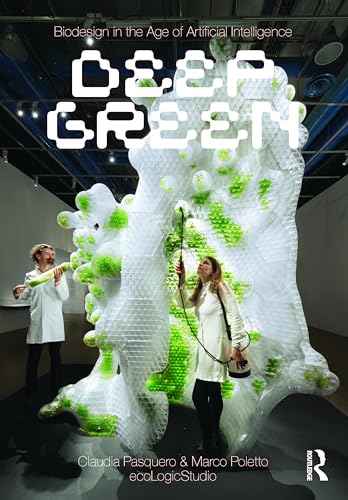

Biodesign in the age of artificial intelligence : deep green. / Claudia Pasquero & Marco Poletto. txt
Editor: New York, NY : Routledge, 2022Descripción: 259p. : ill. ; photo. ; maps ; col. ; 26cmTipo de contenido:- text
- unmediated
- volume
- 9780367768041
- 9780367768010
- Deep green
- Architecture and biology
- Architecture and technology
- Sustainable architecture
- Artificial intelligence -- Biological applications
- Artificial intelligence -- Industrial applications
- Artificial intelligence -- Biological applications
- Political science -- Public Policy / -- City Planning and Urban
- ARCHITECTURE / Landscape
- ARCHITECTURE / Urban & Land Use Planning
- 23 720.47
- NA2543.B56 P37 2022
| Imagen de cubierta | Tipo de ítem | Biblioteca actual | Biblioteca de origen | Colección | Ubicación en estantería | Signatura topográfica | Materiales especificados | Info Vol | URL | Copia número | Estado | Notas | Fecha de vencimiento | Código de barras | Reserva de ítems | Prioridad de la cola de reserva de ejemplar | Reservas para cursos | |
|---|---|---|---|---|---|---|---|---|---|---|---|---|---|---|---|---|---|---|
| Libro Col. General CARIBET | CARIBET Biblioteca Arquitectura Colección General CARIBET | General NA2543.B56 P37 2022 (Navegar estantería(Abre debajo)) | 1 | Disponible | 91000000072330 |
Descripciones mejoradas de Syndetics:
Biodesign in the Age of Artificial Intelligence: Deep Greeninvestigates the potentialof nature-based technology for shapingthe evolution of contemporary architectureand design. It takes on the now pervasivetopic of design intelligence, extending itsdefinition to encompass both biologicaland digital realms.
As in their first title, Systemic Architecture: Operating Manual for the Self-Organizing City , the authors engage the topic throughthe specific lens of their innovative designpractice, ecoLogicStudio, and their researchat the University of Innsbruck and at theBartlett, UCL. Part One of the book, entitledPhotoSynthetica(tm), illustrates designsolutions that engage the urban microbiomeand seek to achieve an immediateimpact, while Part Two, entitled DeepGreen, includes synthetic landscapes andoperates within a much larger spatio-temporalframe, going beyond human perceptionand life span to envision design as ageographical and geological force.
In the age of catastrophic climate change,such perceptual expansion helps to clarifythat change cannot simply be stoppedor rolled back. We must instead establishmore positive dynamics of change withinthe living world. To this end, this book proposesto engage with design and architectureas an extended cognitive interface, asentient being that is co-evolutionary andsymbiotic with the living planet, contributingto its beauty and to our continued enjoyment of it.
Includes bibliographical references and index.
Part 1: PhotoSynthetica --
Projects 1.01 : PhotoSynthetica test beds, pilot projects and early adoptions --
Biotechnological architecture : on culturalizing the urban microbiome --
Projects 1.02 : bio-digital sculptures. Designing the living --
Environmentalism beyond ideology : reprogramming the blue-green city --
Projects 1.03 : cyber-gardening the city --
Part 2: Deep Green --
Polycephalum : a journey through architecture, bio-computation and cognition --
Projects 2.01 : synthetic landscapes --
Projects 2.02 : deep planning --
Tomatoes and the immortality of the soul / Mario Carpo.
"Biodesign in the Age of Artificial Intelligence: Deep Green investigates the potential of nature based technology for shaping the evolution of contemporary architecture and design. It takes on the now pervasive topic of design intelligence, extending its definition to encompass both biological and digital realms. As in their first title, Systemic Architecture: Operating Manual for the Self Organizing City, the authors engage the topic through the specific lens of their innovative design practice, ecoLogicStudio and their research at the University of Innsbruck and at the Bartlett, UCL. Part One of the book, entitled PhotoSynthetica, illustrates design solutions that engage the urban microbiome and seek to achieve an immediate impact, while Part Two, entitled Deep Green, includes synthetic landscapes and operates within a much larger spatio-temporal frame, going beyond human perception and life span to envision design as a geographical and geological force. In the age of catastrophic climate change, such perceptual expansion helps to clarify that change cannot simply be stopped or rolled back. We must instead establish more positive dynamics of change within the living world. To this end, this book proposes to engage with design and architecture as an extended cognitive interface, a sentient being that is co-evolutionary and symbiotic with the living planet, contributing to its beauty and to our continued enjoyment of it"--
Notas de autor provistas por Syndetics
Claudia Pasquerois co-founder and director of ecoLogicStudio, lecturer and director of the Urban Morphogenesis Lab at The Bartlett UCL, and professor and director of the Synthetic Landscape Lab at Innsbruck University.
Marco Poletto is an architect, educator and innovator based in London. He is co-founder and director of the architectural practice ecoLogicStudio and the design innovation venture PhotoSynthetica, focussed on developing architectural solutions to fight climate change.