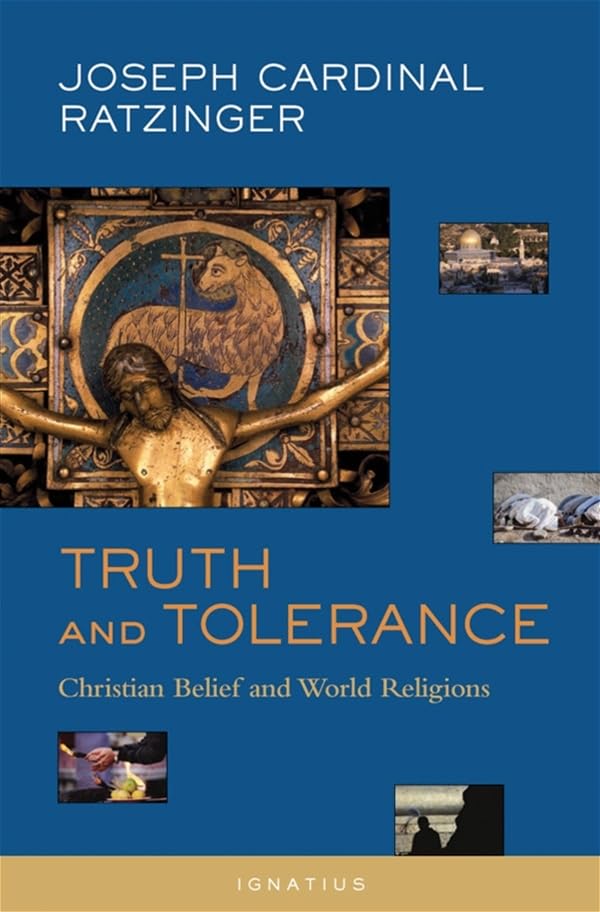

Truth and tolerance : Christian belief and world religions / Joseph Cardinal Ratzinger ; translated by Henry Taylor.
Idioma: Inglés Lenguaje original: Alemán Detalles de publicación: San Francisco : Ignatius Press, ©2004.Descripción: 284 pages ; 21 cmTipo de contenido:- text
- unmediated
- volume
- 158617035X
- 261.2 22
- BR 127 .R3813 2004
| Imagen de cubierta | Tipo de ítem | Biblioteca actual | Biblioteca de origen | Colección | Ubicación en estantería | Signatura topográfica | Materiales especificados | Info Vol | URL | Copia número | Estado | Notas | Fecha de vencimiento | Código de barras | Reserva de ítems | Prioridad de la cola de reserva de ejemplar | Reservas para cursos | |
|---|---|---|---|---|---|---|---|---|---|---|---|---|---|---|---|---|---|---|
| Libro BET | Biblioteca Escuela de Teología Colección General BET | BR 127 .R3813 2004 (Navegar estantería(Abre debajo)) | Disponible | 41000000012774 |
Descripciones mejoradas de Syndetics:
Is truth knowable? If we know the truth, must we hide it in the name of tolerance? Cardinal Ratzinger engages the problem of truth, tolerance, religion and culture in the modern world. Describing the vast array of world religions, Ratzinger embraces the difficult challenge of meeting diverse understandings of spiritual truth while defending the Catholic teaching of salvation through Jesus Christ. "But what if it is true?" is the question that he poses to cultures that decry the Christian position on man's redemption. Upholding the notion of religious truth while asserting the right of religious freedom, Cardinal Ratzinger outlines the timeless teaching of the Magisterium in language that resonates with our embattled culture. A work of extreme sensitivity, understanding, and spiritual maturity, this book is an invaluable asset to those who struggle to hear the voice of truth in the modern religious world.
"Beyond all particular questions, the real problem lies in the question about truth. Can truth be recognized? Or, is the question about truth simply inappropriate in the realm of religion and belief? But what meaning does belief then have, what positive meaning does religion have, if it cannot be connected with truth?"
-- Joseph Cardinal Ratzinger
From the Preface
Includes bibliographical references and indexes.
The Christian Faith in Its Encounter with Cultures and Religions -- The Unity and Diversity of Religions: The Place of Christianity in the History of Religions -- Interlude -- Faith, Religion, and Culture -- Variations on the Theme of Faith, Religion, and Culture -- Inclusivism and Pluralism -- Is Christianity a European Religion? -- Hellenization? -- Abraham and Melchizedek -- Distinguishing What Is Christian -- Multireligious and Interreligious Prayer -- Religions and the Question of Truth -- The New Questions That Arose in the Nineties: The Position of Faith and Theology Today -- The Truth of Christianity? -- Faith between Reason and Feeling -- Christianity–The True Religion? -- Faith, Truth, and Culture -- Reflections by Encyclical Fides et Ratio -- Truth–Tolerance–Freedom -- Faith–Truth–Tolerance --Freedom and Truth -- Individual Chapters Previously Published
Is truth knowable? If we know the truth, must hide it in the name of tolerance? Cardinal Ratzinger engages the problem of truth, tolerance, religion and Culture in the modern world. Describing the vast array of world religions, Ratzinger embraces the difficult challenge of meeting diverse understandings of spiritual truth while defending the Catholic teaching of salvation through Jesus Christ. "But what if it is true?" is the question that he poses to cultures that decry the Christian position on man's redemption. Upholding the notion of religious truth while asserting the right of religious freedom, Cardinal Ratzinger outlines the timeless teaching of the Magisterium in language that resonates with our embattled culture. A work of extreme sensitivity, understanding, and spiritual maturity, This book is an invaluable asset to those who struggle to hear the voice of truth in the modern religious world. "Beyond all particular questions, the real problem lies in the question about truth. Can truth be recognized? Or, is the question about truth simply inappropriate in the realm of religion and belief? But what meaning does belief then have, what positive meaning does religion have, if it cannot be connected with truth?" –Joseph Cardinal Ratzinger From the Preface.
Notas de autor provistas por Syndetics
Joseph Ratzinger was born on April 16, 1927 in Marktl am Inn in the state of Bavaria, Germany.Ratzinger entered the minor seminary in Traunstein, in 1939 and in 1943 along with the rest of his seminary class he was drafted into the Flak [anti-aircraft corps]. In 1944 he was released from the Flak and returned home only to be drafted into labor detail under the infamous Austrian Legion.
In the spring of 1945 Ratzinger deserted the army and headed home but when the Americans arrived at his village shortly thereafter, he was identified as a German soldier and incarcerated in a POW camp for a brief time. Following his release he re-entered the seminary.
In 1951 Joseph was ordained into the priesthood and began lectures as a full professor of fundamental theology at the University of Bonn. From 1962-65 Ratzinger was present during all four sessions of the Second Vatican Council as a peritus, or chief theological advisor to Cardinal Joseph Frings of Cologne, Germany.
. In 1977 Joseph Ratzinger was appointed Archbishop of Munich and Freising and on June 27 elevated to Cardinal of Munich by Pope Paul VI. In 1981 Ratzinger accepted Pope John Paul II's invitation to take over as Prefect for the Congregation for the Doctrine of the Faith and in 1986 he was appointed head of a 12-member commission responsible for drafting the Catechism of the Catholic Church.
Cardinal Ratzinger was elected vice dean of the College of Cardinals in 1988. In 2002 Pope John Paul II, approved his election as dean of the College of Cardinals.
On April 8, 2005, Cardinal Ratzinger presided over the funeral of Pope John Paul II. On April 19, 2005, Cardinal Ratzinger was elected Bishop of Rome on the fourth ballot of the conclave and took the name Benedict XVI.
(Bowker Author Biography)