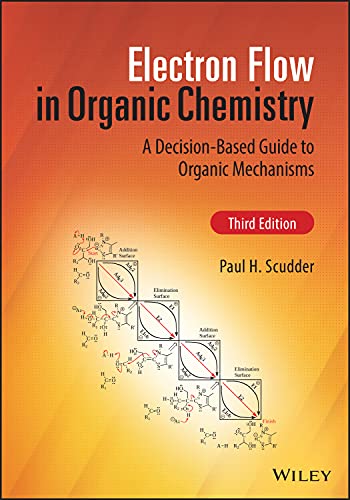

Electron flow in organic chemistry: a decision-based guide to organic mechanisms / Paul. H. Scudder.
Idioma: Inglés Wiley 2023 Hoboken, New Jersey :Edición: Third editionDescripción: 585 pages : illustrationsTipo de contenido:- text
- unmediated
- volume
- 9781119718932
- 23 547
| Imagen de cubierta | Tipo de ítem | Biblioteca actual | Biblioteca de origen | Colección | Ubicación en estantería | Signatura topográfica | Materiales especificados | Info Vol | URL | Copia número | Estado | Notas | Fecha de vencimiento | Código de barras | Reserva de ítems | Prioridad de la cola de reserva de ejemplar | Reservas para cursos | |
|---|---|---|---|---|---|---|---|---|---|---|---|---|---|---|---|---|---|---|
| Libro | Biblioteca Encarnación Valdés Colección General bev | 547.128 S436e3 (Navegar estantería(Abre debajo)) | Disponible | 80000002617572 |
Descripciones mejoradas de Syndetics:
Electron Flow in Organic Chemistry
Teaches students to solve problems in Organic Chemistry using methods of analysis that are valuable and portable to other fields
Electron Flow in Organic Chemistry provides a unique decision-based approach that develops a chemical intuition based on a crosschecked analysis process. Assuming only a general background in chemistry, this acclaimed textbook teaches students how to write reasonable reaction mechanisms and use analytical tools to solve both simple and complex problems in organic chemistry. As in previous editions, the author breaks down challenging organic mechanisms into a limited number of core elemental mechanistic processes, the electron flow pathways, to explain all organic reactions--using flow charts as decision maps, energy surfaces as problem space maps, and correlation matrices to display all possible interactions.
The third edition features entirely new chapters on crosschecking chemical reactions through good mechanistic thinking and solving spectral analysis problems using organic structure elucidation strategies. This edition also includes more biochemical reaction mechanism examples, additional exercises with answers, expanded discussion of how general chemistry concepts can show that structure determines reactivity, and new appendix covering transition metal organometallics. Emphasizing critical thinking rather than memorization to solve mechanistic problems, this popular textbook:
Features new and expanded material throughout, including more flowcharts, correlation matrices, energy surfaces, and algorithms that illustrate key decision-making processes Provides examples from the field of biochemistry of relevance to students in chemistry, biology, and medicine Incorporates principles from computer science and artificial intelligence to teach decision-making processes Contains a general bibliography, quick-reference charts and tables, pathway summaries, a major decisions guide, and other helpful tools Offers material for instructors including a solutions manual, supplemental exercises with detailed answers for each chapter usable as an exam file, and additional online resourcesElectron Flow in Organic Chemistry: A Decision-Based Guide to Organic Mechanisms, Third Edition, is the perfect primary textbook for advanced undergraduate or beginning graduate courses in organic reaction mechanisms, and an excellent supplement for graduate courses in physical organic chemistry, enzymatic reaction mechanisms, and biochemistry.
Includes bibliographical references and index.
1. Bonding and Electron Distribution
2. The Process of Bond Formation
3. Proton Transfer and the Principles of Stability
4. Important Reaction Archetypes
5. Classification of Electron Sources
6. Classification of Electron Sinks
7. The Electron Flow Pathways
8. Interaction of Electron Sources and Sinks
9. Decisions, Decisions
10. Choosing the Most Probable Path
11. Cross-Checks and Decision Boundaries
12. One-Electron Processes
13. Qualitative Molecular Orbital Theory and Pericyclic Reactions
14. Organic Structure Elucidation Strategies
Appendix -- A Bridge to Transition Metal Organometallics -- Hints to Problems from Chapters 8, 9, 10, and 11 -- Solutions to Odd Numbered Problems
"The third edition features entirely new chapters on crosschecking chemical reactions through good mechanistic thinking and solving spectral analysis problems using organic structure elucidation strategies. This edition also includes more biochemical reaction mechanism examples, additional exercises with answers, expanded discussion of how general chemistry concepts can show that structure determines reactivity, and new appendix covering transition metal organometallics."-- Provided by publisher
Reseñas proporcionadas por Syndetics
CHOICE Review
This new edition (1st ed., 1992) of Electron Flow in Organic Chemistry is a much-needed, well-developed textbook that highlights the importance of decision making in organic chemistry through numerous scientific methods. Scudder (New College of Florida) has added new pertinent chapters to illustrate basic concepts as well as advanced topics such as pericyclic reactions. The in-depth discussion of reaction energetics will be useful for students of organic chemistry and biochemistry. Flowcharts, correlation matrices, and energy surface diagrams are extensively used to present and reinforce concepts. Of particular note is the inclusion of the step-by-step approach to solving mechanistic problems in chapter 10. Throughout the book, the author makes an enormous effort to illustrate concepts as building blocks rather than as stand-alone topics. For example, the discussion of acidity and basicity in chapter 3 includes a consideration of the total structural factors; this is seldom done in most textbooks. Overall, this book is much more elaborate compared to its predecessor; it is more than 50 pages longer, contains two additional chapters, and has several new features and extensive logical connections. Summing Up: Highly recommended. Lower-division undergraduates through professionals/practitioners. S. Rajaraman Richard Stockton College of New JerseyNotas de autor provistas por Syndetics
Paul H. Scudder, PhD is Emeritus Professor of Chemistry at New College of Florida. During his 40 years of teaching, Professor Scudder taught courses on Organic Chemistry, Advanced Organic Chemistry, and Organic Structure Elucidation.