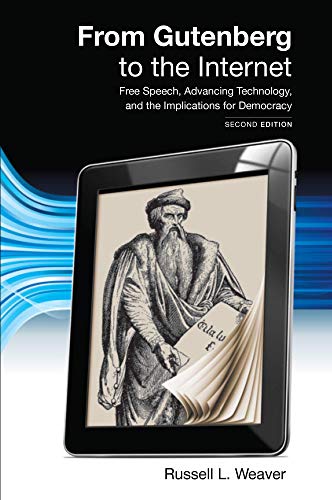

From Gutenberg to the Internet : free speech, advancing technology, and the implications for democracy / Russell L. Weaver.
Editor: Durham, North Carolina : Carolina Academic Press, 2019Edición: Second editionDescripción: xi, 367 pages ; 23 cmTipo de contenido:- text
- unmediated
- volume
- 9781531015091
- JA 85 .W43 2019
| Imagen de cubierta | Tipo de ítem | Biblioteca actual | Biblioteca de origen | Colección | Ubicación en estantería | Signatura topográfica | Materiales especificados | Info Vol | URL | Copia número | Estado | Notas | Fecha de vencimiento | Código de barras | Reserva de ítems | Prioridad de la cola de reserva de ejemplar | Reservas para cursos | |
|---|---|---|---|---|---|---|---|---|---|---|---|---|---|---|---|---|---|---|
| Libro | Biblioteca de Derecho Mons. Fremiot Torres Oliver Colección General biblioteca derecho | JA 85 .W43 2019 (Navegar estantería(Abre debajo)) | Disponible | 70000000905831 |
Descripciones mejoradas de Syndetics:
The history of free expression is inextricably intertwined with advances in speech technology. However, until recently, most forms of communication were limited and controlled by so-called "gatekeepers" who had the power to limit or control the ability of ordinary individuals to communicate with each other. With the advent of the Internet and new forms of technology, people have much greater capacity to communicate with each other. Although both governments and private entities have attempted to control discourse over the Internet, new technologies have enabled ordinary individuals to more easily communicate with each other and to participate in the political process.
This new edition explores how then-candidate Donald Trump used the Internet to help fuel his 2016 presidential campaign and also examines such phenomena as "fake news," Russian interference in the 2016 election, and some of the other problems that the Internet has spawned.
"Weaver's book is particularly fascinating in charting the progress of communication from the cave-painting of prehistoric times to the social media interaction of the modern day. In his characteristically accessible style, he provides passages that are rich and breath-taking in the range and depth of rigorous scholarship, whilst at the same time deeply enjoyable, demonstrating both a love of the subject and a tremendous knowledge of its history."--Dr. Paul Wragg, Communications Law, Vol. 24, No. 3, 2019
"From personal experience I can vouch for it being an excellent addition to any media lawyer's collection. Weaver has managed to strike a very difficult balance: this book is accessible to a wide range of audiences, yet it provides a depth of analysis and insight that will make it invaluable to media law and communication scholars. It will also be of interest to practising media lawyers and those involved in communication policy
and media regulation."-- Dr. Peter Coe, Entertainment Law Review 2020, 31(5), 185-186
Includes bibliographical references and index.
Early communication -- The Gutenberg Revolution -- The emergence of "Gatekeepers": Public and private -- The development of electricity: An explosion of new technologies -- Electronic (non-Internet) gatekeepers -- The development of the Internet -- The implications of the Internet for democracy -- Governmental repression and the emergence of new gatekeepers -- The dark side of the web -- The Internet's impact on traditional media -- Information overload.
"The history of free expression is inextricably interwined with advances in speech technology. However, until recently, most forms of communication were limited and controlled by so-called "gatekeepers" who had the power to limit or control the ability of ordinary individuals to communicate with each other. With the advent of the Internet, and new forms of technology (e.g., personal computers, iPhones, etc.), people have much greater capacity to communicate with each other. Although both goverments and private entities have attemted to control discourse over the Internet, new technologies have enabled ordinary individuals to more easily communicate with each other and to participate in the political process. As a result, the Internet is reshaping political debate and political action all over the world."