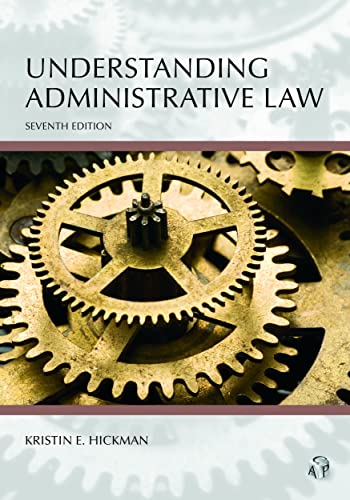

Understanding administrative law / by Kristin E. Hickman.
Series Understanding seriesEditor: Durham, North Carolina : Carolina Academic Press, LLC, 2022Edición: Seventh editionDescripción: xvi, 501 pages ; 26 cmTipo de contenido:- text
- unmediated
- volume
- 9781531004491
- KF 5402 .F68 2022
| Imagen de cubierta | Tipo de ítem | Biblioteca actual | Biblioteca de origen | Colección | Ubicación en estantería | Signatura topográfica | Materiales especificados | Info Vol | URL | Copia número | Estado | Notas | Fecha de vencimiento | Código de barras | Reserva de ítems | Prioridad de la cola de reserva de ejemplar | Reservas para cursos | |
|---|---|---|---|---|---|---|---|---|---|---|---|---|---|---|---|---|---|---|
| Libro | Biblioteca de Derecho Mons. Fremiot Torres Oliver Colección General biblioteca derecho | KF 5402 .F68 2022 (Navegar estantería(Abre debajo)) | Disponible | 70000000905834 |
Descripciones mejoradas de Syndetics:
This Understanding volume is designed to help the reader grasp the fundamental concepts of administrative law. Understanding Administrative Law addresses the role of administrative agencies in our system of government, the processes of administrative decisionmaking by agencies, and judicial review of agency action. As appropriate, Understanding Administrative Law touches on the substance of the laws that agencies are called upon to implement and administer.
As students study the topic of administrative law and later enter into legal practice, they will find that the substance of the laws that agencies implement and administer and the procedures that agencies follow in performing those functions are increasingly intertwined and, in many instances, almost inextricable. An awareness that no bright line exists between substance and procedure, particularly in the context of an administrative agency, is especially helpful to a thorough understanding of administrative law.
Additionally, Understanding Administrative Law includes recommendations for identifying administrative law issues and tools for organizing the reader's thinking once an issue has been identified. Understanding Administrative Law highlights the manner in which a client's issues may move through a typical agency and the manner in which lawyers cope with different stages of client representation before administrative agencies. Additionally, Understanding Administrative Law identifies trends in judicial review of agency action, including an evolving jurisprudence regarding the nondelegation doctrine, agency design, and judicial deference to agency interpretations of law. The seventh edition discusses recent cases and provides extensive citations to law review articles and other resources for readers who wish to study further topics covered by the volume.
Includes bibliographical references and index.
Introduction -- External controls on administrative agencies : the legislative branch -- External controls on administrative agencies : the executive branch -- The exercise of agency power -- Constitutional due process and agency decisionmaking -- Agency decisionmaking : choosing between rulemaking and adjudication -- Rulemaking -- APA formal adjudication proceedings -- Informal agency action -- Judicial review of agency action : reviewability -- Judicial review : timing doctrines -- Judicial review of agency action : standing -- Judicial review : on the merits -- Obtaining government information.
"This Understanding treatise is designed to help the reader grasp the fundamental concepts of administrative law. Understanding Administrative Law addresses both the role of administrative agencies in our system of government, the process of administrative decisionmaking, and judicial review of agency action. As appropriate, it touches on the substance of the laws that agencies are called upon to implement and administer. As students study the topic of administrative law and later enter into legal practice, they will find that substance of the laws that agencies administer and the procedures they follow in performing that function become more and more intertwined and, in many instances, become almost inextricable. An awareness that there is no bright line between substance and procedure, particularly in the context of an administrative agency, is especially helpful to a thorough understanding of administrative law. Additionally, this book includes recommendations for identifying administrative law issues and tools for organizing the reader's thinking once an issue has been identified. Understanding Administrative Law highlights the manner in which a client's issues may move through a typical agency and the manner in which lawyers cope with the various stages of client representation before administrative agencies. Additionally, this volume identifies trends in judicial review of agency action, including an evolving jurisprudence regarding the nondelegation doctrine, agency design, and judicial deference to agency interpretations of law. The seventh edition discusses recent cases and provides extensive citations to law review articles and other resources for readers who wish to study further topics covered by the volume"--