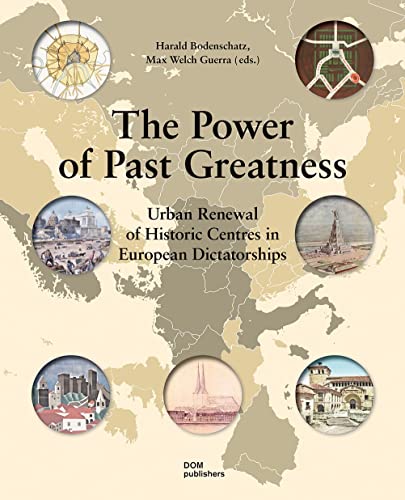

The power of past greatness : urban renewal of historic centres in European dictatorships. / Harald Bodenschatz [and five others] ; Harald Bodenschatz, Max Welch Guerra (eds.) ; translation, Irene Wilson. txt
Series Schriften des Bauhaus-Instituts für Geschichte und Theorie der Architektur und Planung der Bauhaus-Universität Weimar. Papers of the Bauhaus Institute for the History and Theory of Architecture and Planning at the Bauhaus-Universität WeimarEditor: Berlin : DOM Publishers, 2021Descripción: 191 p. : ill. ; photo. ; col. ; maps ; plans ; 31 cmTipo de contenido:- text
- still image
- unmediated
- volume
- 9783869222059
- 3869222050
- Urban renewal of historic centres in European dictatorships
- 724.6
- HT178.E85 B63 2021
| Imagen de cubierta | Tipo de ítem | Biblioteca actual | Biblioteca de origen | Colección | Ubicación en estantería | Signatura topográfica | Materiales especificados | Info Vol | URL | Copia número | Estado | Notas | Fecha de vencimiento | Código de barras | Reserva de ítems | Prioridad de la cola de reserva de ejemplar | Reservas para cursos | |
|---|---|---|---|---|---|---|---|---|---|---|---|---|---|---|---|---|---|---|
| Libro Col. General CARIBET | CARIBET Biblioteca Arquitectura Colección General CARIBET | General HT178.E85 B63 2021 (Navegar estantería(Abre debajo)) | 1 | Disponible | 91000000071878 |
Descripciones mejoradas de Syndetics:
The redevelopment of historical centres became an important policy field in the era of European dictatorships following the First World War.
At that time historical centres were regarded as shabby and as tarnishing the desired image of a magnificent new city, of a showcase of the dictatorship. This led to the widespread demolition of older buildings. Historical streets and squares disappeared and were replaced by new apartments and workplaces for the loyal middle classes, by car-friendly roads and ostentatious new buildings. Nevertheless, the redevelopment of historical centres did not exclusively mean the eradication of the 'old town'. The aim of the dictatorship in many cases was also the preservation, and often the cultic display, of historical testimonials to past greatness.
The book presents examples of the redevelopment of historical centres in Mussolini's Italy, in Stalin's Soviet Union, in Hitler's Germany, in Salazar's Portugal and in Franco's Spain.
Translated from the German.
Includes bibliographical references and index.
6 The Urban Renewal of Historic Centres in the Service of European Dictatorships Harald Bodenschatz and Welch Guerra --
I 0 The Urban Renewal of Historic Centres in Mussolini's Italy Harald Bodenschatz --
11 Rome: The Evocation of Imperial Greatness --
28 Brescia: A New Square from One Mould --
30 Bologna: Contradictory Concepts --
33 Naples: Radical Modernization --
35 Policy of Urban Renewal --
44 The Urban Renewal of Historic Centres in Stalin's Soviet Union: Moscow Steffen Ott with Harald Bodenschatz and Christiane Post --
45 Moscow after the October Revolution --
47 The Great Turnaround of Socialist Urban Development --
50 The Reconstruction of the Historic Centre of Moscow --
72 Policy of Urban Renewal --
82 The Urban Renewal of Historic Centres in Hitler's Germany: Berlin Harald Bodenschatz --
86 Plans for the Historic Centre of Berlin towards the End of the 'Weimar Republic --
89 The Reconstruction of Berlin's Southern Historic Centre after 1933 --
93 Projects on the Periphery of the Historic Centre --
96 A Second Phase of Historic Centre Redevelop --
98 Policy of Urban Renewal --
106 The Urban Renewal of Historic Centres in Salazar Portugal Christian von Oppen --
107 Limbo = Centre of die Empire --
114 Evora Museum City --
125 Obidos Portugnese Rothenbarg --
134 Policy of Urban Renewal --
142 The Urban Renewal of Historic Centres in Franco's Spain Piero Sassi --
143 Madrid: A New Crown for the Historic Centre --
147 Toledo: Place of Pilgrimage for Heroic Remembrance --
150 Barcelona: A New Gothic Quarter --
158 Zaragoza: "Spiritual Centre of Sanishness --
163 Santillana del Mar: a National Monument --
165 Policy of Urban Renewal --
174 Urban Renewal of Historic al Centres Part of the in Dictatorships: An Integral European History of Urban 'Development Harald Bodenschatz --
175 The Urban Renewal of 'Historic Centres before the First World --
176 New Appreciation of the Historic Centres in Professional Circles --
178 Ambivalent Appreciation of the'Historic Centres between the Wars --
183 Wartime Destruction, Reconstruction and 'Wholesale Demolition --
185 Cautious 'Urban Renewal since the 1970s --
187 Outlook --
190 Register of Persons --
191 Authors --
The redevelopment of historical centres became an important policy field in the era of European dictatorships following the First World War. At that time historical centres were regarded as shabby and as tarnishing the desired image of a magnificent new city, of a showcase of the dictatorship. This led to the widespread demolition of older buildings. Historical streets and squares disappeared and were replaced by new apartments and workplaces for the loyal middle classes, by car-friendly roads and ostentatious new buildings. Nevertheless, the redevelopment of historical centres did not exclusively mean the eradication of the ?old town?. The aim of the dictatorship in many cases was also the preservation, and often the cultic display, of historical testimonials to past greatness.0The book presents examples of the redevelopment of historical centres in Mussolini?s Italy (Rome, Brescia, Bologna, Naples), in Stalin?s Soviet Union (Moscow), in Hitler?s Germany (Berlin), in Salazar?s Portugal (Lisbon, Évora, Óbidos) and in Franco?s Spain (Madrid, Toledo, Barcelona, Zaragoza, Santillana del Mar). These are followed by a brief summary of the history of the redevelopment of historical centres in Europe. This volume represents the very first attempt to identify the commonalities and differences in the redevelopment of historical centres in dictatorships in Europe in the first half of the 20th century.