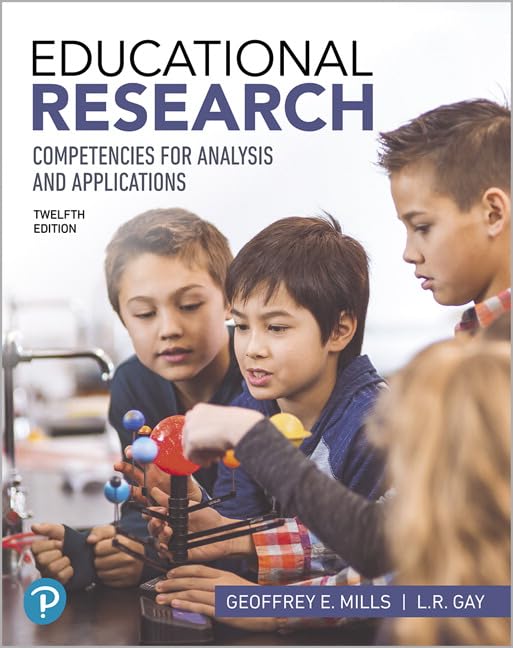

Educational research : competencies for analysis and applications / Geoffrey E. Mills and L.R. Gay.
Editor: New York, New York : Pearson, [2019]Edición: Twelfth editionDescripción: xix, 691 pages : illustrations ; 26 cmTipo de contenido:- text
- unmediated
- volume
- 9780134784229
- 370.72 23
- LB1028 .M495 2019
| Imagen de cubierta | Tipo de ítem | Biblioteca actual | Biblioteca de origen | Colección | Ubicación en estantería | Signatura topográfica | Materiales especificados | Info Vol | URL | Copia número | Estado | Notas | Fecha de vencimiento | Código de barras | Reserva de ítems | Prioridad de la cola de reserva de ejemplar | Reservas para cursos | |
|---|---|---|---|---|---|---|---|---|---|---|---|---|---|---|---|---|---|---|
| Libro | Biblioteca Encarnación Valdés Colección General bev | 370.72 M6571 2019 (Navegar estantería(Abre debajo)) | Disponible | 80000002654732 |
Descripciones mejoradas de Syndetics:
A comprehensive, accessible introduction to educational research
Educational Research: Competencies for Analysis and Applications uses engaging, straightforward language to introduce students to the information and skills required to successfully conduct research and to competently evaluate research. Long known for their clear and at times humorous writing, the authors are accessible and thoughtful guides for readers who are being introduced for the first time to a field that many of them might find initially intimidating. The text provides a total instructional system that lays out clear learning targets and then supports students as they practice and develop expertise in both doing and reading research.
The 12th Edition includes a new, separate chapter on ethics, expands its coverage of single-subject research, covers the latest digital strategies and tools for doing research, and introduces students to the open source statistics software R.
Also available with MyLab Education
MyLab is the teaching and learning platform that empowers you to reach every student. By combining trusted author content with digital tools and a flexible platform, MyLab personalizes the learning experience and improves results for each student. MyLab Education helps teacher candidates bridge the gap between theory and practice--better preparing them for success in their future classrooms.
Note: You are purchasing a standalone product; MyLab Education does not come packaged with this content. Students, if interested in purchasing this title with MyLab Education, ask your instructor to confirm the correct package ISBN and Course ID. Instructors, contact your Pearson representative for more information.
If you would like to purchase both the physical text and MyLab Education search for:
0134784073 / 9780134784076 Educational Research: Competencies for Analysis and Applications plus MyLab Education with Pearson eText -- Access Card Package
Package consists of:
Includes bibliographical references and indexes.
Tabla de contenidos provista por Syndetics
- Part I Foundational Concepts and Processes
- Chapter 1 Introduction To Educational Research(p. 2)
- Tasks 1A.1B(p. 3)
- Task 1C(p. 3)
- Welcome!(p. 3)
- The Scientific Method(p. 4)
- Limitations of the Scientific Method(p. 4)
- Application of the Scientific Method in Education(p. 5)
- Different Approaches to Educational Research(p. 6)
- The Continuum of Research Philosophies(p. 6)
- Quantitative Research(p. 6)
- Qualitative Research(p. 7)
- Mixed Methods Research(p. 8)
- Characteristics of Quantitative and Qualitative Research Approaches(p. 8)
- Classification of Research by Design(p. 10)
- Quantitative Approaches(p. 10)
- Qualitative Approaches(p. 13)
- Classification of Research by Purpose(p. 16)
- Basic and Applied Research(p. 16)
- Evaluation Research(p. 17)
- Research and Development (R&D)(p. 17)
- Action Research(p. 17)
- Summary(p. 20)
- Performance Criteria Task 1(p. 23)
- Tasks 1A and 1B(p. 23)
- Task 1C(p. 23)
- Task 1A Quantitative Example(p. 24)
- Task 1B Qualitative Example(p. 48)
- Chapter 2 Ethics in Educational Research(p. 60)
- Task ID(p. 61)
- Ethical Codes(p. 61)
- Informed Consent and Protection from Harm(p. 62)
- Deception(p. 63)
- Ethical Issues Unique to Qualitative Research(p. 64)
- Navigating Ethical Issues In Qualitative Research(p. 65)
- Action Research and IRBs(p. 67)
- Gaining Entry to a Research Site(p. 69)
- Summary(p. 73)
- Performance Criteria Task 1D(p. 75)
- Chapter 3 Selecting And Defining A Research Problem(p. 76)
- Task 2(p. 77)
- The Research Problem(p. 77)
- Identifying a Research Problem(p. 77)
- Sources of Research Problems(p. 78)
- Narrowing the Problem(p. 81)
- Characteristics of Good Problems(p. 82)
- Stating the Research Problem(p. 82)
- Developing Research Questions(p. 83)
- Formulating and Stating a Hypothesis(p. 85)
- Definition and Purpose of Hypotheses in Quantitative Studies(p. 86)
- Types of Hypotheses(p. 87)
- Stating the Hypothesis(p. 88)
- Testing the Hypothesis(p. 89)
- Definition and Purpose of Hypotheses in Qualitative Studies(p. 89)
- Summary(p. 91)
- Performance Criteria Task 2(p. 93)
- Chapter 4 Reviewing The Literature(p. 94)
- Task 3A(p. 95)
- Task 3B(p. 95)
- Review of Related Literature: Purpose and Scope(p. 95)
- Qualitative Research and the Review of Related Literature(p. 97)
- Identifying Keywords and Identifying, Evaluating, and Annotating Sources(p. 97)
- Identifying Keywords(p. 97)
- Identifying Your Sources(p. 98)
- Evaluating Your Sources(p. 109)
- Annotating Your Sources(p. 111)
- Analyzing, Organizing, and Reporting the Literature(p. 114)
- Make an Outline(p. 114)
- Analyze Each Reference in Terms of Your Outline(p. 115)
- Analyze the References Under Each Subheading for Similarities and Differences(p. 116)
- Give a Meaningful Overview of Past Research(p. 116)
- Discuss the References Least Related to Your Problem First and Those Most Related to Your Problem Just Before the Statement of the Hypothesis(p. 116)
- Conclude the Review with a Brief Summary of the Literature and Its Implications(p. 116)
- Meta-Analysis(p. 119)
- Summary(p. 121)
- Performance Criteria Tasks 3A and 3B(p. 124)
- Tasks 3A and 3B(p. 124)
- Task 3 Example(p. 125)
- Chapter 5 Preparing And Evaluating A Research Plan(p. 128)
- Task 4A(p. 129)
- Task 4B(p. 129)
- Definition and Purpose of a Research Plan(p. 129)
- Components of the Quantitative Research Plan(p. 130)
- Introduction Section(p. 130)
- Method Section(p. 131)
- Data Analysis(p. 133)
- Time Schedule(p. 133)
- Budget(p. 133)
- Components of the Qualitative Research Plan(p. 134)
- Prior Fieldwork(p. 134)
- Title(p. 134)
- Introduction Section(p. 134)
- Research Procedures Section(p. 135)
- Appendixes(p. 139)
- Revising and Improving the Research Plan(p. 139)
- Summary(p. 140)
- Performance Criteria Task 4(p. 142)
- Task 4 Example(p. 143)
- Chapter 6 Selecting A Sample(p. 146)
- Task 5A(p. 147)
- Task 5B(p. 147)
- Sampling in Quantitative Research(p. 147)
- Defining a Population(p. 148)
- Selecting a Random Sample(p. 148)
- Determining Sample Size(p. 155)
- Avoiding Sampling Error and Bias(p. 157)
- Selecting a Nonrandom Sample(p. 158)
- Sampling in Qualitative Research(p. 159)
- Selecting Research Participants: Purposive Sampling Approaches(p. 160)
- Determining Sample Size(p. 161)
- Summary(p. 162)
- Performance Criteria Task 5(p. 164)
- Task 5A Example(p. 165)
- Chapter 7 Selecting Measuring Instruments(p. 166)
- Task 6(p. 167)
- Vignette: Big Pine School District(p. 167)
- Constructs(p. 167)
- Variables(p. 168)
- Measurement Scales and Variables(p. 168)
- Quantitative and Qualitative Variables(p. 170)
- Dependent and independent Variables(p. 170)
- Characteristics of Measuring Instruments(p. 171)
- Instrument Terminology(p. 171)
- Quantitative and Qualitative Data Collection Methods(p. 172)
- Interpreting Instrument Data(p. 172)
- Types of Measuring Instruments(p. 173)
- Cognitive Tests(p. 173)
- Affective Tests(p. 174)
- Projective Tests(p. 177)
- Criteria for Good Measuring Instruments(p. 178)
- Validity of Measuring Instruments(p. 178)
- Reliability of Measuring Instruments(p. 182)
- Test Selection, Construction, and Administration(p. 187)
- Selecting a Test(p. 187)
- Sources of Test Information(p. 188)
- Selecting from Alternatives(p. 190)
- Constructing Tests(p. 191)
- Test Administration(p. 192)
- Summary(p. 194)
- Performance Criteria Task 6(p. 197)
- Task 6 Example(p. 198)
- Part II Research Designs
- Chapter 8 Survey Research(p. 200)
- Task 7A(p. 201)
- Survey Research: Definition and Purpose(p. 202)
- Survey Research Designs(p. 202)
- Cross-Sectional Surveys(p. 202)
- Longitudinal Surveys(p. 203)
- Conducting Survey Research(p. 203)
- Conducting a Questionnaire Study(p. 204)
- Administering the Questionnaire(p. 208)
- Summary(p. 214)
- Example: Survey Study(p. 216)
- Chapter 9 Correlational Research(p. 222)
- Task 7B(p. 223)
- Correlational Research: Definition and Purpose(p. 224)
- The Correlational Research Piocess(p. 225)
- Problem Selection(p. 225)
- Participant and instrument Selection(p. 225)
- Design and Procedure(p. 225)
- Data Analysis and Interpretation(p. 225)
- Relationship Studies(p. 229)
- Data Collection(p. 229)
- Data Analysis and Interpretation(p. 230)
- Prediction Studies(p. 232)
- Data Collection(p. 233)
- Data Analysis and Interpretation(p. 233)
- Other Correlation-Based Analyses(p. 234)
- Problems to Consider in Interpreting Correlation Coefficients(p. 235)
- Summary(p. 236)
- Example: Correlational Study(p. 239)
- Chapter 10 Causal-Comparative Research(p. 248)
- Task 7C(p. 249)
- Causal-Comparative Research: Definition and Purpose(p. 250)
- The Causal-Comparative Research Process(p. 253)
- Design and Procedure(p. 253)
- Control Procedures(p. 254)
- Data Analysis and Interpretation(p. 255)
- Summary(p. 257)
- Example: Causal-Comparative Study(p. 258)
- Chapter 11 Experimental Research(p. 272)
- Task 7D(p. 273)
- Experimental Research: Definition and Purpose(p. 274)
- The Experimental Process(p. 275)
- Manipulation and Control(p. 276)
- Threats to Experimental Validity(p. 277)
- Threats to Internal Validity(p. 278)
- Threats to External Validity(p. 281)
- Control of Extraneous Variables(p. 286)
- Group Experimental Designs(p. 288)
- Single-Variable Designs(p. 289)
- Factorial Designs(p. 297)
- Summary(p. 300)
- Chapter 12 Single-Subject Experimental Research(p. 320)
- Task 7E(p. 321)
- Single-Subject Experimental Designs(p. 322)
- Single-Subject versus Group Designs(p. 322)
- The Single-Variable Rule(p. 322)
- Types of Single-Subject Designs(p. 322)
- Data Analysis and Interpretation(p. 328)
- Threats to Validity(p. 328)
- External Validity(p. 328)
- Internal Validity(p. 329)
- Replication(p. 330)
- Single-Subject Experimental Research Design in Action(p. 330)
- Summary(p. 333)
- Performance Criteria Task 7(p. 335)
- Task 7 Example(p. 336)
- Example: Single-Subject Study(p. 338)
- Chapter 13 Narrative Research(p. 350)
- Task 8A(p. 351)
- Narrative Research: Definition and Purpose(p. 352)
- Types of Narrative Research(p. 353)
- Narrative Analysis and the Analysis of Narrative(p. 354)
- The Narrative Research Process(p. 354)
- Key Characteristics of Narrative Research(p. 356)
- Narrative Research Techniques(p. 356)
- Restoring(p. 357)
- Oral History(p. 358)
- Examining Photographs, Memory Boxes, and Other Artifacts(p. 358)
- Storytelling(p. 358)
- Letter Writing(p. 358)
- Autobiographical and Biographical Writing(p. 359)
- Other Narrative Data Sources(p. 359)
- Writing the Narrative(p. 359)
- Summary(p. 361)
- Chapter 14 Ethnographic Research(p. 376)
- Task 8B(p. 377)
- Ethnographic Research: Definition and Purpose(p. 378)
- The Ethnographic Research Process(p. 379)
- Key Characteristics of Ethnographic Research(p. 381)
- Types of Ethnographic Research(p. 382)
- Ethnographic Research Techniques(p. 383)
- Participant Observation(p. 383)
- Field Notes(p. 385)
- Observing and Recording Everything You Possibly Can(p. 387)
- Looking for Nothing in Particular; Looking for Bumps and Paradoxes(p. 388)
- Summary(p. 390)
- Chapter 15 Case Study Research(p. 402)
- Task 8C(p. 403)
- Case Study Research: Definition and Purpose(p. 404)
- When to Use Case Study Research(p. 405)
- Characteristics of Case Study Research(p. 405)
- Case Study Research Design(p. 406)
- Sample Selection in Case Study Research(p. 408)
- Data Collection Techniques(p. 408)
- Conducting and Analyzing Multiple Case Studies(p. 409)
- Summary(p. 412)
- Chapter 16 Mixed Methods Research: Integrating Quantitative And Qualitative Research Designs(p. 428)
- Task 8D(p. 429)
- Mixed Methods Research: Definition and Purpose(p. 430)
- Types of Basic Mixed Methods Research Designs(p. 431)
- The Explanatory Sequential (QUAN → qual) Design(p. 431)
- The Explanatory Sequential (QUAL → quan) Deisgn(p. 432)
- The Convergent Parallel (QUAN + QUAL) Design(p. 433)
- Conducting Mixed Methods Research(p. 433)
- Identifying Studies Using Mixed Method Designs(p. 435)
- Evaluating a Mixed Methods Study(p. 435)
- Summary(p. 437)
- Performance Criteria Task 8(p. 438)
- Task 8 Example(p. 439)
- Chapter 17 Action Research(p. 450)
- Task 9(p. 451)
- Action Research: Definition and Purpose(p. 452)
- Key Characteristics of Action Research(p. 452)
- Action Research Is Persuasive and Authoritative(p. 452)
- Action Research is Relevant(p. 453)
- Action Research Is Accessible(p. 453)
- Action Research Challenges the Intractability of Reform of the Educational System(p. 453)
- Action Research Is Not a Fad(p. 453)
- Types of Action Research(p. 454)
- Critical Action Research(p. 454)
- Practical Action Research(p. 455)
- Levels of Action Research(p. 455)
- The Action Research Process(p. 456)
- Identifying an Area of Focus(p. 457)
- Data Collection, Analysis, and Interpretation(p. 458)
- Action Planning(p. 458)
- Summary(p. 460)
- Performance Criteria and Examples Task 9(p. 461)
- Write an Area-of-Focus Statement(p. 461)
- Define the Variables(p. 461)
- Develop Research Questions(p. 461)
- Describe the Intervention or Innovation(p. 461)
- Describe the Membership of the Action Research Group(p. 461)
- Describe Negotiations That Need to Be Undertaken(p. 462)
- Develop a Time Line(p. 462)
- Develop a Statement of Resources(p. 462)
- Develop Data Collection Ideas(p. 462)
- Example: Action Research(p. 463)
- Part III Working With Quantitative and Qualitative Data
- Chapter 18 Descriptive Statistics(p. 474)
- The Word Is Statistics, Not Sadistics(p. 475)
- The Language of Statistics(p. 475)
- Preparing Data for Analysis(p. 476)
- Scoring Procedures(p. 476)
- Tabulation and Coding Procedures(p. 476)
- Types of Descriptive Statistics(p. 477)
- Frequencies(p. 477)
- Measures of Central Tendency(p. 478)
- Measures of Variability(p. 480)
- The Normal Curve(p. 482)
- Skewed Distributions(p. 484)
- Measures of Relative Position(p. 485)
- Measures of Relationship(p. 488)
- Graphing Data(p. 491)
- "R" You Ready?(p. 492)
- Step 1 Installing R on Your Computer(p. 493)
- Step 2 Getting Your Data Into R(p. 493)
- Step 3 Calculating Some Descriptive Statistics(p. 495)
- Postscript(p. 496)
- Summary(p. 497)
- Chapter 19 Inferential Statistics(p. 500)
- Task 10(p. 501)
- Concepts Underlying Inferential Statistics(p. 501)
- Standard Error(p. 501)
- Hypothesis Testing(p. 504)
- Tests of Significance(p. 504)
- Two-Tailed and One-Tailed Tests(p. 505)
- Type I and Type II Errors(p. 507)
- Degrees of Freedom(p. 510)
- Selecting Among Tests of Significance(p. 510)
- The t Test(p. 511)
- Analysis of Variance(p. 518)
- Multiple Regression(p. 521)
- Chi Square(p. 525)
- Other Investigative Techniques: Data Mining, Factor Analysis, and Structural Equation Modeling(p. 528)
- Types of Parametric and Nonparametric Statistical Tests(p. 529)
- Calculating Inferential Statistics Using R(p. 530)
- Calculating the t Test for Independent Samples Using R(p. 531)
- Calculating the t Test for Nonindependent Samples Using R(p. 533)
- Calculating ANOVA with Post Hoc Multiple Comparison Tests Using R(p. 533)
- Calculating Multiple Regression Using R(p. 535)
- Calculating Chi Square Using R(p. 535)
- If You "R" Still Onboard(p. 536)
- Summary(p. 538)
- Performance Criteria Task 10(p. 542)
- Task 10 Example(p. 543)
- Chapter 20 Qualitative Data Collection(p. 548)
- Data Collection Sources and Techniques(p. 549)
- Observing(p. 549)
- Interviewing(p. 554)
- Questionnaires(p. 556)
- Examining Records(p. 557)
- Validity and Reliability in Qualitative Research(p. 558)
- Validity in Qualitative Research(p. 558)
- Reliability in Qualitative Research(p. 562)
- Getting Started(p. 563)
- Summary(p. 564)
- Chapter 21 Qualitative Research: Data Analysis And Interpretation(p. 566)
- Data Analysis and Interpretation: Definition and Purpose(p. 567)
- Data Analysis During Data Collection(p. 567)
- Data Analysis After Data Collection(p. 568)
- Steps in Analyzing Qualitative Research Data(p. 568)
- Reading/Memoing(p. 569)
- Describing(p. 570)
- Classifying(p. 570)
- Data Analysis Strategies(p. 570)
- Identifying Themes(p. 570)
- Coding Surveys, Interviews, and Questionnaires(p. 571)
- Asking Key Questions(p. 573)
- Doing an Organizational Review(p. 574)
- Developing a Concept Map(p. 574)
- Analyzing Antecedents and Consequences(p. 574)
- Displaying Findings(p. 575)
- Stating What Is Missing(p. 575)
- Qualitative Data Analysis: An Example(p. 575)
- Data Interpretation Strategies(p. 578)
- Ensuring Credibility in Your Study(p. 579)
- Summary(p. 580)
- Part IV Reporting And Critiquing Research
- Chapter 22 Preparing A Research Report(p. 582)
- Task 11(p. 583)
- Guidelines for Writing a Research Report(p. 583)
- Format and Style(p. 585)
- Formatting Theses and Dissertations(p. 586)
- Preliminary Pages(p. 586)
- The Main Body(p. 589)
- References(p. 590)
- Appendixes(p. 591)
- Writing for Journal Publication(p. 591)
- Summary(p. 593)
- Performance Criteria Task 11(p. 595)
- Task 11 Example(p. 596)
- Chapter 23 Evaluating A Research Report(p. 608)
- Task 12(p. 609)
- General Evaluation Criteria(p. 609)
- Introduction(p. 610)
- Method(p. 610)
- Results(p. 611)
- Discussion (Conclusions and Recommendations)(p. 611)
- Abstract or Summary(p. 611)
- Design-Specific Evaluation Criteria(p. 612)
- Survey Research(p. 612)
- Correlational Research(p. 612)
- Causal-Comparative Research(p. 612)
- Experimental Research(p. 612)
- Single-Subject Research(p. 613)
- Qualitative Research (in General)(p. 613)
- Evaluating Validity and Reliability in Qualitative Studies(p. 613)
- Narrative Research(p. 614)
- Ethnographic Research(p. 614)
- Case Study Research(p. 614)
- Mixed Methods Research(p. 614)
- Action Research(p. 614)
- Summary(p. 615)
- Performance Criteria Task 12(p. 616)
- Task 12 Example(p. 617)
- Appendix A Statistical References(p. 631)
- Appendix B Suggested Responses(p. 657)
- Glossary(p. 663)
- Name Index(p. 673)
- Subject Index(p. 681)
Notas de autor provistas por Syndetics
About our authorsGeoffrey E. Mills is a native of Australia, Geoff moved to the USA in 1986 to undertake doctoral studies at the University of Oregon. After completing his Ph.D. in 1988, Geoff accepted his first teaching position at Southern Oregon State College (now Southern Oregon University). After 12 years of teaching, Geoff moved into university administration and was Dean and Professor of Education in the School of Education for 12 years. Geoff returned to teaching at Southern Oregon University in 2012 and now teaches educational leadership and educational research.
Geoff has traveled extensively and given invited presentations in Australia, New Zealand, Greenland, United Kingdom, Canada and many states in the US. Geoff is also the author of Action Research: A Guide for the Teacher Researcher.