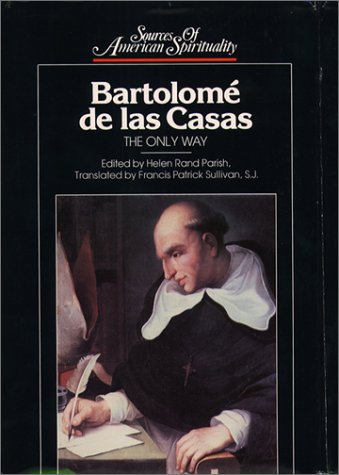

The only way / Bartolomé de las Casas ; edited by Helen Rand Parish ; translated by Francis Patrick Sullivan.
Idioma: Inglés Lenguaje original: Latín Detalles de publicación: New York : Paulist Press, 1992.Descripción: vi, 282 pages ; 24 cmTipo de contenido:- text
- unmediated
- volume
- 0809103672
- 266/.0089/97 20
- BV 3790 .C3513 1992
| Imagen de cubierta | Tipo de ítem | Biblioteca actual | Biblioteca de origen | Colección | Ubicación en estantería | Signatura topográfica | Materiales especificados | Info Vol | URL | Copia número | Estado | Notas | Fecha de vencimiento | Código de barras | Reserva de ítems | Prioridad de la cola de reserva de ejemplar | Reservas para cursos | |
|---|---|---|---|---|---|---|---|---|---|---|---|---|---|---|---|---|---|---|
| Libro BET | Biblioteca Escuela de Teología Colección General BET | 266.0089.97 R186 1991 (Navegar estantería(Abre debajo)) | Disponible | 41000000010588 |
Descripciones mejoradas de Syndetics:
The Only Way, edited by Helen Rand Parish; translated by Francis R. Sullivan, S.J. Las Casas, called the "Defender of the Indians", wrote his most famous treatise, De Unico Modo in the 1550s. This translation provides a picture of the spiritual experience of the man whose quest for social justice is relevant for us today.
Spine title: Bartolomé de las Casas.
Translation of: De unico vocationis.
Includes bibliographical references (p. 244-254) and index.
Las Casas' Spirituality The Tree Crises -- A Prophetic Crisis in the New World -- A Christian Crisis in the New World -- An Apostolic Crisis in the New World -- Bartolomé de las Casas: The Only Way to Draw all People to a Living Faith -- Humanity of the Indians --True Evangelization -- The Only Way: Wining the Mind and Will -- False Evangelization -- Epilogue. Restoration of the Indians -- Biographical Addenda --- Textual Appedices
Bartolomé de las Casas (1484-1566) is the key to the quincentenary debate–should we celebrate or should we weep? His was the main cry against the tragic fate of the Indians, the main cry for reform. Until now, he has been known only from incomplete sources. This book begins his rediscovery in 1992. Parish's introduction shows that Las Casas was barely 18 when he came to America in 1502, spending the next decade as a planter in the West Indies. He befriended the natives, but saw them cruelly massacred and exploited by conquistadors. In 1514 the mounting shock turned him into a defender of the Indians from then until his death at 82. As a priest-colonism a Dominican friar, a bishop, he fought a court and in the New World for their full human rights, using his first book, The Only Way, to great effect. The earliest version produced a papal encyclical on behalf of the Indians, the second motivated an emperor to issue laws protecting them, the third taught a generation of Spanish scholars. Sullivan's translation of the only Way to Draw All People to a Living Faith lets us hear Las casas in full at last. The familiar horrors and denunciations are all there, but so is a gentle voice filled with compassion and yearning for peace. For centuries, the treatise influenced mission theory and Practice in many lands; modern writers studied its missiology and its relation to his own mission experiment. But this new version –the lost opening restricted, the massive proof texts banished, the original form restored– reveals the doctrine that guided Las Casa's career. In it, he pleads for the way of Christ: evangelization by peaceful charity and respect not by " fire and brilliant rendering of the powerful posed at Oaxaca in 1539 to change the conscience of Christendom. The work makes the same appeal to conscience today.