
| Imagen de cubierta | Tipo de ítem | Biblioteca actual | Biblioteca de origen | Colección | Ubicación en estantería | Signatura topográfica | Materiales especificados | Info Vol | URL | Copia número | Estado | Notas | Fecha de vencimiento | Código de barras | Reserva de ítems | Prioridad de la cola de reserva de ejemplar | Reservas para cursos | |
|---|---|---|---|---|---|---|---|---|---|---|---|---|---|---|---|---|---|---|
| Libro | Biblioteca Mons. Iñaki Mallona (Arecibo) | Ej. | Disponible |
Descripciones mejoradas de Syndetics:
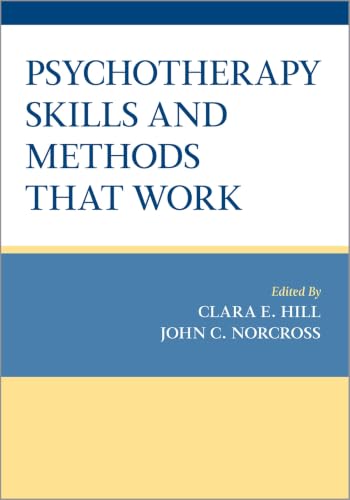
While we know that psychotherapy works, there is hearty debate about what makes it work. In the past, rival arguments have maintained that psychotherapy proves effective because of the treatment approach, patient contributions, or the therapeutic relationship. Psychotherapy Skills and Methods That Work argues that clinical skills and methods also play a crucial role and that what therapists do has major consequences for improving practice.Psychotherapy Skills and Methods That Work is the result of a multiyear, interorganizational Task Force commissioned to identify, compile, and disseminate the research evidence and clinical practices on psychotherapist skills and methods used across theoretical orientations. Edited by renowned scholars Clara E. Hill and John C. Norcross, this book provides original research reviews on the effectiveness of 27 specific psychotherapy skills and methods, including affirmation, self-disclosure, role induction, between-session homework, empathic reflections, mindfulness and acceptance, emotion regulation, and cognitive restructuring. Each chapter on a therapy skill or method features clinical examples, diversity considerations, training implications, and bulleted therapeutic practices, while the final chapter summarizes the research evidence for the effectiveness of these skills/methods and emphasizes implications for clinical training and practice.Forcefully demonstrating what therapists do to help clients change and live more effective lives, Psychotherapy Skills and Methods That Work will serve as a go-to guide for psychotherapy practitioners of all persuasions and professions, as well as graduate students and psychotherapy researchers.
Tabla de contenidos provista por Syndetics
- Preface(ix)
- Acknowledgments(xv)
- About the Editors(xvii)
- List of Contributors(xix)
- 1 Introduction to Psychotherapy Skills and Methods That Work(1)
- 2 Affirmation/Validation, Self-Disclosure, Immediacy, and Rupture Repairs(28)
- 3 Questions(53)
- 4 Socratic Questioning and Guided Discovery(74)
- 5 Empathic Reflection(99)
- 6 Metaphors(138)
- 7 Interpretations(165)
- 8 Paradoxical Interventions(199)
- 9 Advice, Suggestions, Recommendations(224)
- 10 Integrating Between-Session Homework(247)
- 11 Silence(281)
- 12 Facilitating Dyadic Synchrony(327)
- 13 Role Induction(367)
- 14 Collaborative Assessment Methods(399)
- 15 Routine Outcome Monitoring(429)
- 16 Strength-Based Methods(472)
- 17 Enhancing Emotion Regulation(502)
- 18 Chairwork(547)
- 19 Dream Work and Nightmare Treatments(577)
- 20 Meditation, Mindfulness, and Acceptance(605)
- 21 Facilitating Behavioral Activation(625)
- 22 Cognitive Restructuring(652)
- 23 Skills and Methods That Work in Psychotherapy: Research Results, Training Implications, Therapeutic Practices, and Task Force Conclusions(676)
- Index(703)