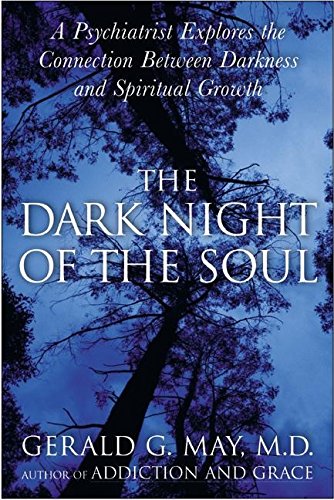
Imagen de portada de Amazon
Imagen de Amazon.com
Imagen de cubierta Syndetics
Portada de Syndetics
Imagen de OpenLibrary

The dark night of the soul : a psychiatrist explores the connection between darkness and spiritual growth / Gerald G. May.

Por: Detalles de publicación: San Francisco : HarperSanFrancisco, 2004.Edición: 1st edDescripción: viii, 216 pages ; 22 cmTipo de contenido:
  • text
Tipo de medio:
  • unmediated
Tipo de soporte:
  • volume
ISBN:
  • 0060554231 (cloth)
Tema(s): Clasificación CDD:
  • 248.29 22
Clasificación LoC:
  • BV 5083 .M32 2004
Contenidos:
Ccknolegments -- Introduction -- Half a Friar The Story of Teresa and John -- We are Love The Theology of Teresa and John -- Adeeper Longing The Liberation of Desire -- With a Temple Meditation and Contemplation -- Three Signs and Three Spirits The Psychology of the Night -- The Dark Night Today Modern Context -- Daybreak The Coming of the Dawn
Resumen: Distinguished psychiatrist, spiritual councelor, and bestselling author Gerald G. May argues that the "shadow" side of the spiritual life has been trivialized and neglected to our serious detritment. In The Dark Night of the Soul, Dr. May shows that the dark side is a vital ingridient for deep, authentic , healthy spirituality. Superficial and naively upbeat spirituality does not heal and enrich the soul; nor does our tendency to relegate deep spiritual growth to mystics and saints help us cope with the fullness of what we experience in life. Only honest, sometimes dificult encounters with what Christian spirituality calls "the dark night of the soul" can lead to true spiritual wholwness. May emphasizes thet the dark night is not necessarilly a tim of duffering and despair, but rather one of deep transition, during whic our lives are clouded and full of mystery as we move throught a time of trial and uncertainity to freedom and joy. The darkness of the night impies nothing sinister, but rather that our liberation takes place mysteriously, in secret, and beyond our conscious control. May draws on the great Christian spiritual techings and writings on the "dark night," especialluy by John of the Cross and Teresa of Avila, on other spiritual traditions, psychiatricnideas and resources, and on poetry and literature. The Dark Night of the Soul embraces the universal spiritual experience of disorientation, doubt, fear, emptiness, "dyness and despair, all of wich are ingredients in developing a mature, authentic spiritual life.
Valoración
    Valoración media: 0.0 (0 votos)
Existencias
Imagen de cubierta Tipo de ítem Biblioteca actual Biblioteca de origen Colección Ubicación en estantería Signatura topográfica Materiales especificados Info Vol URL Copia número Estado Notas Fecha de vencimiento Código de barras Reserva de ítems Prioridad de la cola de reserva de ejemplar Reservas para cursos
Libro BET Biblioteca Escuela de Teología Colección General BET BV 5083 .M32 c.2 (Navegar estantería(Abre debajo)) Disponible 41000000010679
Libro BET Biblioteca Escuela de Teología Colección General BET BV 5083 .M32 2004 (Navegar estantería(Abre debajo)) Disponible 4000000010489
Total de reservas: 0

Descripciones mejoradas de Syndetics:

Gerald G. May, M.D., one of the great spiritual teachers and writers of our time, argues that much to our detriment, the dark "shadow" side of true spiritual life has been trivialized and neglected. Superficial and naively upbeat spirituality does not heal and enrich the soul; nor does the tendency to relegate deep spiritual growth to mystics and saints. Only the honest, sometimes difficult encounters with what St. John of the Cross describes as "the dark night of the soul" can lead to true spiritual wholeness.

Drawing on the resources of great Christian writings as well as other spiritual traditions, psychiatric theory, and literature, May emphasizes that the "dark night" is not necessarily a time of suffering and despair, but rather an opportunity for transition and transformation. The Dark Night of the Soul embraces the universal spiritual experience of doubt, fear, emptiness, and despair, all of which are ingredients in developing a mature, authentic spiritual life. The dark gives depth, dimension, and fullness to enlightenment.Gerald May, M.D., (1940-2005) was a psychiatrist and spiritual counselor and Senior Fellow in Contemplative Theology and Psychology at the Shalem Institute for Spiritual Formation in Bethesda, MD. He wrote many books and articles blending spirituality and psychology, including Addiction and Grace and The Awakened Heart."[May] becomes a messenger of hope, reminding readers that every dark night brings the sweet dawn of awakening."-Publishers Weekly

Includes bibliographical references (p. 201-212) and index.

Ccknolegments -- Introduction -- Half a Friar The Story of Teresa and John -- We are Love The Theology of Teresa and John -- Adeeper Longing The Liberation of Desire -- With a Temple Meditation and Contemplation -- Three Signs and Three Spirits The Psychology of the Night -- The Dark Night Today Modern Context -- Daybreak The Coming of the Dawn

Distinguished psychiatrist, spiritual councelor, and bestselling author Gerald G. May argues that the "shadow" side of the spiritual life has been trivialized and neglected to our serious detritment. In The Dark Night of the Soul, Dr. May shows that the dark side is a vital ingridient for deep, authentic , healthy spirituality. Superficial and naively upbeat spirituality does not heal and enrich the soul; nor does our tendency to relegate deep spiritual growth to mystics and saints help us cope with the fullness of what we experience in life. Only honest, sometimes dificult encounters with what Christian spirituality calls "the dark night of the soul" can lead to true spiritual wholwness. May emphasizes thet the dark night is not necessarilly a tim of duffering and despair, but rather one of deep transition, during whic our lives are clouded and full of mystery as we move throught a time of trial and uncertainity to freedom and joy. The darkness of the night impies nothing sinister, but rather that our liberation takes place mysteriously, in secret, and beyond our conscious control. May draws on the great Christian spiritual techings and writings on the "dark night," especialluy by John of the Cross and Teresa of Avila, on other spiritual traditions, psychiatricnideas and resources, and on poetry and literature. The Dark Night of the Soul embraces the universal spiritual experience of disorientation, doubt, fear, emptiness, "dyness and despair, all of wich are ingredients in developing a mature, authentic spiritual life.

Tabla de contenidos provista por Syndetics

  • Acknowledgments(p. vii)
  • Introduction(p. 1)
  • 1 Half a Friar: The Story of Teresa and John(p. 15)
  • 2 We Are Love: The Theology of Teresa and John(p. 41)
  • 3 A Deeper Longing: The Liberation of Desire(p. 63)
  • 4 With a Temple: Meditation and Contemplation(p. 103)
  • 5 Three Signs and Three Spirits: The Psychology of the Night(p. 135)
  • 6 The Dark Night Today: Modern Contexts(p. 153)
  • 7 Daybreak: The Coming of the Dawn(p. 181)
  • Notes(p. 201)
  • Index(p. 213)

Extracto provisto por Syndetics

The Dark Night of the Soul A Psychiatrist Explores the Connection Between Darkness and Spiritual Growth Chapter One Half a Friar The Story of Teresa and John That Jews and Christians, together with Muslims, can live in amity, respecting differences while honoring commonalities -- that this is no pipe dream -- is proven by the fact that, for centuries, they did just that. -- James Carroll Jews, Christians, and Muslims did indeed live in harmony in a time and place that "some remember as a kind of paradise." It is known as the convivencia, the "living together." The time was between the ninth and twelfth centuries, and the place was Spain. As Carroll recounts it, it was a time when Muslims opened the doors of their mosques for Christian worship services and when Jews were schoolmasters for Christian children. This rich cross-fertilization of faiths and cultures produced famous universities and renowned thinkers, including the great Jewish philosopher Moses Maimonides, who chose to write not in Hebrew, but in Arabic. Religious warfare originating outside Spain began to dismantle the convivencia in the twelfth century, but vestiges of its rich heritage lasted into the sixteenth century, the time of Teresa of Ávila and John of the Cross. In many ways, Teresa and John inherited the creative legacy of the convivencia. John of the Cross will forever be credited for the idea of dark night of the soul, but the inspiration wasn't his alone. John acknowledged his indebtedness to a number of previous authors, including an obscure sixth-century mystic who wrote under the name of Dionysius and spoke of "a ray of darkness." Of all those who influenced John's work, however, the most important was Teresa, the woman he called his spiritual mother. Though he seldom acknowledged her as a source, nearly all of John's imagery and most of his fundamental insights can be found in Teresa's earlier writings. Thus to appreciate the meaning of the dark night, we must start with Teresa of Ávila. Teresa In the rugged central highlands of Spain, fifty miles west of Madrid, is the ancient walled city of Ávila. It lies on the Adaja River, in a valley between two great mountain ranges: the Sierra de Gredos to the south and the Sierra de Guadarrama to the east. Teresa was born there in the cold early spring of 1515. It was the last year of the reign of King Ferdinand; Isabella had died a decade earlier, after establishing the Spanish Inquisition, putting a formal end to the convivencia by expelling all Jews from Spain, and sending Columbus to the New World. Balboa had just claimed the entire Pacific Ocean in the name of Spain, and treasure from the Americas was making Spain the wealthiest and most powerful empire in the world. Elsewhere, Leonardo da Vinci had just painted the Mona Lisa and Michelangelo had finished his sculpture of David. Copernicus was developing his claim that the planets revolve around the sun, and two years later Martin Luther would nail his theses to the church door in Wittenberg. Teresa was born into a wealthy family of textile merchants. Her grandfather had been a converso, a Jew forced to convert to Christianity by the Inquisition. Her father saw to the education of his twelve children and made sure his daughters learned to read and write at home -- there was no public education for women. Teresa was bright, spirited, adventurous, and, like many children of the time, fervently religious. At the age of seven, inspired by reading the lives of the saints, she and a brother tried to run away from home and become martyrs, "to go to the land of the Moors ... and have them cut off our heads." They were apprehended at the edge of town by an uncle, who returned them to their worried mother. "Our greatest obstacle," Teresa later wrote, "was that we had parents." When Teresa was twelve, her mother died. Soon thereafter, her father noticed that Teresa's passions had shifted from spirituality to romance novels and, of course, to boys. Concerned about her future, he sent her to a convent school when she was sixteen. He never wanted her to become a nun and could not have foreseen that her passions would revert, as they soon did, to prayer and a growing call to religious life. Because her father was strongly set against her becoming a nun, Teresa struggled mightily with the decision. Perhaps in part because of this conflict, she fell ill. The illness, the first of many that were to plague her the rest of her life, forced her to leave the school. Her recovery took nearly two years, during which her sense of call to religious life grew even stronger. Finally at the age of twenty, she convinced her father of her determination and became a Carmelite novice. Less than two years after her profession as a nun, she again became ill, eventually suffering a paralysis of her legs that kept her an invalid for three years. Then, at the age of twenty-seven, while praying to St. Joseph, she experienced what she felt was a miraculous recovery. In that same year, 1542, less than thirty miles away in the small village of Fontiveros, John of the Cross was born. John John's father, like Teresa's, had come from a wealthy family of textile merchants. But the family disowned him when he married John's mother, a poor weaver far beneath his social station. Thus, unlike Teresa, John was born into poverty. Worse, his father died shortly after John was born, leaving John and his mother and two older brothers destitute. After one of his brothers died, possibly from malnutrition, his mother moved to Medina del Campo. There she was able to place John in a church orphanage school, where he could be fed and educated. He excelled academically and as a teenager worked in a hospital as an orderly. We have no evidence that he ever considered any career other than the religious life ... The Dark Night of the Soul A Psychiatrist Explores the Connection Between Darkness and Spiritual Growth . Copyright © by Gerald G. May. Reprinted by permission of HarperCollins Publishers, Inc. All rights reserved. Available now wherever books are sold. Excerpted from Dark Night of the Soul: A Psychiatrist Explores the Connection Between Darkness and Spiritual Growth by Gerald G. May All rights reserved by the original copyright owners. Excerpts are provided for display purposes only and may not be reproduced, reprinted or distributed without the written permission of the publisher.

Reseñas proporcionadas por Syndetics

Library Journal Review

Most people journey through a period of spiritual blindness, however short, where much is unknown and life cannot be controlled. In this state, it is impossible to judge good from bad. Drawing upon the 16th-century poems of St. Teresa of Avila and St. John of the Cross, May, a psychiatrist and spiritual counselor, proposes that we are given this sacred mystery (or dark night of the soul) as an interim psychic protection to prevent us from sabotaging ourselves until a deeper awareness of truth dawns. The author also shares some fresh and interesting ideas: that taking psychiatric medication does not preclude a person's spiritual growth and that the Creator rejoices and grieves along with us in our earthly ventures. He quickly earns the reader's respect for his simple yet profound insight and his unique thinking concerning this enigma. Ultimately, May finds that we evolve spiritually and our lives improve as we pass from the dark night into the dawn, for now the path we walk has real meaning. Recommended for psychology and spirituality sections of larger public libraries as well as graduate-level theology and psychology collections.-Lisa Liquori, MLS, Syracuse, NY (c) Copyright 2010. Library Journals LLC, a wholly owned subsidiary of Media Source, Inc. No redistribution permitted.

Publishers Weekly Review

"Hello darkness my old friend, I've come to talk with you again." These lyrics from Simon and Garfunkel's famous song could be the guiding theme of this excellent offering by psychiatrist and spiritual counselor May. As May delves into the meaning and purpose of "the dark night of the soul," we come to see it as a comforting and necessary friend, ushering in a time of transformation, rather than a gloomy blackness to avoid. In order to illuminate the dark night, May draws upon the lives of the Carmelite mystics, John of the Cross and Teresa of Avila, as well as psychiatric research and scripture. Like the contemporary scholars of psychiatry, both Teresa and John had early insights into the unconscious dimension of life that goes on beneath our awareness-an obscure and mysterious arena that they both called "the dark." Since humans are so skilled at denial-especially denying the power of their compulsions and attachments-they would never enter into this spiritual night of reckoning if they could see in advance what it would entail. This is why we need the darkness in front of us. May, who also wrote Addiction and Grace, eventually moves into a strong discussion about depression and addiction, showing why the dark night is necessary to overcome both. Ultimately, he becomes a messenger of hope, reminding readers that every dark night brings the sweet dawn of awakening. With its clear writing and strong psychological foundation, this is a relevant resource for readers of all spiritual persuasions. (Feb.) Forecast: Readers gravitate toward May's ability to combine sound psychiatric guidance with spiritual insights and accessible writing; Addiction and Grace has sold more than 200,000 copies. (c) Copyright PWxyz, LLC. All rights reserved

Notas de autor provistas por Syndetics

Gerald G. May is now Senior Fellow in Contemplative Theology and Psychology at the Shalem Institute for Spiritual Formation in Bethesda, Maryland.
Compartir
logopucpr-y-vive

Contáctanos

¡Queremos saber de ti!

Tel. 787.841.2000 Ext. 1801

bibliotecavaldes@pucpr.edu

⁣Búscanos en las redes

© 2026 Desarrollado por Ignite Online • All Rights Reserved • Powered by Koha.