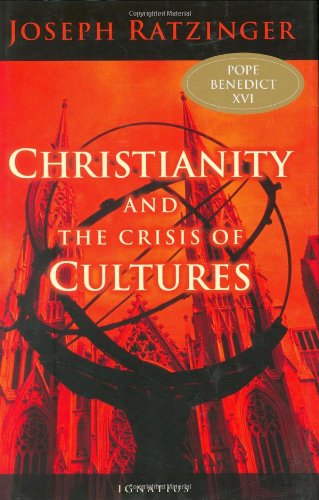

Christianity and the crisis of cultures / Joseph Ratzinger (Pope Benedict XVI) ; introduction by Marcello Pera ; translated by Brian McNeil.
Idioma: Inglés Lenguaje original: Italiano Descripción: 116 pages ; 21 cmTipo de contenido:- text
- unmediated
- volume
- 9781586171421 (alk. paper)
- 1586171429 (alk. paper)
- 261 22
- BR 115.W6 B36 2006
| Imagen de cubierta | Tipo de ítem | Biblioteca actual | Biblioteca de origen | Colección | Ubicación en estantería | Signatura topográfica | Materiales especificados | Info Vol | URL | Copia número | Estado | Notas | Fecha de vencimiento | Código de barras | Reserva de ítems | Prioridad de la cola de reserva de ejemplar | Reservas para cursos | |
|---|---|---|---|---|---|---|---|---|---|---|---|---|---|---|---|---|---|---|
| Libro BET | Biblioteca Escuela de Teología Colección General BET | BR 115 .W6 B36 2006 (Navegar estantería(Abre debajo)) | Disponible | 41000000010356 |
Descripciones mejoradas de Syndetics:
Written by Joseph Ratzinger shortly before he became Pope Benedict XVI, Christianity and the Crisis of Cultures looks at the growing conflict of cultures evident in the Western world. The West faces a deadly contradiction of its own making, he contends.
Terrorism is on the rise. Technological advances of the West, employed by people who have cut themselves off from the moral wisdom of the past, threaten to abolish man (as C.S. Lewis put it)--whether through genetic manipulation or physical annihilation.
In short, the West is at war-with itself. Its scientific outlook has brought material progress. The Enlightenment's appeal to reason has achieved a measure of freedom. But contrary to what many people suppose, both of these accomplishments depend on Judeo-Christian foundations, including the moral worldview that created Western culture.
More than anything else, argues Joseph Ratzinger/Benedict XVI, the important contributions of the West are threatened today by an exaggerated scientific outlook and by moral relativism-what Benedict XVI calls "the dictatorship of relativism"-in the name of freedom.
Christianity and the Crisis of Cultures is no mere tirade against the moral decline of the West. Razinger challenges the West to return to its roots by finding a place for God in modern culture. He argues that both Christian culture and the Enlightenment formed the West, and that both hold the keys to human life and freedom as well as to domination and destruction.
Ratzinger challenges non-believer and believer alike. "Both parties," he writes, "must reflect on their own selves and be ready to accept correction." He challenges secularized, unbelieving people to open themselves to God as the ground of true rationality and freedom. He calls on believers to "make God credible in this world by means of the enlightened faith they live."
Topics include:
Reflections on the Cultures in Conflict Today The Significance and Limits of Today's Rationalistic Culture The Permanent Significance of the Christian Faith Why We Must Not Give Up the Fight The Law of the Jungle, the Rule of Law We Must Use Our Eyes! Faith and Everyday Life Can Agnosticism Be a Solution? The Natural Knowledge of God "Supernatural" Faith and Its OriginsIncludes bibliographical references.
Introduction by Marcello Pera: A Proposal That Should Be Accepted -- The Crisis of Cultures -- Reflections on Cultures That Are in Conflict Today -- The Significance and Limits of Today's Rationalistic Culture -- The Permanent Significance of the Christian Faith -- The Right to Life -- Why We Must Not Give Up the Fight -- The Law of the Jungle, the Rule of Law -- We Must Use Our Eyes! -- What DOes It Mean to Belive? -- Faith and Everyday Life: A fundamental Human Attitude -- Can Agnosticism Be a Solution? -- The Natural Knowledge of God -- "Supernatural" Faith and Its Origins -- Development of Premises -- The verification of faith in life -- Faith's "I", "you, and "we"
Written shortly before his election to Papacy, Joseph Cardinal Ratzinger addressed the crisis of culture that is evident in Europe today, and the Western World in general. Some of the results of the crisis are greater threats to security, growing poverty, the danger of genetic engineering, and a decline in moral energy. The Christian roots and foundation of Western civilization are being replaced by "modern Enlightenment philosophy", observed Cardinal Ratzinger. Such philosophies recognize God's existance or objective truth, these philosophies consequently reduce morality to relative concept, leading to a "confused ideology of freedom that leads to dogmatism" and ultimately "to the self-destruction of freedom", cautioned Cardinal Ratinger. What Cardinal Ratzinger offered then –and what Pope Benedict XVI is offering now– as an answer to the nihislic secularization that pervades Europe and the West, is not politics, but a spiritual renewal, a renuewal similar to that of Saint Benedict and the members of His Order who combined holiness and love for the truth which ultimately helped save a similarly declining Europe from cultural collape.
Reseñas proporcionadas por Syndetics
Booklist Review
The subtitle here refers to Ratzinger's new status as Pope Benedict XVI and to the sixth-century saint who helped preserve Christianity via the monastic order he founded after the fall of Rome. By associating the two Benedicts, it also suggests that their eras are alike, that the state of Europe indicated by the failure of the first pan-European constitution (withdrawn in 2005) to acknowledge Europe's Christian heritage is like that of the sixth century. In the first of the three lectures here, Ratzinger lays out the dangers of thoroughgoing official secularism and proposes to those outside the church that, regardless of their beliefs, they assume God exists--a form of Pascal's wager. The second explains why, regardless of secular laws, the church may not stop fighting abortion, euthanasia, and other challenges to the sanctity of each human life. The last expounds on the necessarily contingent and communal nature of faith. Each speech's close argument rewards careful attention and, though immediately addressed to Europe, applies to secular-spiritual clashes throughout the world. --Ray Olson Copyright 2006 BooklistNotas de autor provistas por Syndetics
Joseph Ratzinger was born on April 16, 1927 in Marktl am Inn in the state of Bavaria, Germany.Ratzinger entered the minor seminary in Traunstein, in 1939 and in 1943 along with the rest of his seminary class he was drafted into the Flak [anti-aircraft corps]. In 1944 he was released from the Flak and returned home only to be drafted into labor detail under the infamous Austrian Legion.
In the spring of 1945 Ratzinger deserted the army and headed home but when the Americans arrive at his village shortly thereafter, he was identified as a German soldier and incarcerated in a POW camp for a brief time. Following his release he re-entered the seminary.
In 1951 Joseph was ordained into the priesthood and began lectures as a full professor of fundamental theology at the University of Bonn. From 1962-65 Ratzinger was present during all four sessions of the Second Vatican Council as a peritus, or chief theological advisor to Cardinal Joseph Frings of Cologne, Germany.
. In 1977 Joseph Ratzinger was appointed Archbishop of Munich and Freising and on June 27 elevated to Cardinal of Munich by Pope Paul VI. In 1981 Ratzinger accepted Pope John Paul II's invitation to take over as Prefect for the Congregation for the Doctrine of the Faith and in 1986 he was appointed head of a 12-member commission responsible for drafting the Catechism of the Catholic Church.
Cardinal Ratzinger was elected vice dean of the College of Cardinals in 1988. In 2002 Pope John Paul II, approved his election as dean of the College of Cardinals.
On April 8, 2005, Cardinal Ratzinger presided over the funeral of Pope John Paul II. On April 19, 2005, Cardinal Ratzinger was elected Bishop of Rome on the fourth ballot of the conclave and took the name Benedict XVI.
(Bowker Author Biography)