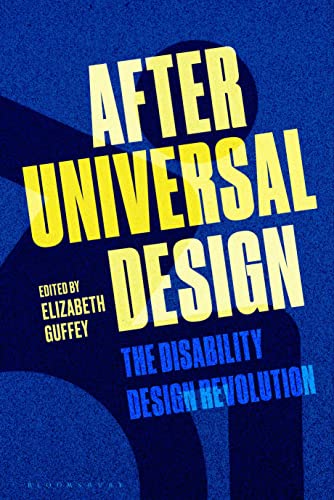

After Universal Design: the disability design revolution / edited by Elizabeth Guffey.
Idioma: Inglés Bloomsbury Visual Arts, 2023 London, United Kingdom :Descripción: xii, 221 pages : illustrations ; 24 cmTipo de contenido:- text
- unmediated
- volume
- 9781350241503
- 23 746.92
| Imagen de cubierta | Tipo de ítem | Biblioteca actual | Biblioteca de origen | Colección | Ubicación en estantería | Signatura topográfica | Materiales especificados | Info Vol | URL | Copia número | Estado | Notas | Fecha de vencimiento | Código de barras | Reserva de ítems | Prioridad de la cola de reserva de ejemplar | Reservas para cursos | |
|---|---|---|---|---|---|---|---|---|---|---|---|---|---|---|---|---|---|---|
| Libro | Biblioteca Encarnación Valdés Colección General bev | 746.92 A2588 (Navegar estantería(Abre debajo)) | Disponible | 80000002653932 |
Descripciones mejoradas de Syndetics:
How might we develop products made with and by disabled users rather than for them? Could we change living and working spaces to make them accessible rather than designing products that "fix" disabilities? How can we grow our capabilities to make designs more "bespoke" to each individual? After Universal Design brings together scholars, practitioners, and disabled users and makers to consider these questions and to argue for the necessity of a new user-centered design.
As many YouTube videos demonstrate, disabled designers are not only fulfilling the grand promises of DIY design but are also questioning what constitutes meaningful design itself. By forcing a rethink of the top-down professionalized practice of Universal Design, which has dominated thinking and practice around design for disability for decades, this book models what inclusive design and social justice can look like as activism, academic research, and everyday life practices today.
With chapters, case studies, and interviews exploring questions of design and personal agency, hardware and spaces, the experiences of prosthetics' users, conventional hearing aid devices designed to suit personal style, and ways of facilitating pain self-reporting, these essays expand our understanding of what counts as design by offering alternative narratives about creativity and making. Using critical perspectives on disability, race, and gender, this book allow us to understand how design often works in the real world and challenges us to rethink ideas of "inclusion" in design.
A universal conundrum / Elizabeth Guffey
Section one: Agency
Four commitments of crip technoscience / Kelly Fritsch and Aimi Hamraie
Fixing meets expressing: design by designers with disability experience / Natalia Perez Liebergesell, Peter-Willem Vermeersch, and Ann Heylighen
Case study: Brett's leather case / Jaipreet Virdi
Case Study: Zebreda makes it work! and the "key" to innovation / Elizabeth Guffey
Case study: privileging agency: a conversation with design and disability advocate Jessica Ryan-Ndegwa / Alison Kurdock Adams
Case study: rehabilitation technology at the self-help shop then and now / Bess Williamson
Case study: beyond the bespoke: agency and the hands of X / Andrew Cook and Graham Pullin
Case study: re-imagining access and its pedagogies / Maggie Hendrie, Joshua Halstead, Robert Dirig, Elise Co, and Todd Masilko
Section two: Equity section
Equations for reducing disability stigma through design equity / Josh Halstead
Making equity: how the disability community met the maker movement / Emeline Brule
Case study: shaping inclusive and equitable makerspaces / Katherine M. Steele
Case study: a study of skilled craftwork among blind fiber artists / Maitraye Das and Katya Borgos-Rodriguez and Anne Marie Piper
Case study: Towards sensory equity: a more inclusive museum space designed from disability experience / Peter-Willem Vermeersch and Ann Heylighen
Case study: The politics of friction: designing a sex toy for every body / David Serlin
Case study: The face-based pain scale: a tool for whom? / Gabi Schaffzin
Case study: next practice: towards equalities design / Natasha Trotman
Section three: Speculation
Speculative making / Sara Hendren
Speculating on upstanding norms / Ashley Shew
Case study: M Eifler's prosthetic memory as speculative archive / Lindsey D. Felt
Case study: the way ahead / Caroline Cardus
Case study: customizing reading: Harvey Lauer's "Reading machine of the future" / Mara Mills
Case study: "Captioning on captioning" with Shannon Finnegan / Louise Hickman
Case study: a squishy house / Emily Watlington
Case study: Black disabled joy as an act of resistance / Jen White-Johnson
"How might we develop products made with and by disabled users rather than for them? Could we change living and working spaces to make them accessible rather than designing products that "fix" disabilities? How can we grow our capabilities to make designs more "bespoke" to each individual? After Universal Design brings together scholars, practitioners, and disabled users and makers to consider these questions and to argue for the necessity of a new user-centered design. As many YouTube videos demonstrate, disabled designers are not only fulfilling the grand promises of DIY design but are also questioning what constitutes meaningful design itself. By forcing a rethink of the top-down professionalized practice of Universal Design, which has dominated thinking and practice around design for disability for decades, this book models what inclusive design and social justice can look like as activism, academic research, and everyday life practices today. With chapters, case studies, and interviews exploring questions of design and personal agency, hardware and spaces, the experiences of prosthetics' users, conventional hearing aid devices designed to suit personal style, and ways of facilitating pain self-reporting, these essays expand our understanding of what counts as design by offering alternative narratives about creativity and making. Using critical perspectives on disability, race, and gender, this book allow us to understand how design often works in the real world and challenges us to rethink ideas of "inclusion" in design"-- Publisher's description
Tabla de contenidos provista por Syndetics
- List of Figures(viii)
- Acknowledgments(x)
- Glossary of Terms(xi)
- A Universal Conundrum Elizabeth Guffey(1)
- Section 1 Agency(13)
- Introduction(13)
- Key Points(15)
- 1 Four Commitments of Crip Technoscience(17)
- 2 Fixing Meets Expressing: Design by Designers with Disability Experience(35)
- 3 Case Study: Brett's Leather Case(51)
- 4 Case Study: Zebreda Makes It Work! and the "Key" to Innovation(55)
- 5 Case Study: Privileging Agency: A Conversation with Designer and Disability Advocate Jessica Ryan-Ndegwa(61)
- 6 Case Study: Rehabilitation Technology at the Self-Help Shop Then and Now(65)
- 7 Case Study: Beyond the Bespoke: Agency and Hands of X(71)
- 8 Case Study: Re-imagining Access and Its Pedagogies(77)
- Section 2 Equity(83)
- Introduction(83)
- Key Points(85)
- 9 Equations for Reducing Disability Stigma through Design Equity(87)
- 10 Making Equity: How the Disability Community Met the Maker Movement(99)
- 11 Case Study: Shaping inclusive and Equitable Makerspaces(117)
- 12 Case Study: A Study of Skilled Craftwork among Blind Fiber Artists(123)
- 13 Case Study: Toward Sensory Equity: A More Inclusive Museum Space Designed from Disability Experience(129)
- 14 Case Study: The Politics of Friction: Designing a Sex Toy for Every Body(135)
- 15 Case Study: The Face-Based Pain Scale: A Tool for Whom?(141)
- 18 Case Study: Next Practice: Toward Equalities Design(147)
- Section 3 Speculation(153)
- Introduction(153)
- Key Points(155)
- 17 Speculative Making(157)
- 18 Speculating on Upstanding Norms(165)
- 19 Case Study: M Eifler's Prosthetic Memory as Speculative Archive(179)
- 20 Case Study: The Way Ahead(185)
- 21 Case Study: Customizing Reading: Harvey Lauer's "Reading Machine of the Future"(189)
- 22 Case Study: "Captioning on Captioning" with Shannon Finnegan(195)
- 23 Case Study: A Squishy House(199)
- 24 Case Study: Black Disabled Joy as an Act of Resistance(203)
- List of Contributors(208)
- Index(214)