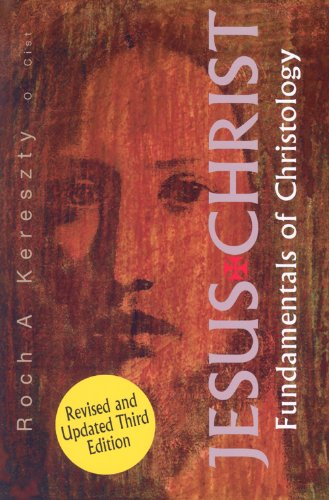

Jesus Christ : fundamentals of Christology / Roch A. Kereszty.
Detalles de publicación: New York : St Pauls, 2002.Edición: Rev. and updated edDescripción: xii, 530 pages ; 21 cmTipo de contenido:- text
- unmediated
- volume
- 9780818909177
- 232 20
- BT 202 .K364 2002
| Imagen de cubierta | Tipo de ítem | Biblioteca actual | Biblioteca de origen | Colección | Ubicación en estantería | Signatura topográfica | Materiales especificados | Info Vol | URL | Copia número | Estado | Notas | Fecha de vencimiento | Código de barras | Reserva de ítems | Prioridad de la cola de reserva de ejemplar | Reservas para cursos | |
|---|---|---|---|---|---|---|---|---|---|---|---|---|---|---|---|---|---|---|
| Libro BET | Biblioteca Escuela de Teología Colección General BET | BT 203 .K47 2002 (Navegar estantería(Abre debajo)) | Disponible | 41000000008947 |
Descripciones mejoradas de Syndetics:
This revised and expanded second edition of Father Kereszty's widely used Christology text is equipped with recommended readings, study questions and updated bibliography. In dialogue with contemporary concerns and controversies, it presents a penetrating and integral approach to the mystery of Christ, with broad appeal to Roman Catholics, Protestants and Orthodox Christians alike. In it they will find an articulation of their common faith in Jesus, the Christ, true God and true man. Though written as a Christology text on the graduate level, the book should interest any educated reader who seeks to know Jesus.
"Communio book."
The Method of Biblical Christology -- The Death and Resurrection of Jesus -- The Beginning of the Gospel -- Jesus and the Kingdom -- The Kingdom and the Death of Jesus -- The Understanding of the Mystery of Christ in the Apostolic Church -- Historical Christology -- Introduction: Patristic Christology -- The Soteriology of the Fathers -- The Christology of the Fathers -- Medieval Christology -- Christology of the Reformation -- Protestant Christologies in the Twentieth Century -- Systematic Christology -- The Unity of the Mystery of Christ -- Sin as a Threefold Alienation -- The Mystery of the Incarnation -- The Humanity of the Son -- Redemption as Assumption of Humankind into Trinitarian Communion -- The Universal Significance of Christ in the Context of Other Religions -- Christ and Possible Other Universes and Extraterrestrial Intelligent Beings
This revised and expanded second edition of Father Keresty's widely used Christology text is equipped with recommended readings, study questions and updated bibliography. In dialogue with contemporary concerns and controversies, it presents a penetrating and integral approach to the mystery of Christ, with broad appeal to Roman Catholics, Protestants and Orthodox Christians alike. In it they will find an articulation of their common faith in Jesus, The Christ, true God and true man. Though written as a Christology text on the graduate level, the book should interest any educated reader who seeks to know Jesus.
Tabla de contenidos provista por Syndetics
- Introduction(p. xiii)
- List of Abbreviations(p. xix)
- Biblical Abbreviations(p. xx)
- Part I Christology of the New Testament
- Chapter I The Method of Biblical Christology(p. 3)
- 1. Critique of the "Liberal Quest," the "New Quest," and the "Third Quest" for the Historical Jesus(p. 5)
- 2. Reflections on the Method of Historiography in General(p. 15)
- 3. A Theological History of Jesus(p. 19)
- 4. The Historical Foundations of Faith in Jesus(p. 22)
- a. The criterion of double dissimilarity(p. 25)
- b. The criterion of embarrassment(p. 26)
- c. The personal style of Jesus(p. 27)
- d. Multiple attestation(p. 28)
- e. The criterion of necessary explanation(p. 29)
- Chapter II The Death and Resurrection of Jesus(p. 32)
- A. The Crucifixion of Jesus(p. 33)
- B. The Resurrection(p. 34)
- 1. Sources(p. 34)
- a. The earliest kerygma of the resurrection in Paul's interpretation (1 Cor 15:3-8)(p. 34)
- b. The resurrection narratives in the Gospels and Acts(p. 42)
- (1) The appearance narratives(p. 42)
- (2) The empty tomb narratives(p. 46)
- 2. Historical Facts Connected with the Origin of Faith in the Resurrection(p. 48)
- 3. Hypotheses Denying Any Form of Resurrection(p. 50)
- 4. Various Interpretations of the Resurrection of Jesus(p. 54)
- 5. The Resurrection in Fundamental Theology(p. 65)
- a. The epistemological question regarding the appearances(p. 65)
- b. The credibility of the resurrection(p. 68)
- Chapter III The Beginning of the Gospel(p. 72)
- 1. The Virginal Conception of Jesus(p. 72)
- 2. "The brothers and sisters of Jesus"(p. 77)
- 3. The Holy Family(p. 81)
- 4. Is Jesus "the Son of David"?(p. 85)
- 5. The twelve-year-old Jesus in the Temple(p. 87)
- 6. "The private life of Jesus" before his public ministry(p. 90)
- Chapter IV Jesus and the Kingdom(p. 93)
- 1. The baptism of Jesus by John(p. 93)
- 2. The temptations of Jesus(p. 98)
- 3. The outline of the public ministry of Jesus(p. 104)
- 4. The message of Jesus: the reign of God is at hand(p. 106)
- 5. The miracles of Jesus(p. 110)
- a. The phenomenon of the miracle in the public ministry of Jesus(p. 110)
- b. Historical foundations for the miracle accounts(p. 113)
- c. Theological and philosophical considerations(p. 115)
- 6. The multiplication of loaves: a turning point in the ministry of Jesus?(p. 118)
- Chapter V The Kingdom and the Death of Jesus(p. 121)
- 1. "Get behind me, Satan!"(p. 121)
- 2. The Last Supper and the Kingdom(p. 124)
- 3. The sacrifice of the Servant(p. 126)
- 4. "My God, my God, why have you forsaken me?"(p. 130)
- 5. Foretelling his resurrection?(p. 130)
- 6. The Kingdom and the end of this world(p. 132)
- 7. The implicit Christology of Jesus(p. 136)
- Chapter VI The Understanding of the Mystery of Christ in the Apostolic Church(p. 148)
- A. "According to the Scriptures"(p. 150)
- 1. "In all the Scriptures" (Lk 24:27)(p. 150)
- 2. The Suffering Servant of Yahweh(p. 153)
- 3. The Son of Man(p. 155)
- 4. Jesus the new eschatological Israel(p. 157)
- 5. Jesus as High Priest and Perfect Sacrifice(p. 158)
- 6. Jesus the Messiah(p. 161)
- 7. Jesus as son of Adam and the last Adam(p. 163)
- 8. Jesus as the final and complete theophany of God(p. 164)
- 9. The unexpected newness of the New Testament(p. 168)
- B. Jesus as "Lord," "Son of God," and "God"(p. 169)
- 1. Jesus is Lord(p. 169)
- 2. Jesus is the Son of God(p. 176)
- 3. Jesus is God(p. 181)
- 4. The value of the Old Testament for the contemporary Christian(p. 183)
- Part II Historical Christology
- Introduction: Patristic Christology(p. 189)
- 1. The character and significance of patristic Christology(p. 189)
- 2. The relationship between Christianity and non-Christian religions(p. 191)
- Chapter I The Soteriology of the Fathers(p. 196)
- 1. Sin(p. 197)
- 2. Redemption(p. 198)
- a. The metaphysical foundation of redemption(p. 200)
- b. Christ as mediator(p. 201)
- c. "He who descended is the very one who ascended"(p. 203)
- d. "Admirabile commercium"(p. 204)
- e. Redemption as victory and deliverance(p. 209)
- f. Redemption as sacrifice(p. 212)
- g. Christ as Teacher and Example(p. 214)
- h. Redemption as uniting all creation to God(p. 217)
- 3. Conclusion(p. 220)
- Chapter II The Christology of the Fathers(p. 222)
- 1. Docetism and Gnosticism(p. 223)
- 2. Adoptionism(p. 226)
- 3. Arianism(p. 227)
- 4. Apollinarianism(p. 229)
- 5. Christological development in the West(p. 232)
- 6. The School of Alexandria(p. 235)
- 7. The School of Antioch(p. 236)
- 8. The Councils of Ephesus and Chalcedon (431, 451)(p. 240)
- 9. The Second and Third Councils of Constantinople (553, 680-681)(p. 248)
- Chapter III Medieval Christology(p. 251)
- 1. St. Bernard of Clairvaux(p. 251)
- 2. St. Anselm of Canterbury(p. 256)
- 3. St. Thomas(p. 260)
- Chapter IV Christology of the Reformation(p. 267)
- 1. Luther(p. 267)
- 2. John Calvin(p. 278)
- 3. Liberal Protestant Christology(p. 284)
- a. Kant(p. 285)
- b. Hegel(p. 289)
- c. Schleiermacher(p. 295)
- Chapter V Protestant Christologies in the Twentieth Century(p. 299)
- 1. Crisis Theology(p. 299)
- 2. Rudolph Bultmann(p. 300)
- 3. Karl Barth(p. 306)
- 4. Dietrich Bonhoeffer(p. 316)
- Part III Systematic Christology
- Introduction: The Unity of the Mystery of Christ(p. 327)
- Chapter I Sin as a Threefold Alienation(p. 331)
- 1. Sin(p. 331)
- 2. The punishment of sin(p. 336)
- 3. The need for redemption(p. 339)
- 4. Why redemption through the death of God's Incarnate Son?(p. 340)
- Chapter II The Mystery of the Incarnation(p. 343)
- 1. The Old Testament: God entering into solidarity with humankind through Israel(p. 343)
- 2. A new stage in solidarity with humankind: God has become a human being(p. 344)
- 3. The immanent Trinity as the metaphysical condition for divine freedom in the incarnation(p. 347)
- 4. The feminist critique of the Christian mysteries(p. 349)
- a. Historical considerations(p. 350)
- b. Systematic considerations(p. 353)
- 5. The ontological aspect of the hypostatic union(p. 358)
- 6. The psychological aspect of the hypostatic union(p. 361)
- 7. The intelligibility of the incarnation as a mystery of Trinitarian love(p. 368)
- 8. The incarnation as an existential process(p. 372)
- a. The Word becoming a human being(p. 373)
- b. Jesus the human being "becoming God"(p. 375)
- Chapter III The Humanity of the Son(p. 378)
- 1. What does it mean for all of us that the Son has taken on human nature as his own?(p. 378)
- 2. Why human nature?(p. 379)
- 3. Why only one incarnation?(p. 382)
- 4. Why has the Son assumed our fallen nature?(p. 385)
- 5. The human knowledge of Jesus(p. 389)
- a. The common human knowledge of Jesus(p. 389)
- b. Jesus' knowledge of God(p. 390)
- 6. The human will of the Son(p. 393)
- Chapter IV Redemption as Assumption of Humankind into Trinitarian Communion(p. 397)
- 1. The role of the Father(p. 397)
- 2. The role of the incarnate Son(p. 401)
- a. The unique character of the suffering of Jesus(p. 401)
- b. In Jesus God himself died for us(p. 403)
- c. The self-giving of Jesus to God on the cross as the reversal of our alienation(p. 404)
- d. The sacrifice of Jesus(p. 406)
- e. The sacrifice of Christ as satisfaction(p. 409)
- 3. The role of the Holy Spirit in redemption(p. 415)
- 4. The final goal of our redemption(p. 420)
- 5. The "redemption" of the material world(p. 425)
- Chapter V The Universal Significance of Christ in the Context of Other Religions(p. 430)
- 1. What can the history of religions tell us about the significance of Christian revelation?(p. 431)
- 2. What does Christian revelation say about its own place among other religions?(p. 437)
- 3. How can we accept Christ as the fullness of God's revelation and universal Savior?(p. 439)
- Chapter VI Christ and Possible Other Universes and Extraterrestrial Intelligent Beings(p. 442)
- 1. Biblical-historical considerations(p. 443)
- a. Concerning other universes(p. 443)
- b. Concerning intelligent extraterrestrial beings(p. 443)
- 2. Systematic considerations(p. 446)
- Conclusion(p. 451)
- Appendix Relationship Between Anthropology and Christology(p. 454)
- St. Bernard, A Teacher For Our Age(p. 454)
- I. The Universality of Salvation and the Structure of Salvation History(p. 456)
- II. The Misery of Fallen Man: The Threefold Alienation(p. 458)
- III. The Descent of God and the First Phase of Man's Redemption(p. 461)
- IV. The Mystery of Redemption: Liberation, Satisfaction, Sacrifice, Buying Man Back at a Precious Price(p. 467)
- V. The Ascension of Christ and Man's Ascension(p. 472)
- Conclusions: The Importance of St. Bernard's Christology for Our Age(p. 480)
- Reader's Guide: How To Use the Book for Different Purposes(p. 485)
- Index(p. 523)