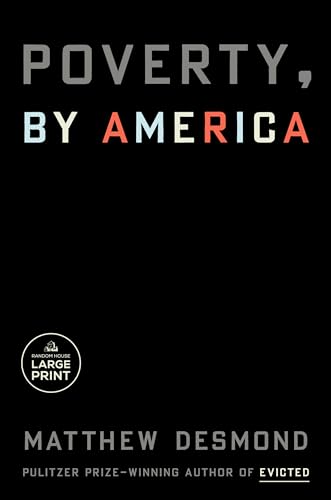

Poverty, by America / Matthew Desmond.
Idioma: Inglés Random House, 2023 New York, New York :Descripción: 383 pagesTipo de contenido:- texto
- no mediado
- volume
- 9780593678541
- 23 362
| Imagen de cubierta | Tipo de ítem | Biblioteca actual | Biblioteca de origen | Colección | Ubicación en estantería | Signatura topográfica | Materiales especificados | Info Vol | URL | Copia número | Estado | Notas | Fecha de vencimiento | Código de barras | Reserva de ítems | Prioridad de la cola de reserva de ejemplar | Reservas para cursos | |
|---|---|---|---|---|---|---|---|---|---|---|---|---|---|---|---|---|---|---|
| Libro | Biblioteca Encarnación Valdés Colección General bev | 362.5 D464p (Navegar estantería(Abre debajo)) | Disponible | 80000002653353 |
Descripciones mejoradas de Syndetics:
#1 NEW YORK TIMES BESTSELLER * The Pulitzer Prize-winning author of Evicted reimagines the debate on poverty, making a "provocative and compelling" (NPR) argument about why it persists in America: because the rest of us benefit from it.
A BEST BOOK OF THE YEAR: The New Yorker, The New York Times Book Review, NPR, Oprah Daily, Time, The Star Tribune, Vulture, The Christian Science Monitor, Chicago Public Library, Esquire, California Review of Books, She Reads, Library Journal
"Urgent and accessible . . . Its moral force is a gut punch."-- The New Yorker
Longlisted for the Inc. Non-Obvious Book Award * Longlisted for the Andrew Carnegie Medal
The United States, the richest country on earth, has more poverty than any other advanced democracy. Why? Why does this land of plenty allow one in every eight of its children to go without basic necessities, permit scores of its citizens to live and die on the streets, and authorize its corporations to pay poverty wages?
In this landmark book, acclaimed sociologist Matthew Desmond draws on history, research, and original reporting to show how affluent Americans knowingly and unknowingly keep poor people poor. Those of us who are financially secure exploit the poor, driving down their wages while forcing them to overpay for housing and access to cash and credit. We prioritize the subsidization of our wealth over the alleviation of poverty, designing a welfare state that gives the most to those who need the least. And we stockpile opportunity in exclusive communities, creating zones of concentrated riches alongside those of concentrated despair. Some lives are made small so that others may grow.
Elegantly written and fiercely argued, this compassionate book gives us new ways of thinking about a morally urgent problem. It also helps us imagine solutions. Desmond builds a startlingly original and ambitious case for ending poverty. He calls on us all to become poverty abolitionists, engaged in a politics of collective belonging to usher in a new age of shared prosperity and, at last, true freedom.
Includes bibliographical references and index.
The United States is the richest country on earth, yet has more poverty than any other advanced democracy. One in seven Americans live below the poverty line, a line which hasn't shifted over the last fifty years, despite the efforts of successive governments and extensive relief programs. Why is there so much scarcity in this land of dollars?In Poverty, by America, acclaimed sociologist Matthew Desmond examines the nature of American poverty today and the stories we tell ourselves about it. Spanning racism, social isolation, mass incarceration, the housing crisis, domestic violence, crack and opioid epidemics, welfare cuts and more, Desmond argues that poverty does not result from a lack of resources or good policy ideas. We already know how to eliminate it. The hard part is getting more of us to care.To do so, we need a new story. As things stand, liberals explain poverty through insurmountable structural issues, whereas conservatives highlight personal failings and poor life choices. Both analyses abdicate responsibility, and ignore the reality that the advantages of the rich only come at the expense of the poor. It is time better-paid citizens put themselves back in the narrative, recognizing that the depth and expanse of poverty in any nation reflects our failure to look out for one another. Poverty must ultimately be met by community- all this suffering and want is our doing, and we can undo it.
Extracto provisto por Syndetics
Reseñas proporcionadas por Syndetics
Library Journal Review
Pulitzer Prize--winning sociologist Desmond (Evicted) argues that poverty exists in the United States because wealthy people benefit from it. While the United States ranks among the richest countries in the world, it has the largest amount of poverty; the author expects that to expand. Presently, every one in three Americans work in low-paying jobs, one in eight live in severe poverty, and the wealth gap between Black and white families remains large. For example, in the average white family, the head of household with a high school diploma is better paid than the head of a Black household with a college degree. The author also points to when most white women did not have to work outside their home; whereas Black women, to survive, had to work any job available. The author suggests solutions by advocating for what he calls "poverty abolitionists," people he hopes will insist on collective bargaining and producing true economic rewards for workers. He also urges the government to end hunger and create laws that ensure all Americans make a livable wage. VERDICT This book will likely interest scholars. Add it to social and behavioral sciences collections.--Claude UryPublishers Weekly Review
Pulitzer winner Desmond follows up Evicted with a powerful inquiry into why the U.S. is "the richest country on earth, with more poverty than any other advanced democracy." Noting that 38 million Americans cannot afford basic necessities, Desmond argues that poverty persists because others benefit from it: workers are paid non-living wages and unions are discouraged in order to boost the pay of corporate executives; poor consumers are overcharged for rental housing and financial services so that landlords and banks can prosper; and affluent families benefit from tax breaks, student loans, and other forms of federal aid while welfare programs are publicly belittled and made difficult to access. Poverty is further entrenched by the underfunding of education, mass transit, and healthcare, Desmond argues, creating a world of private opulence and public squalor. His solutions include eliminating the residential segregation that blocks poor families from well-funded public services and employment and housing opportunities. More broadly, he calls for better-off Americans to acknowledge their complicity in perpetuating poverty and to pressure the government to undertake "an aggressive, uncompromising antipoverty agenda." Though the path to achieving these reforms isn't always clear, Desmond enriches his detailed and trenchant analysis with poignant reflections on America's "unblushing inequality" and the "anomie of wealth." It's a gut-wrenching call for change. Agent: Katherine Flynn, Kneerim & Williams. (Mar.)CHOICE Review
Desmond (sociology, Princeton Univ.), who won the Pulitzer Prize for his earlier work Evicted (CH, Aug'10, 47-7150), masterfully explains why the US, a country among the most developed nations, has such protracted and embedded poverty. Pulling no punches, Desmond indicts the nation, Americans' indifference to penury, a tax code that advantages the affluent, zoning that discriminates against the poor, and a widely accepted ideology of individual responsibility. Clearly, the US has ample resources, so the nation's poverty effort could parallel that of other developed countries, but a scheme of "resource diversion" impedes anti-poverty progress. Demond's anti-poverty agenda includes community organizing, more scattered-site public housing, stronger unions, and progressive tax reform. Poverty, by America is short and accessible, a must read for anyone concerned about racism, inequality, and social justice. Desmond's case is pessimistic, leaving little room for progress; Mark Rank's The Poverty Paradox (CH, Dec'23, 61-1069) is a partial corrective. Summing Up: Highly recommended. Advanced undergraduates through faculty; general readers; professionals. --David Stoesz, independent scholarBooklist Review
Sociologist and MacArthur fellow Desmond follows up his Carnegie Medal--winning Evicted (2016) with a brilliantly researched and artfully written study of how the U.S. has failed to effectively address the issue of poverty. Grounding his thesis in statistics that defy easy analysis and show that the ebb and flow of the problem continues regardless of political leadership, recession, or economic boom, he provides readers with unforgettable images--"if America's poor founded a country . . . [it] would have a bigger population than Australia or Venezuela"--and pointed truths about how individual states failed to allocate funds to assist their poor. For example, Oklahoma spent tens of millions in federal poverty funds on the Oklahoma Marriage Initiative. Arizona used millions on abstinence-only education. Maine supported a Christian summer camp, and Mississippi officials committed fraud on a scale that has led to multiple indictments. Thankfully, as Desmond reveals the frustrating ways in which private and public systems designed to help the poor have fallen short, he also uses his knowledge of the subject to explore what works and identify potential solutions that merit further consideration. This thoughtful investigation of a critically important subject, a piercing title by an astute writer who is both passionate and fearless, is valuable reading for all concerned with affecting positive change.Notas de autor provistas por Syndetics
Matthew Desmond received a bachelor's degree from Arizona State University and a Ph.D. in sociology from the University of Wisconsin at Madison in 2010. He is a professor of social sciences at Harvard University. His books include On the Fireline: Living and Dying with Wildland Firefighters, Race in America written with Mustafa Emirbayer, The Racial Order written with Mustafa Emirbayer, and Evicted: Poverty and Profit in the American City, which won the Pulitzer Prize for general nonfiction in 2017.(Bowker Author Biography)