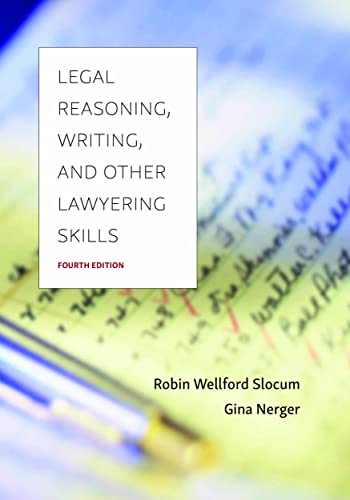

Legal reasoning, writing, and other lawyering skills / Robin Slocum, Gina Nerger.
Editor: Durham, North Carolina : Carolina Academic Press, LLC, [2022]Edición: Fourth editionDescripción: xxx, 644 pages : ilustraciones ; 26 cmTipo de contenido:- text
- unmediated
- volume
- 9781531024048
- KF 250 .S568 2022
| Imagen de cubierta | Tipo de ítem | Biblioteca actual | Biblioteca de origen | Colección | Ubicación en estantería | Signatura topográfica | Materiales especificados | Info Vol | URL | Copia número | Estado | Notas | Fecha de vencimiento | Código de barras | Reserva de ítems | Prioridad de la cola de reserva de ejemplar | Reservas para cursos | |
|---|---|---|---|---|---|---|---|---|---|---|---|---|---|---|---|---|---|---|
| Libro | Biblioteca de Derecho Mons. Fremiot Torres Oliver Colección General biblioteca derecho | KF 250 .S568 2022 (Navegar estantería(Abre debajo)) | Disponible | 70000000905695 |
Descripciones mejoradas de Syndetics:
The fourth edition of Legal Reasoning, Writing and Other Lawyering Skills draws on lessons from neuroscience and psychology to deepen students' understanding of self and others, and of the emotional biases and filters that undermine their efforts to "think like a lawyer." The fourth edition retains the same core chapters of earlier editions that emphasize and illustrate the "process" of thinking through, and writing about, a client problem. Within those core chapters, however, the fourth edition refines and adds clarity to foundational concepts.
For example, the fourth edition distinguishes between types of client conclusions within legal analysis--ultimate conclusions and legal issue conclusions, and it breaks down the types of reasoning provided within court opinions--explanatory reasoning and application reasoning. These labels foster deeper understanding of the core concepts needed to engage in legal analysis. The fourth edition also provides a more specific formula for successfully drafting rule statements for use within memorandums and briefs.
In addition, the fourth edition retains chapters covering the practicalities of modern-day legal practice, with a focus on documents students will draft in day-to-day law practice, from client letters, email responses, demand/settlement letters, and trial briefs. The fourth edition adds a new chapter on drafting summary judgment briefs, and introduces students to working with and citing record evidence. It also adds additional exercises throughout for more hands-on learning opportunities. This book can be used in a typical two-semester legal skills course, as well as more intensive two-semester courses, and three- and even four-semester courses.
Includes bibliographical references and index.
Introduction to legal writing & other lawyering skills -- Introduction to American legal system -- Reading and briefing cases : the basics -- The lawyer as advisor : "human" factors that complicate your role -- The lawyer as investigator : the client interview -- Evaluating rules of law -- Evaluating a case -- Evaluating how an earlier case affects your client -- The office memorandum : an overview -- The discussion section : the basic template for analysis -- The discussion section : drafting the analysis (single case) -- Evaluating multiple cases -- The discussion section : drafting the analysis (multiple cases) -- The discussion section : drafting roadmap paragraphs -- Drafting an office memo : completing the draft -- Revising and finalizing the memo : content & organizational structure -- Revising & finalizing the memo : sentence structure & word choice -- Selecting cases for the memo -- Drafting short memos : the thin-sliced analysis -- Professional e-mail communications -- Drafting client letters -- The lawyer as advisor/collaborator : counseling the client -- Persuasive writing style strategies -- Fact-centered arguments : pre-drafting strategies -- Fact-centered arguments : drafting the argument -- Law-centered arguments : working with mandatory case precedent -- Law-centered arguments : working with policy -- Law-centered arguments : working with statutes -- Drafting law-centered arguments based on statutes & policy -- Addressing unfavorable law and arguments -- Trial & appellate court briefs -- Trial & appellate court briefs : the factual statement -- Trial & appellate court briefs : drafting roadmaps of the argument -- Summary judgment briefs -- Appellate court briefs : scope of review & statement of the issues -- Oral arguments -- Demand & settlement letters.
"The fourth edition of Legal Reasoning, Writing and Other Lawyering Skills draws on lessons from neuroscience and psychology to deepen students' understanding of self and others, and of the emotional biases and filters that undermine their efforts to "think like a lawyer." The fourth edition retains the same core chapters of earlier editions that emphasize and illustrate the "process" of thinking through, and writing about, a client problem. Within those core chapters, however, the fourth edition refines and adds clarity to foundational concepts. For example, the fourth edition distinguishes between types of client conclusions within legal analysis-ultimate conclusions and legal issue conclusions, and it breaks down the types of reasoning provided within court opinions-explanatory reasoning and application reasoning. These labels foster deeper understanding of the core concepts needed to engage in legal analysis. The fourth edition also provides a more specific formula for successfully drafting rule statements for use within memorandums and briefs. In addition, the fourth edition retains chapters covering the practicalities of modern-day legal practice, with a focus on documents students will draft in day-to-day law practice, from client letters, email responses, demand/settlement letters, and trial briefs. The fourth edition adds a new chapter on drafting summary judgment briefs, and introduces students to working with and citing record evidence. It also adds additional exercises throughout the book for more hands-on learning opportunities. This book can be used in a typical two-semester legal skills course, as well as more intensive two-semester courses, and three- and even four-semester courses"--