Imagen de portada de Amazon
Imagen de Amazon.com
Imagen de cubierta Syndetics
Portada de Syndetics
Imagen de OpenLibrary

Truth : a guide / Simon Blackburn

Por: Descripción: xxi, 238 pages 21 cmTipo de contenido:
  • text
Tipo de medio:
  • unmediated
Tipo de soporte:
  • volume
ISBN:
  • 9780195315806
Tema(s): Clasificación LoC:
  • BC 171  .B58 2005
Contenidos:
Faith, belief, and reason -- Cliffordd's Duties -- Will and Passion in James -- Fiction and Myth -- Kinds of Animation -- Man the measure -- Turning the Tables: the Recoil Argument -- Modern Judo -- The Variation of Subjectivities -- The Moving Bull's-eye -- Doing it Ourselves -- Ishmael's problem and the delights of keeping quiet -- Who Tells the Tale? -- A Gestalt Switch -- You Tell Me, or Down with Pilate -- Moral Relativism -- Man the Measurer -- Summary -- Nietzsche : the arch debunker -- Facts or Interpretations? -- Twilight of the Idols -- Perspectivism -- Adequate Words -- Heraclitus and the Flux -- The Darwinian Element -- The possibility of philosophy -- Getting Puzzled -- Eliminativism -- Realism -- Deconstructing the Issue -- The Constructivist Corner -- The Example of Wittgenstein -- Observation and truth : from Locke to Rorty -- Paradise Lost -- First Impressions -- Holism -- Davidson's Mantle -- Rorty's talking World -- Keeping our Feet on the Ground -- Interlude: Law, Tennis and the Coffee-house -- A Political Message -- Realism as science; realism about science -- No Miracles -- Science Red in Tooth and Claw -- Explaining from Within -- Animation and Belief Again -- Underdetermination -- Historians and others -- Conceptual Schemes -- Mind Reading -- Mirroring -- Infirmities -- Collectives and their Histories -- Peace Breaks Out
Premios: Haga clic para abrir en una nueva ventana
Valoración
    Valoración media: 0.0 (0 votos)
Existencias
Imagen de cubierta Tipo de ítem Biblioteca actual Biblioteca de origen Colección Ubicación en estantería Signatura topográfica Materiales especificados Info Vol URL Copia número Estado Notas Fecha de vencimiento Código de barras Reserva de ítems Prioridad de la cola de reserva de ejemplar Reservas para cursos
Libro BET Biblioteca Escuela de Teología Colección General BET BC 171 .B58 2005 (Navegar estantería(Abre debajo)) Disponible 41000000008038
Total de reservas: 0

Descripciones mejoradas de Syndetics:

The author of the highly popular book Think, which Time magazine hailed as "the one book every smart person should read to understand, and even enjoy, the key questions of philosophy," Simon Blackburn is that rara avis--an eminent thinker who is able to explain philosophy to the general reader. Now Blackburn offers a tour de force exploration of what he calls "the most exciting and engaging issue in the whole of philosophy"--the age-old war over truth. The front lines of this war are well defined. On one side are those who believe in plain, unvarnished facts, rock-solid truths that can be found through reason and objectivity--that science leads to truth, for instance. Their opponents mock this idea. They see the dark forces of language, culture, power, gender, class, ideology and desire--all subverting our perceptions of the world, and clouding our judgement with false notions of absolute truth. Beginning with an early skirmish in the war--when Socrates confronted the sophists in ancient Athens--Blackburn offers a penetrating look at the longstanding battle these two groups have waged, examining the philosophical battles fought by Plato, Protagoras, William James, David Hume, Hans-Georg Gadamer, Jacques Derrida, Michel Foucault, Richard Rorty, and many others, with a particularly fascinating look at Nietzsche. Among the questions Blackburn considers are: is science mere opinion, can historians understand another historical period, and indeed can one culture ever truly understand another. Blackburn concludes that both sides have merit, and that neither has exclusive ownership of truth. What is important is that, whichever side we embrace, we should know where we stand and what is to be said for our opponents.

Includes bibliographical references (pages 223-234) and index.

Faith, belief, and reason -- Cliffordd's Duties -- Will and Passion in James -- Fiction and Myth -- Kinds of Animation -- Man the measure -- Turning the Tables: the Recoil Argument -- Modern Judo -- The Variation of Subjectivities -- The Moving Bull's-eye -- Doing it Ourselves -- Ishmael's problem and the delights of keeping quiet -- Who Tells the Tale? -- A Gestalt Switch -- You Tell Me, or Down with Pilate -- Moral Relativism -- Man the Measurer -- Summary -- Nietzsche : the arch debunker -- Facts or Interpretations? -- Twilight of the Idols -- Perspectivism -- Adequate Words -- Heraclitus and the Flux -- The Darwinian Element -- The possibility of philosophy -- Getting Puzzled -- Eliminativism -- Realism -- Deconstructing the Issue -- The Constructivist Corner -- The Example of Wittgenstein -- Observation and truth : from Locke to Rorty -- Paradise Lost -- First Impressions -- Holism -- Davidson's Mantle -- Rorty's talking World -- Keeping our Feet on the Ground -- Interlude: Law, Tennis and the Coffee-house -- A Political Message -- Realism as science; realism about science -- No Miracles -- Science Red in Tooth and Claw -- Explaining from Within -- Animation and Belief Again -- Underdetermination -- Historians and others -- Conceptual Schemes -- Mind Reading -- Mirroring -- Infirmities -- Collectives and their Histories -- Peace Breaks Out

Tabla de contenidos provista por Syndetics

  • Preface
  • Introduction
  • Chapter 1 Faith, Belief And Reason
  • 1 Clifford's Duties
  • 2 Fiction and MythJames
  • 4 Kinds of Animation
  • Chapter 2 Man The Measure
  • 1 Turning the Tables: the Recoil Argument
  • 2 Modern Judo
  • 3 The Variation of Subjectives
  • 4 The Moving Bull's-eye
  • 5 Doing it Ourselves
  • Chapter 3 Ishmael's Problem And The Delights Of Keeping Quiet
  • 1 Who Tell the Tale?
  • 2 A Gestalt Switch
  • 3 You Tell Me, or Down with Pilate
  • 4 Moral Relativism
  • 5 Man the Measurer
  • 6 Summary
  • Chapter 4 Nietzche: The Arch Debunker
  • 1 Facts or Interpretations?
  • 2 Twilight of the Idols
  • 3 Perspectivism
  • 4 Adequate Words
  • 5 Heraclitus and the Flux
  • 6 The Darwinian Element
  • Chapter 5 The Possibility Of Philosophy
  • 1 Getting Puzzled
  • 2 Four Responses
  • 3 Eliminativism
  • 4 Realism
  • 5 Deconstructing the Issue
  • 6 The Constructivist Corner
  • 7 The Example of Wittgenstein
  • Chapter 6 Observation And Truth: From Locke To Rorty
  • 1 Paradise Lost
  • 2 First Impressions
  • 3 Holism
  • 4 Davidson's Mantle
  • 5 Rorty's Talking World
  • 6 Keeping our Feet on the Ground
  • 7 Interlude: Law, Tennis, and the Coffee-house
  • 8 A Political Message
  • Chapter 7 Realism As Science; Realism About Science
  • 1 No Miracles
  • 2 Science Red in Tooth and Claw
  • 3 Explaining from Within
  • 4 Animation and Belief Again
  • 5 Underdetermination
  • Chapter 8 Historians And Others
  • 1 Conceptual Schemes
  • 2 Mind Reading
  • 3 Mirroring
  • 4 Infirmities
  • 5 Collectives and their Histories
  • 6 Peace Breaks Out
  • Notes
  • Index

Reseñas proporcionadas por Syndetics

Library Journal Review

Blackburn (philosophy, Univ. of Cambridge; Think: A Compelling Introduction to Philosophy) wants to help readers attain a philosophical understanding of the concept of "truth." What does it mean, he asks, to make a statement that asserts this concept? The average person, perhaps, has no trouble doing so, but analysis of it goes to the heart of philosophical puzzlement. Blackburn reviews what philosophers, writers, novelists, scientists, and disparate thinkers have had to say about it, including Plato, Francis Bacon, Voltaire, Locke, Hume, Wittgenstein, William James, Rorty, and Nietzsche-especially Rorty and Nietzsche owing to their central and contrasting views. In this detailed consideration, Blackburn himself seems to favor objective standards for truth rather than the subjectivist, relativist position. His writing is fluid, highly literate, and deeply informed, but by its very nature it will be tough going for anyone who is not philosophically inclined and oriented. Highly recommended, then, for academic philosophy and literature collections.-Leon H. Brody, U.S. Office of Personnel Management Lib., Washington, DC (c) Copyright 2010. Library Journals LLC, a wholly owned subsidiary of Media Source, Inc. No redistribution permitted.

CHOICE Review

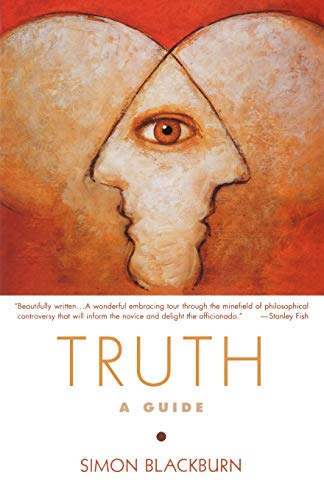
Their dust jackets suggest the different stances these two books take to their topic. On the cover of Why Truth Matters is a photograph of a naked, transparent light bulb, its glowing filament symbolic of the illumination provided by science. Truth: A Guide bears a painting of two opposed, overlapping profiles sharing a single eye, indicative of its author's desire to reconcile enemies in the truth wars. Benson and Stangroom, authors of The Dictionary of Fashionable Nonsense (2004), hearken back to a decidedly unfashionable Enlightenment ideal of objective and scientifically verifiable truth battling the obscurantist forces of relativism, skepticism, faith, and identity politics. The authors are not academics, and their book is written for a lay audience, so although they do evaluate the arguments of some scholars (especially in a couple of chapters on the sociology of science), they as frequently turn to newspapers for contemporary examples of the disregard for truth (e.g., a tobacco company suppressing medical research damaging to its interests, a pro-Palestinian professor shouting down Jewish students). This element of social critique is the most interesting part of the book, whereas the philosophical argumentation is too superficial for academic purposes. Truth matters, the authors say, because "humans are the only entities in the entire universe, for all we know, who have the capacity to make truth their object"--dubious reasoning for Darwinians who do not accept an Aristotelian teleological metaphysics.Truth: A Guide, although not particularly technical (especially given its provenance as the 2004 Gifford Lectures), is nevertheless written at a higher level of abstraction than Why Truth Matters. It is more concerned with analyzing Protagoras, Nietzsche, Rorty, van Fraassen, et al., than with reporting on current events. It is also more moderate. Blackburn (philosophy, Univ. of Cambridge) rejects the extremes of relativism and skepticism and respects the methodology of science, as do Benson and Stangroom. On the other hand, Blackburn allows that more sophisticated forms of relativism are not subject to the same objections, and rejects the correspondence theory of truth of hard-line absolutists. He gives a sympathetic reading of the late Wittgenstein, who believed that truth is embedded in "language games," and argues that scientific theories are not objects of belief, necessarily, but rather that they "animate" scientists by setting the parameters for further research. ^BSumming Up: Optional. Benson and Stangroom's book: Lower-level undergraduates and general readers. Recommended. Blackburn's book: Upper-level undergraduates through faculty/researchers. C. S. Seymour Wayland Baptist University

Notas de autor provistas por Syndetics

Simon Blackburn is Professor of Philosophy at the University of Cambridge. He was Edna J. Doury Distinguished Professor of Philosophy at the University of North Carolina, and from 1969 to 1990 was a Fellow and Tutor at Pembroke College, Oxford. He is the author of The Oxford Dictionary of Philosophy and the best-selling Think and Being Good, among other books.
Compartir
logopucpr-y-vive

Contáctanos

¡Queremos saber de ti!

Tel. 787.841.2000 Ext. 1801

bibliotecavaldes@pucpr.edu

⁣Búscanos en las redes

© 2026 Desarrollado por Ignite Online • All Rights Reserved • Powered by Koha.