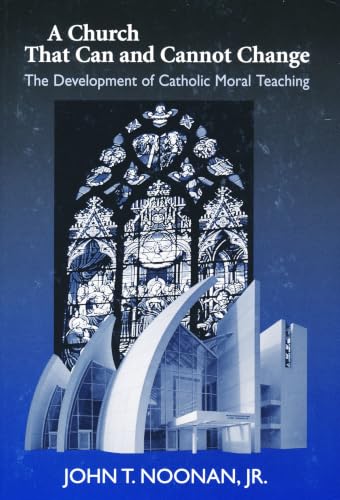

A church that can and cannot change : the development of Catholic moral teaching / John T. Noonan, Jr.
Descripción: xiv, 297 pages ; 24 cmTipo de contenido:- text
- unmediated
- volume
- 0268036039 (cloth : alk. paper)
- 241/.042 22
- BX 946 .N66 2005
| Imagen de cubierta | Tipo de ítem | Biblioteca actual | Biblioteca de origen | Colección | Ubicación en estantería | Signatura topográfica | Materiales especificados | Info Vol | URL | Copia número | Estado | Notas | Fecha de vencimiento | Código de barras | Reserva de ítems | Prioridad de la cola de reserva de ejemplar | Reservas para cursos | |
|---|---|---|---|---|---|---|---|---|---|---|---|---|---|---|---|---|---|---|
| Libro BET | Biblioteca Escuela de Teología Colección General BET | BX 9446 .N66 2005 (Navegar estantería(Abre debajo)) | Disponible | 41000000007535 |
Descripciones mejoradas de Syndetics:
Using concrete examples, John T. Noonan, Jr., demonstrates that the moral teaching of the Catholic Church has changed and continues to change without abandoning its foundational commitment to the Gospel of Jesus Christ. Specifically, Noonan looks at the profound changes that have occurred over the centuries in Catholic moral teaching on freedom of conscience, lending for a profit, and slavery. He also offers a close examination of the change now in progress concerning divorce.
In these changes Noonan perceives the Catholic Church to be a vigorous, living organism answering new questions with new answers, and enlarging the capacity of believers to learn through experience and empathy what love demands. He contends that the impetus to change comes from a variety of sources, including prayer, meditation on Scripture, new theological insights and analyses, the evolution of human institutions, and the examples and instruction given by persons of good will.
Noonan also states that the Church cannot change its commitment to preaching the Gospel of Jesus Christ. Given this absolute, how can the moral teaching of the Church change? Noonan finds this question unanswerable when asked in the abstract. But in the context of the specific facts and events he discusses in this book, an answer becomes clear. As our capacity to grasp the Gospel grows, so too, our understanding and compassion, which give life to the Gospel commandments of love, grow.
"A John W. Kluge Center book."
Includes bibliographical references (p. 226-284) and index.
"Change is not a thing to be ashamed of, to be whispered about, to be disguised or held from the light of day, as grave guardians sometimes think. Change, in continuity with roots, is the rule of human life. It has been the way of life of the Church. It is a way of teaching celebrated in the Gospel itself in the image of the scribe learned in the law of Moses who is 'like a householder who produces from his treasury what is anew and what is old' (Mt 13:52). The new and the old cannot in life be neatly distinguished as the old slowly comes to fruition in the new". –from the book
Reseñas proporcionadas por Syndetics
CHOICE Review
A judge for the US Court of Appeals, Noonan is known for his incisive writings on legal and moral topics. His latest book analyzes a perennial problem in the Catholic Church's understanding of doctrine: how doctrine develops. Noonan addresses the most salient historical examples of what have been significant changes in the church's moral doctrine over time: its positions on slavery, usury, religious freedom, and divorce. After exhaustive historical research on each of these, Noonan claims that the church changed its positions on these questions because of the growth in its experience of the human condition and thus its compassion. In no case has it changed its absolute commitment to the "deposit of faith" as revealed in the gospels. So, for example, even though Pope John Paul II in 1993 declared the practice of slavery to be intrinsically evil, and even though it was previously not only tolerated but engaged in by the church, Noonan concludes that this change represents not a contradiction but rather the discovery of the truth of the immorality of slavery. ^BSumming Up: Highly recommended. Upper-level undergraduates and above, especially historians, church historians, and moral theologians. J. C. Swindal John Carroll UniversityNotas de autor provistas por Syndetics
John Thomas Noonan Jr. was born in Boston, Massachusetts on October 24, 1926. He received a bachelor's degree in English from Harvard University. He studied at St. John's College at the University of Cambridge. He received a master's degree and a doctorate in philosophy from the Catholic University of America in Washington and a law degree from Harvard Law School. After law school, he worked for President Dwight D. Eisenhower's national security adviser, defeated Michael S. Dukakis for a seat on the Brookline, Massachusetts Redevelopment Authority, and joined his father's Boston law firm.In 1961, he taught law at the University of Notre Dame. In 1966, he joined the faculty of the University of California, Berkeley, Boalt Hall School of Law, where he taught until he was appointed a judge. He was appointed to the appeals court in San Francisco in 1985 by President Ronald Reagan. He sat on the federal bench through December 2016. He wrote several books during his lifetime including Contraception: A History of Its Treatment by the Catholic Theologians and Canonists, Persons and Masks of the Law, Bribes, The Responsible Judge: Readings in Judicial Ethics, The Lustre of Our Country: The American Experience of Religious Freedom, and Narrowing the Nation's Power: The Supreme Court Sides with the States. He died from heart failure on April 17, 2017 at the age of 90.
(Bowker Author Biography)