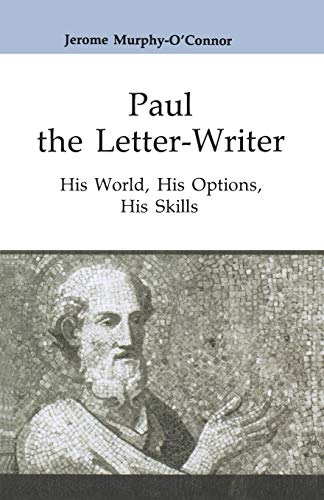

Paul the letter-writer : his world, his options, his skills / Jerome Murphy-O'Connor.
Series Good News Studies ; 41Descripción: viii, 152 pages ; 21 cmTipo de contenido:- text
- unmediated
- volume
- 0814658458
- 227/.066 20
- BS 2650.2 .M87 1995
| Imagen de cubierta | Tipo de ítem | Biblioteca actual | Biblioteca de origen | Colección | Ubicación en estantería | Signatura topográfica | Materiales especificados | Info Vol | URL | Copia número | Estado | Notas | Fecha de vencimiento | Código de barras | Reserva de ítems | Prioridad de la cola de reserva de ejemplar | Reservas para cursos | |
|---|---|---|---|---|---|---|---|---|---|---|---|---|---|---|---|---|---|---|
| Libro BET | Biblioteca Escuela de Teología Colección General BET | BS 2650.2 .M87 1995 (Navegar estantería(Abre debajo)) | Disponible | 41000000007519 |
Descripciones mejoradas de Syndetics:
Paul's letters are intensely human documents. In the examination of such basic human questions as What did he write the letters with?" "Did he use a secretary to record them?" and "What was his personal writing style?" much real information can be gathered regarding his thought without intimidating the average reader.
Scholar Jerome Murphy-O'Connor has put together such a work, one that, tapping into his knowledge of classical Greek and Latin writings, addresses the physical nature of a first-century letter as well as the actual composition, presentation, and question of authorship collaborative or other of the Pauline letters. The formal features of the letters and their organization show the extent to which Paul adapted current epistolary conventions. At the same time, they draw attention to his mood while writing and his relationship with the recipients. Father Murphy-O'Connor also investigates the question of how these letters, written to widely scattered churches, were brought together to form the Pauline canon.
Jerome Murphy-O'Connor, OP (1935-2013) , was a professor of New Testament at the famous École Biblique in Jerusalem since 1967. A frequent lecturer in summer sessions in the United States, he had written widely on Paul's life and theology. In addition to his 1 Corinthians and Becoming Human Together: The Pastoral Anthropology of St.Paul , The Liturgical Press has published his St. Paul's Corinth: Texts and Archaeology , which does for Corinth what this book does for the Pauline letters: reveal their character.
"A Michael Glazier book."
Includes bibliographical references (p. 134-144) and indexes.
Putting Pen to Paper -- Tools of a Writer's Trade -- Paul Used a Secretary -- First-Century Secretaries and Their Skills -- Recorder -- Editor -- Substitute Author -- Collaborators as Coauthors 1 and 2 Thessalonians -- First Corinthians -- Second Corinthians -- The Ï"Sections -- The "We" Sections -- 2 Cor 10-13 -- Other Letters -- Co-authorship in Practice -- A Pauline Style? -- Note-Takers and Church Tradition -- Sending a Letter -- Organizing a Letter -- Letters or Epistles? -- Address -- Sender -- Recipient -- To a Church -- To the Members of a Church -- To Individuals -- Opening Greeting -- Thanksgiving -- Greek Papyrus Letters -- The Forms of the Thanksgiving -- Thanksgivings in the Body of the Letter -- The Absence of a Thanksgiving -- Thanksgivings as Introductions -- The Body of the Letter -- Rhetorical Criticism of Letter -- The Three Types of Oratory -- The Rhetorical Classification of the Pauline Letters -- The Components of a Deliberative Speech -- Exordium -- Narratio -- Digressio -- Propositio -- Confirmatio -- Peroratio -- The Rhetorical Schema Applied to the Pauline Letters -- Misuse of the Rhetorical Schema -- The Importance of the Propositio -- Concentrically Structured Documents -- COncentrically Structured Parts of Documents -- Epistolary Classification of Letters -- Conclusion -- The Final Blessing -- Greetings -- The Position of the Greeting -- The Source of the Greeting -- The Recipients of the Greeting -- Greeting with the Kiss -- The Peace Wish -- Postscripts -- Collecting the Letters -- The Evolutionary Theory -- The Big Bang Theory -- Was Paul Involved? --The Order and Length of the Letters -- The Order of the Letters
How did Paul use his secretaries? Did he rely on co-authors? Did his rhetorical education affect the way he organized his material? This unusual book confronts these questions on the basis of extensive quotations from classical Greek and Latin authors. A synoptic survey of the beginnings and ends of the letters brings out the extent to which Paul both used and adapted current epistolary conventions. At the same time it draws attention to his mood while writing and to his relations with the recipients. The effect is to humanize the Pauline letters and make their complex theology less daunting.