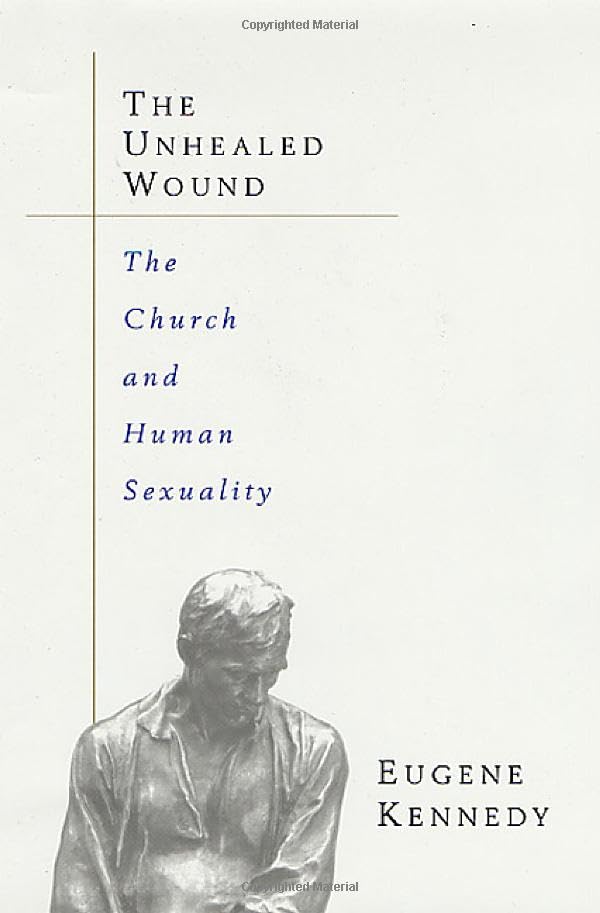
Kennedy, a psychologist, former priest, and a leading Catholic author and scholar, addresses one of the most compelling yet undiscussed issues in the Church: human sexuality. The Unhealed Wound is a penetrating and insightful study of the unresolved conflicts Catholics face regarding both their sexuality and spirituality, deep conflicts which grow more and more serious as they remain unaddressed within the Church.
He astutely yet respectfully takes to task a faith that--despite the reality of erotic love as a natural and human aspect of life itself--condemns birth control, marriage for priests, and sex outside of marriage. The Unhealed Wound also examines the Church's formidable hierarchy, challenging those clerics who uphold papal edicts unthinkingly. Articulately postulating our need not only to understand but celebrate our own sexuality, this book will engender both controversy and heated dialogue among today's scholars, students, and believers of Catholicism.
Includes bibliographical references.
Tabla de contenidos provista por Syndetics
Part 1 The Myth of the Unhealed Wound
1 Overture: Tristan's Wound(p. 3)
2 Unhealed Wounds(p. 6)
3 Wounded, Everyone, Everywhere(p. 11)
4 The Myth of the Grail King Anfortas(p. 21)
5 John Paul II, Wounded Healer(p. 26)
6 Our Myth, Our Experience, Our Story(p. 34)
Part 2 Brick and Mortar: The Church as Institution
7 Myths of Institutional Catholicism: Brick and Mortar(p. 45)
8 Romanticized Discipline: Women Do the suffering(p. 55)
9 Asexuality in Action: The Curial Style(p. 64)
10 The Varieties of Ecclesiastical Control(p. 82)
Part 3 Healing the Wound: The Church As Mystery
11 The Gift of Reception in Catholic Experience(p. 101)
12 Maimed for the Kingdom(p. 119)
13 Defending and Pursuing Celibacy(p. 140)
14 What Wounds are These?(p. 164)
15 What is it That Ails You?(p. 182)
Notes(p. 207)
Reseñas proporcionadas por Syndetics
Library Journal Review
The myth of Grail King Anfortas, which describes the slaying of Nature in an illusory search for spiritual perfection, serves here to engage readers in the controversial topic of the "unhealed wound of sexuality within institutional Catholicism." Psychologist and former priest Kennedy (My Brother Joseph: The Spirit of a Cardinal and the Story of a Friendship) suggests that human nature has been overruled by the reproaches and restrictions of the bureaucracy of the Catholic Church. The author addresses such topics as the priest shortage, hierarchical control within the Church, and sexual discrimination of women to create a dialog on papal edicts and foster critical thinking on the future direction of the Church. The Catholic bureaucracy would have the layperson believe that if the shortage of priests (and thus the need to ordain women) is not discussed, then it does not exist and male supremacy remains. In this way, the Church invests its power in mastery over human beings and loses its true authority in helping men and women heal and celebrate their nature and sexuality. This thoughtful but demanding discussion is recommended for academic religion collections. Leo Kriz, West Des Moines P.L., IA (c) Copyright 2010. Library Journals LLC, a wholly owned subsidiary of Media Source, Inc. No redistribution permitted.
Publishers Weekly Review
The Catholic Church has been pilloried aplenty in modern times for its teachings on birth control, priestly celibacy and a male-only priesthood. Kennedy, a psychologist and former Catholic priest, adds his voice to the jeering in this indictment of the Church of Rome. Kennedy argues that Catholicism suffers from a gaping wound because of its alleged failure to deal with sexual intimacy in its midst. Besides opposing artificial contraception and requiring priests to be unmarried males, Kennedy says the Church has failed its people by labeling as sinful all sexual activity outside marriage and deeming homosexuality an "objective disorder." He claims the Church is willing to look at intimate human experience only through its own "distorting lenses," but he fails to point out that other churches with a traditional view share many of Catholicism's positions on sexual behavior. Kennedy also criticizes the Vatican for what he says is its unwillingness to publicly discuss the celibate, all-male priesthood and for mishandling pedophilia scandals. Kennedy maintains that celibacy is a means "to master... men" through controlling their sexuality, and he traces the pedophilia problem to the immature sexual development of priest perpetrators. Readers who are unhappy with the Church's stances on human sexuality will find a sympathetic ear in Kennedy, but little in the way of realistic, constructive solutions. (Apr.) (c) Copyright PWxyz, LLC. All rights reserved
Booklist Review
No topic has generated as much controversy and division within the Catholic Church as the issue of human sexuality. For centuries the faithful have wrestled with the seemingly inherent conflict between doctrinal edicts and human eroticism. Persuasively arguing that all aspects of our God-endowed human nature should be celebrated, Kennedy urges the institutional church to move beyond bureaucratic stasis to reestablish a healthy pastoral dialogue regarding all aspects of human sexuality. The subissues addressed in a thoughtful and provocative manner include the institutionalized subjugation of women, the enforcement of clerical celibacy, sex outside the confines of marriage, and birth control and abortion. Kennedy, a psychologist and former priest, insists that in order to remain viable in the twenty-first century, the Church must breach the artificially imposed gulf between sexuality and spirituality. --Margaret Flanagan
Notas de autor provistas por Syndetics
Eugene Kennedy is an award-winning author, syndicated columnist, and professor emeritus of psychology at Loyola University of America. He and his wife, Sara Charles, M.D., live in Chicago